The Quiet Wins That Matter Most

The Quiet Wins That Matter Most


This has been on my mind today…

Some days, the work feels heavy. You’re building something that doesn’t yet exist. A platform that reimagines education, reshapes how kids learn, and gives power back to the people who’ve been left out of the conversation for too long—parents, students, and those who learn a little differently.

You push through meetings, plans, deadlines, product reviews. You tweak systems, question decisions, and hold the big vision in your mind like a lighthouse, even on foggy days. But once in a while, something cuts through all that noise. A comment. A thank-you. A message that reminds you why you started this in the first place.

That happened to me recently.

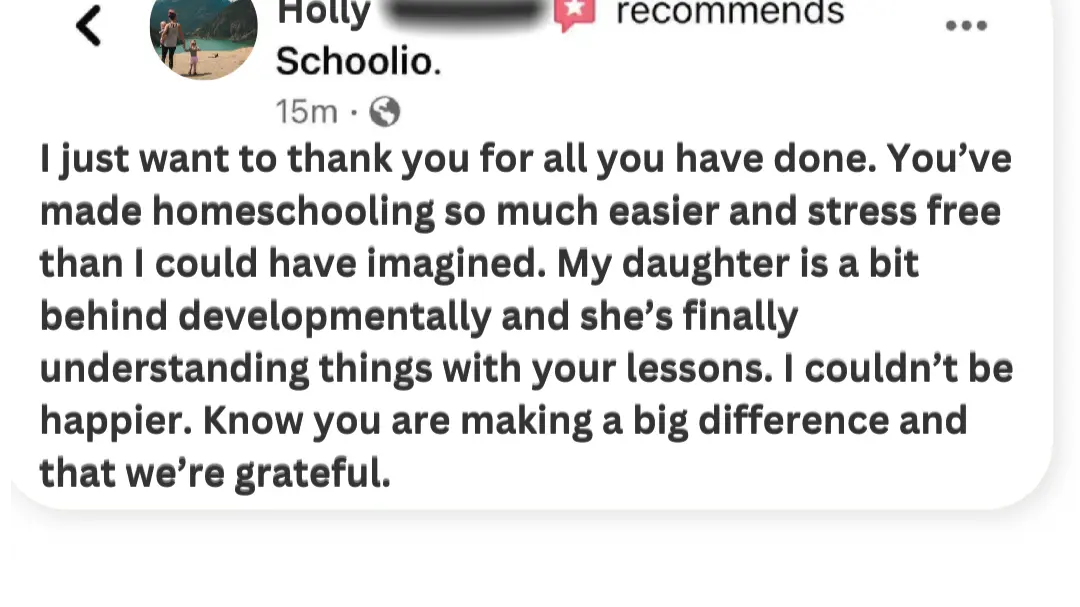
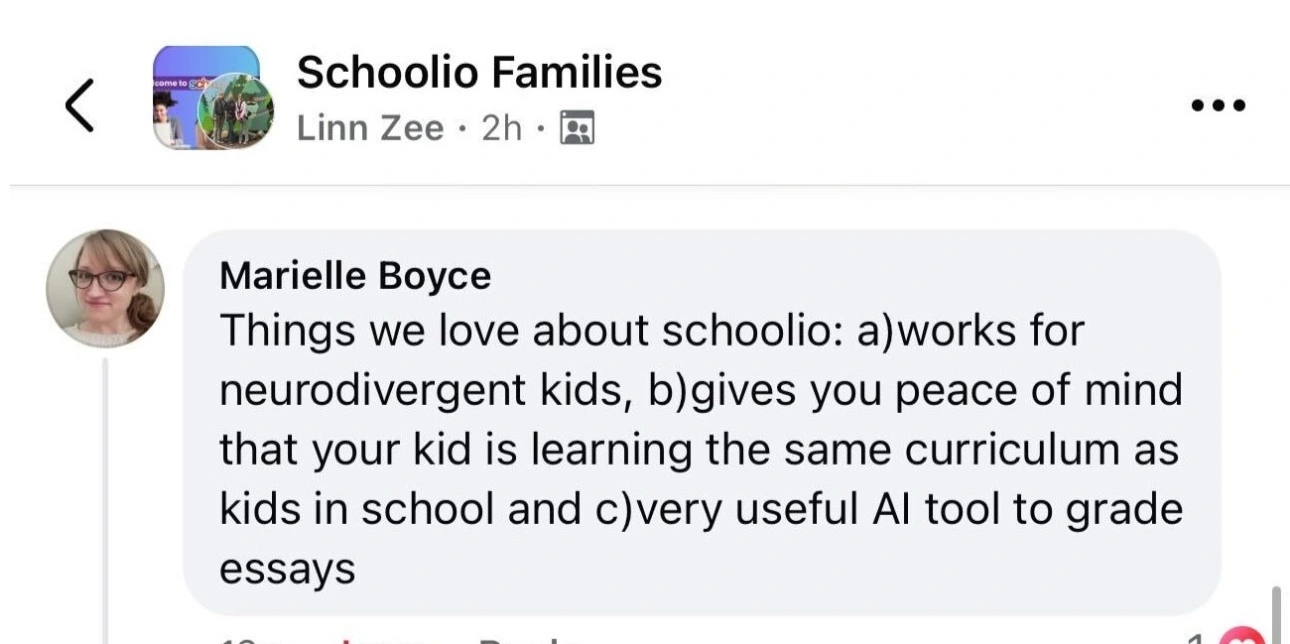
A parent shared a short post in our Schoolio Families group. Just a few lines. No hashtags. No fuss. Just truth.She said she loved Schoolio because it works for her neurodivergent child. Because it gives her peace of mind knowing her kid is learning the same curriculum as students in traditional school. And because the AI tools helped with grading essays.


Customer Testimonial

Simple. Direct. But when I read it, it stopped me.

Because that right there is the quiet win that matters.

She didn’t say we changed her life. She didn’t say we were perfect. What she shared was something more real. She shared relief. Confidence. Stability. The kind of stability every parent needs, but especially the ones who are walking a different path.


The truth is, a lot of the parents we serve never wanted to homeschool. They weren’t planning for it. It wasn’t on their vision board. But something shifted—maybe a bad experience at school, a child’s needs not being met, or just a gut feeling that things weren’t working.

And now they’re here, trying to do what’s best for their child, even when the world questions them for it.

This is what we built Schoolio for. For that parent who lies awake at night wondering if they’re doing enough, for the child who learns better with space and silence, for the families that don’t see themselves in glossy brochures or test scores and for the moments when a tool actually helps and no one has to fight for it.

You don’t always get to see the impact of your work. You don’t always hear how it lands. But every now and then, someone like Marielle speaks up and says, This helped. And for me, that’s everything.

Because this isn’t just about curriculum or platforms or AI tools. This is about building something that lets families breathe again. Something that says: you’re not alone. You’re not wrong. And yes, you can do this.

That’s the win I hold onto today.


Sathish

still learning, still unlearning

One of Homeschooling Quietest Strengths

One of Homeschooling Quietest Strengths


By Lindsey Casselman, special-ed teacher & homeschooling mom


When I first started homeschooling, I thought a “good homeschooler” had a tidy schedule. Wake up at 8, lessons by 9, neat little blocks of math, reading, and science lined up like ducks in a row.

But then reality stepped in: my kids aren’t ducks, and neither am I.

What I learned over time — and what research keeps confirming — is that one of the most powerful tools we have in homeschooling is also the simplest: sleep.

In traditional school, kids are often shaken awake by alarms, rushed through breakfast, dressed half-asleep, and hustled out the door before their brains have even had a chance to fully wake up. I remember my own school mornings feeling like chaos in fast-forward. But homeschooling gave us the freedom to slow down, and that’s when I noticed something life-changing.

Well-rested kids don’t just learn better. They feel better. They laugh more. They regulate their emotions more easily. They can focus longer, without the constant battle against exhaustion. Science tells us sleep is not laziness — it’s learning in disguise. It’s when the brain is literally growing, making connections, and preparing itself for curiosity.


Here’s what that looked like in our homeschool:

  • Starting the day when my kids naturally woke up, not when a bus schedule dictated.
  • Protecting rest days after big field trips, instead of pushing through.
  • Building gentle morning and bedtime rhythms so transitions felt calming, not chaotic.
  • Letting rest be part of the curriculum, because restoration fuels curiosity.

And here’s the best part: this isn’t “falling behind.” It’s moving forward in a way that honors kids as whole humans — body, mind, and spirit.

So maybe the question isn’t, “Am I doing enough school hours?”

Maybe it’s, “Am I giving my child enough rest to flourish?”

Because the truth is, flexible sleep schedules aren’t a weakness of homeschooling. They’re one of its greatest strengths.


? Lindsey

Certified Special-Ed Educator & Co-Founder, Schoolio

Trauma-Informed Education

What Is Trauma-Informed Education, And Why It Might Be Exactly What Your Child Needs


By Lindsey, certified special-ed educator and co-founder, Schoolio

If you’ve pulled your child out of school because something wasn’t working- and I mean really wasn’t working- you’re not alone.

We hear from families every day whose kids are recovering from what we call school trauma.

Maybe your child:

  • Was bullied and felt unsafe
  • Shut down from anxiety or sensory overload
  • Was constantly in trouble for behavior no one tried to understand
  • Masked all day to fit in and melted down at home
  • Fell behind and couldn’t catch up, no matter how hard they tried and had their confidence and self-esteem shaken

Whatever your story looks like, one thing is clear:

Your child didn’t just need to “toughen up”. This isn’t a “right of passage” and it’s not learning to “deal with the real world”, they need a completely different kind of learning environment to feel safe and recover.


What “Counts” As Trauma?

Trauma is not something we narrowly define. In reality, all experiences that have negative and long-lasting impact can cause trauma. Another child being mean to your child one time on the playground may not be a traumatic event, but on-going bullying and the emotional abuse, harassment, and character destruction that includes certainly can be. In fact, it is the way we process and experience certain events that defines how traumatic they are; two kids may process the same episode quite differently, making it a traumatic event for one but a minor blip on the radar for the other.

Trauma impacts learning and behavior. It can significantly slow down, or completely stop our ability to learn.

Kids experiencing trauma are more likely to fall behind in school, struggle to catch up, or get in trouble for behavior issues. These results can compound more trauma and make things increasingly worse.

If your child has experienced school trauma, you did the right thing by removing them from that environment. But you might be asking yourself, now what?

That’s where trauma-informed education comes in.


What Is Trauma-Informed Education?

Trauma-informed education isn’t just a buzzword- it’s a researched, intentional framework grounded in how children process stress and recover from negative experiences. It is an approach to teaching that recognizes the widespread impact of trauma on a child, and aims to create a safe, supportive, and inclusive learning environment. It acknowledges that your child’s past experiences, including trauma, can directly affect their ability to learn. By understanding these impacts, we can adjust teaching methods and create a home environment that fosters their recovery and resilience while supporting real learning.

Trauma-Informed Education is built on six key principles:

  1. Safety: Children must feel emotionally, mentally, and physically safe in their learning environment. You’ve established this by bringing them home to learn and removing them from the unsafe environment of school.
  2. Trustworthiness and Transparency: It’s important now that your feels like they know what to expect and know that the adults around them are predictable and honest.
  3. Empowerment, Voice, and Choice: Kids do better when they have a say in their learning process and are given appropriate autonomy.
  4. Collaboration and Mutuality: Learning should not be something done to a child, but something done with them.
  5. Peer Support: Feeling part of a community and knowing you are not alone is a critical part of healing. Remember that your family unit is also a “community”.
  6. Cultural Responsiveness: It’s cruical that your home and family affirm and respect your child’s identity, history, and experiences.

A trauma-informed approach recognizes that stress, fear, and overwhelm shut down learning. When a child feels unsafe, emotionally or physically, their nervous system goes into survival mode. And survival mode leaves very little room for comprehension, creativity, or curiosity. Feeling “unsafe” doesn’t always mean they feel like they’re in danger. Fear of failure or criticism, fear of exclusion, and fear of retaliation are all legitimate attacks on a child’s sense of safety.

Trauma-informed education begins with the right questions:

  • Does my child feel safe right now?
    • Remember the above ways of feeling unsafe- this includes their feel of failing or getting in trouble.
  • Do they feel heard and respected?
  • Are they given choices and control over their learning?
  • Is our environment calm, clear, and consistent?
    • As parents, we get frustrated and overwhelmed too- we’re human after all. If you need a break to calm down, take it. The environment isn’t calm if you’re stressed. Only a regulated person can help calm a dysregulated person.

If the answer to those questions is no, it doesn’t matter how high-quality the curriculum is, their brain won’t be ready to receive it. Establish all four consistently before you start a learning program. Deschooling and recovering from public school burnout should come first. Download our free guide here.

How Schoolio Supports Trauma-Impacted Learners

We didn’t create Schoolio to be a trauma recovery program. But we did design it to be flexible, gentle, and deeply learner-centered. For many children recovering from difficult school experiences, that’s exactly what they need.

Here’s how our program applies trauma-informed educational practices, supports recovery, and helps you provide a safe and calm learning experience for your child:

  1. Predictability Without Pressure

    Our lessons follow a consistent, easy-to-understand structure, but you, the parent, set the pace.

    Kids who’ve experienced chaos or overstimulation in school find relief in knowing what to expect, without the added stress of rigid deadlines.

  2. Reduced Sensory Load

    Our videos and digital content are intentionally designed to be calm and simple. We avoid overstimulation and excessive noise or visuals because overstimulated brains don’t retain information, they shut down.

  3. Adaptable to Their Energy and Academic Levels

    Many children exiting the school system are burnt out. They don’t need another mountain to climb, they need space to breathe. Schoolio’s bite-sized lessons, printable offline options, and flexible scheduling create room for healing without halting progress. You can also mix-and-match grade levels to create a program where they feel confident and successful, rebuilding self-esteem and security.

  4. Emotional Learning Built In

    Our social-emotional learning and mental health courses are not extras, they’re part of our core offerings. Kids deserve to learn how to name their feelings, manage emotions, build healthy relationships, and recover from stress. These aren’t bonus skills, they’re life skills.

  5. No One-Size-Fits-All Expectations

    Many kids develop trauma in school simply because they didn’t fit the mold. At Schoolio, we don’t have a mold.

    Your child can move ahead in one subject while slowing down in another.

    They can demonstrate knowledge through art, play, projects, and conversation, not just multiple-choice tests.

    They can build a learning plan that matches their pace, their passions, and their strengths.

Final Thoughts

If your child is resistant to learning right now, that doesn’t mean they’re lazy or broken.

If they seem shut down, checked out, or angry, that doesn’t mean homeschooling won’t work.

It means they’re still healing.

They need time, safety and trust.

And they need a learning environment that sees them as a whole person, not a problem to fix.

That’s what trauma-informed education offers.

That’s what we aim to provide at Schoolio.

And if that’s what your child needs, you’re in the right place.


Lindsey

certified special-ed educator and co-founder, Schoolio

When Science Turned Into a Betta Fish

When Science Turned Into a Betta Fish


By Lindsey Casselman, special-ed teacher & homeschooling mom


One of the things I love most about homeschooling is how easily learning can connect to real life. Sometimes the best projects don’t come from a curriculum guide — they come from your child’s heart.

When my daughter was seven, she desperately wanted a Betta fish. Like many parents, my first instinct was to say, “That’s a lot of responsibility — are you sure you’re ready for that?” But instead of just saying no, I turned it into an opportunity for learning.

We made it her science project. She had to create the classic tri-board presentation — research, write, and present — all about Betta fish. She learned where they live in the wild, what they eat, how to set up the right tank environment, and common mistakes people make in caring for them. But the project didn’t stop at facts. She also had to make the case for why she was ready to take care of one.

I’ll never forget watching her stand in front of that board, confidently explaining filtration systems, water temperatures, and feeding schedules. This wasn’t just a science lesson anymore. It was research skills. Public speaking. Persuasive writing. Responsibility.

And it was driven entirely by her motivation. Because she wanted that fish, she owned the project. She went deeper than she would have if I had assigned “Chapter 3: Aquatic Life.” She wasn’t just doing school — she was preparing for real life.

In the end, she did get her Betta fish. But honestly, the project itself was the real win. She learned that with research and preparation, she could rise to a challenge. And I learned (again) that homeschool doesn’t have to follow someone else’s script to be powerful.

And apparently, I also set a precedent in our house without realizing it. Fast forward a few years, and Grace — now 13 — wanted a new pet. Out of nowhere, I found myself sitting on the couch watching a full PowerPoint presentation on why she should be allowed to get a snake. I hadn’t asked for it, and I hadn’t suggested it. She just knew she needed to convince me in a smart and prepared way.

So fair warning: this approach works beautifully for learning… but it may also get you into more pets than you imagined! ?

? Lindsey

Certified Special-Ed Educator & Co-Founder, Schoolio

Stop Trying to Fix What Was Never Broken: Rethinking Autism and Blame

Stop Trying to Fix What Was Never Broken: Rethinking Autism and Blame


This has been on my mind today…

The latest debates around Tylenol and autism feel like déjà vu. Another attempt to eliminate something we don’t fully understand. This time, the theory is that avoiding acetaminophen during pregnancy could somehow prevent a child from being autistic. And while the internet grabs onto that narrative like it’s gospel, I can’t help but think of the damage it’s doing — not just to scientific truth, but to every child being born into a world where their neurodivergence is seen as a defect.

Autism was discovered long before Tylenol hit pharmacy shelves. The spectrum existed before there were labels, diagnoses, or heated panels on morning talk shows. What’s new isn’t autism. What’s new is our panic around accepting it.

I grew up in Singapore, where the approach to childhood “issues” was very different — but carried the same dangerous root: blame. If you weren’t performing well in school, it wasn’t because you learned differently or were overwhelmed or needed support. You were lazy. Disrespectful. A problem.

My parents believed this. So did my teachers. My inability to focus or sit still or memorize math formulas wasn’t something to understand — it was something to beat out of me. Literally.

I was hit at home. Disciplined at school. Shamed in front of peers. I remember hearing the word potential thrown around like it was a threat — like I could have been something, if I just tried harder. The system, they said, was fine. I just didn’t fit it. That was my fault.

Now I’m older, a father, and an educator building a company that works with thousands of students — many of them neurodivergent. And I see the same root problem, just dressed differently.

Instead of beating kids into conformity, we now try to scare parents out of having children that are different in the first place. Avoid this. Don’t take that. Follow these rules and maybe, just maybe, your kid won’t be one of those.

But that’s not progress. That’s erasure.

Autism isn’t something to get rid of. It’s something to understand. Neurodivergent kids aren’t broken. They’re brilliant. But only if we stop trying to fix them.

We need to stop treating difference like a disease. We need to stop hiding behind policies and prevention myths and start asking better questions. Like: How do we build schools, communities, and systems that allow all kids — not just the compliant ones — to thrive?

At Schoolio, that’s our mission. Not just because it’s good pedagogy, but because it’s personal. I know what it feels like to be punished for the way your brain works. I also know what it feels like to unlearn all of that — to parent differently, build differently, lead differently.

So no, I don’t believe Tylenol is the problem. And I don’t believe discipline should be violent, whether physical or emotional. I believe in kids. I believe in learning environments that adapt to the child — not the other way around.

This isn’t about prevention. It’s about permission — to be different, to be seen, to be accepted.

Let’s stop blaming. And start building.


Sathish

still learning, still unlearning

Unpopular Opinion- Learning Shouldn’t Always Be Fun

Unpopular Opinion- Learning Shouldn’t Always Be Fun

By Lindsey, certified special-ed educator & co-founder, Schoolio


Does this sound familiar?

“How many questions do I have to do?”
“How much longer?”
“I’m bored!”
“Are we done yet?”

If your homeschool days feel like a marathon of sighs, tears, or endless negotiating, you are not alone. And it’s not because you’re a “bad teacher” or your child is “unmotivated.”

The real culprit?
You’re probably replicating school at home.

And the solution is simpler than it sounds: stop doing that.

At Schoolio, we talk a lot about our Philosophy of Learning. But here’s the gist of it: thriving in homeschool comes down to two big ideas—Relevancy and Responsibility.

Relevancy: The “Why” Behind Learning

Kids learn best when they understand why they’re learning something. And there are really only two powerful “whys”:

  • CuriosityI want to know this because it interests me.

  • PurposeI know why this is important for me to learn.

When kids have one of those reasons in mind, they’re naturally more engaged. That’s why Schoolio makes curiosity and purpose central, with our Future Readiness Library and electives that stretch way beyond the basics. Whether it’s learning all about cats, entrepreneurship, or the history of pirates, kids can find what they’re interested in, or see the value of- and often, they’re genuinely excited to learn.

Responsibility: Learning Isn’t Always Fun

Here’s the unpopular opinion: not all learning should be fun.

We love hands-on projects, electives that spark excitement, and letting kids explore their interests. But the truth is, some things in life simply just require effort. Some subjects take persistence. And not everything in life can, or should, be gamified or turned into an adventure.

And that’s not a bad thing. In fact, it’s one of the most valuable lessons homeschool can offer.

Real-world readiness means teaching kids:

✔ Some things you want or need to learn won’t come easily, but they’re worth the effort.
✔ Not everything is a game, but it still has to be done.
✔ Responsibility means following through, even when something isn’t fun.

Because in the end, building grit, self-discipline, and responsibility are just as important as mastering math facts or essay writing.

The Balance

Homeschool should not be all drudgery, but it doesn’t have to be all glitter and games either. The sweet spot is in teaching both: helping kids chase what excites them and showing them how to stick with the hard stuff when it matters.

So maybe the next time you hear “I’m bored!” or “How much longer?” you’ll remember: you’re not failing, you’re teaching real life.

? Lindsey

New Generation, New Rules: How We’re Redefining Discipline

New Generation, New Rules: How We’re Redefining Discipline


This has been on my mind today…

Growing up in a South Asian home, discipline meant one thing: fear.

A raised voice. A quick slap. A look that could shut your whole body down. It was all normal. So normal that no one around you even called it violence. They called it “raising you right.”

My friends weren’t hit — they were “grounded.” That concept felt foreign. Like something only white parents did. “You’re grounded” never hit the same as your dad walking in with a belt, and you instinctively hiding under the bed.

Now fast forward to today. I’m a father of two. And when it comes to discipline, I catch myself constantly questioning: what do I do instead?

We don’t hit. We don’t shame. But we also don’t let chaos rule the house.

So what do we do? We take away the iPad.

Not as punishment. But as a boundary.

No yelling. No lecture about how we had “nothing growing up.” Just a quiet, firm decision — you didn’t clean your room, so screen time’s done for the day. That’s it.

And sometimes I wonder… is that enough?

Did I go too soft? Am I raising them to be weak?

But here’s the truth I keep coming back to: violence didn’t make us strong. It made us scared.

Grounding didn’t teach kids how to think. It just taught them to lie better.

Discipline in 2025 isn’t about obedience. It’s about accountability.

Our kids don’t need to “fear us to respect us.” They need to trust us to listen.

They need to know their actions have consequences — not because they’ll be hit or humiliated, but because choices carry weight.

When I take the iPad away, it’s not about power. It’s about consistency.

When I stay calm, it’s not because I’m weak. It’s because I’m breaking a cycle.

And if you’re a South Asian parent trying to figure it all out — same as me — let me say this:

You’re not being too soft nor raising “spoiled kids.”

You’re raising future adults who won’t flinch when someone raises their voice.

Who won’t think love and fear are the same thing.

Who won’t confuse trauma for tradition.

This is why Schoolio matters to me.

Because we’re not just building curriculum. We’re building culture.

One where families grow together.

Where learning is safe, not stressful.

Where discipline is about guiding — not punishing.

This isn’t about making parenting easier. It’s about making it better.

And the better way?

Starts with us.

Sathish

still learning, still unlearning

When I Realized My Child’s Learning Style Didn’t Match My Own

When I Realized My Child’s Learning Style Didn’t Match My Own

By Lindsey, certified special-ed educator & co-founder, Schoolio


This has been on my mind today…

When I first started homeschooling, I assumed my kids would learn the way I learn. That’s the default, right? We teach from our own perspective. But it didn’t take long for me to realize their learning styles—and their needs—were very different from mine.

I’m ADHD. I thrive on novelty, challenge, and curiosity. I love going out, seeing people, doing things. My brain comes alive when there’s energy in the room. Planning homeschool field trips, events, parties, and mom meet-ups? That gave me life. I thought it would do the same for my kids.

But my kids are autistic. They enjoy their friends, yes—but in small doses, one-on-one, in familiar settings. Big group outings didn’t energize them the way they did me. They drained them. Where I walked away buzzing with energy, they walked away needing quiet, calm, and time to recover.

It was the same in our learning space. I always wanted music playing, stimulation in the background. They wanted silence. I craved variety and spontaneity. They needed consistent, reliable routines. I thrived on the excitement of new challenges. They thrived on knowing what to expect.

At first, I resisted that difference. I kept thinking, but this is how I learn best—shouldn’t it work for them too? When it didn’t, I felt frustrated. But slowly, I realized I had it backwards. My job wasn’t to shape them into my rhythm. It was to honor theirs.

That shift changed everything.

I began planning fewer big events and focusing on more intentional one-on-one time with friends. Instead of background noise, I chose quiet. Our homeschool days gained more rhythm and held fewer surprises. Along the way, I learned how to stretch myself to meet their needs, and gently taught them to stretch a little too—tolerating small bits of novelty, practicing compromise, and knowing it was okay to ask for quiet whenever they needed it.

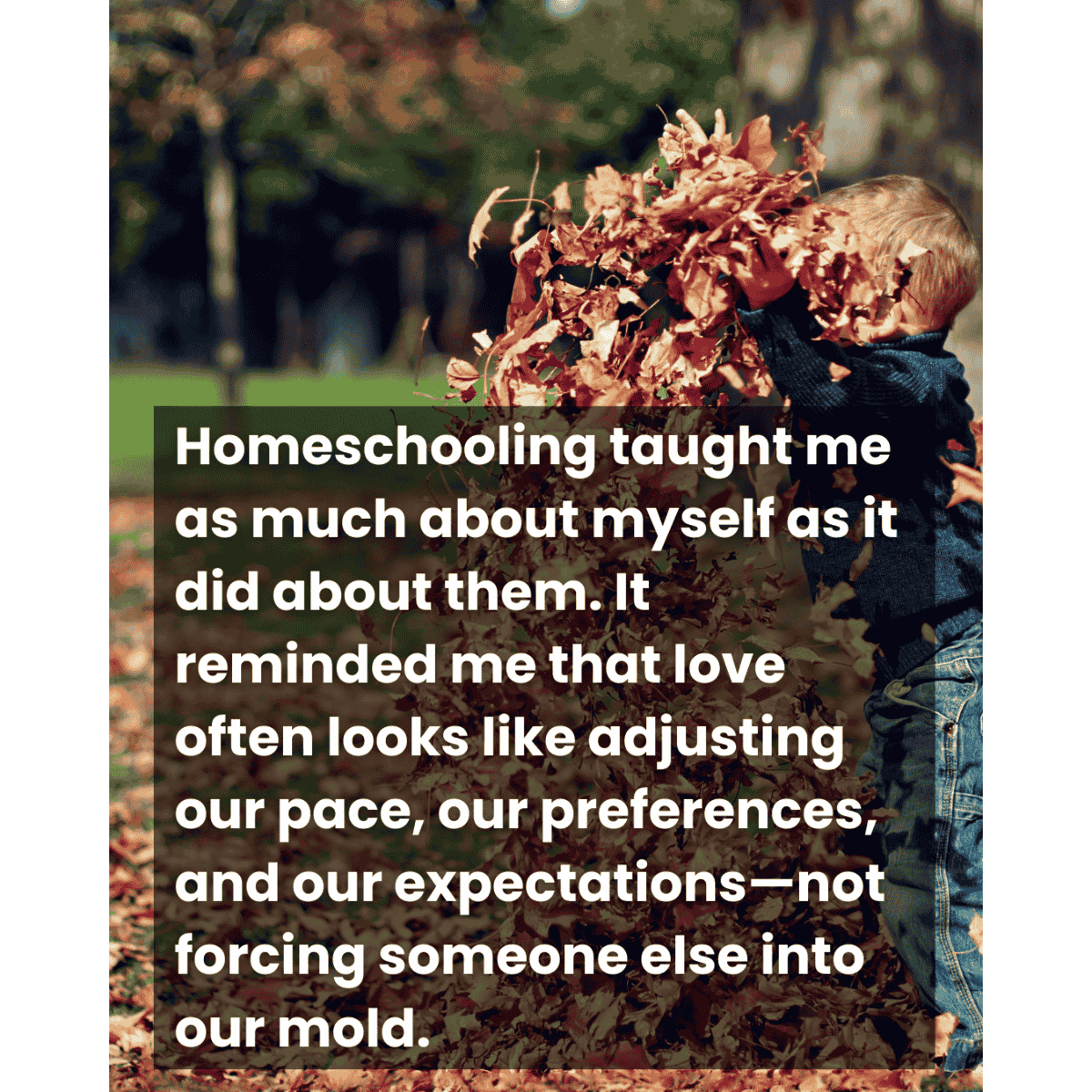
Homeschooling taught me as much about myself as it did about them. It reminded me that love often looks like adjusting our pace, our preferences, and our expectations—not forcing someone else into our mold.

And it gave me this truth:

We don’t have to learn the same way to learn together.

Why ADHD is Keeping Your Child Awake

Why ADHD is Keeping Your Child Awake: Understanding Sleep Struggles in ADHD Kids


It’s 10:00 p.m., and you’re already bracing yourself. Your ADHD child is tucked into bed, but instead of drifting off, they’re talking a mile a minute, bouncing their legs under the covers, or hyperfocusing on a book, game, or story idea. Hours later, they’re still awake — and you know the morning will be rough.

Sound familiar? You’re not alone. Many families of ADHDers find that bedtime is the hardest time of day. ADHD brains and sleep just don’t follow the same rules as everyone else’s. Understanding why ADHD makes sleep so tricky — and how to work with your child’s brain instead of against it — can help you reduce frustration, ease bedtime battles, and support your child’s overall health.


Why ADHD and Sleep Don’t Mix Easily

For kids (and adults) with ADHD, sleep difficulties are extremely common. Up to 70–80% of ADHDers experience persistent sleep problems — not just because of “bad habits,” but because of how their brains and bodies function.

Here are some key reasons ADHD kids struggle with falling and staying asleep:

1. Delayed Melatonin Release

Research shows that many ADHDers have a delay in melatonin production — the hormone that signals the body it’s time to sleep. Their “sleepy signal” comes hours later than typical, making them naturally more alert at night.

2. Hyperactivity as Racing Thoughts

For some ADHDers, hyperactivity doesn’t mean bouncing off the walls — it’s mental. At night, the brain races through thoughts, ideas, or worries, making it nearly impossible to “shut down.”

3. Hyperfocus at Night

When the world is quiet, ADHDers may lock into hyperfocus — reading, building, gaming, or creating — and lose track of time entirely. That 15-minute “just one more” quickly turns into hours.

4. Irregular Routines

ADHD brains crave novelty and struggle with consistency. Sticking to rigid routines can feel impossible, which often leads to inconsistent bedtimes and wake-ups that disrupt circadian rhythms.

5. Circadian Rhythm Shifts (DSPS)

Delayed Sleep Phase Syndrome (DSPS), where the natural body clock runs later than typical, is notably more common in ADHD individuals. They simply aren’t tired until much later than societal schedules allow, making mornings especially painful.


Signs ADHD Sleep Struggles Might Be Affecting Your Child

  • Bedtime stretching into late hours, no matter how early you start winding down
  • Extreme difficulty waking up, even with enough hours in bed
  • Morning irritability, brain fog, or emotional dysregulation
  • Best focus and energy late in the day instead of mornings
  • Constant battles around bedtime routines

If this sounds like your household, it’s not because you’re “failing” at bedtime. It’s because ADHD brains are wired differently.


The Impact of Poor Sleep on ADHD Kids

When kids with ADHD don’t get quality rest, the ripple effects show up everywhere:

  • Increased ADHD symptoms: impulsivity, distractibility, and poor regulation intensify.
  • Emotional dysregulation: meltdowns, frustration, and mood swings are more frequent.
  • Learning struggles: fatigue worsens focus, memory, and motivation.
  • Family stress: nightly battles and groggy mornings strain relationships.

Adapted Sleep Hygiene for ADHD Brains

Standard sleep hygiene tips often feel overwhelming or unrealistic for ADHD families. A neurodiversity-affirming approach makes them practical and supportive. Here are strategies that actually work for ADHDers:

1. Personalized Routines

Establish consistent wind-down rituals, but tailor them to sensory needs. Some kids may prefer dim lights and quiet reading, while others regulate best with stretching, deep pressure (like a weighted blanket), or calming play.

2. Environmental Supports

Create a sensory-friendly sleep environment. Use blackout curtains to block light, white noise to mask sound, weighted blankets for calming pressure, or soft bedding that avoids irritating textures.

3. Tech Timing

Set a structured cut-off for stimulating screens, but don’t remove special interests entirely. Calming formats like audiobooks, podcasts, or slow-paced shows can support winding down without triggering over-stimulation.

4. Flexible Approach

Avoid rigid “sleep rules” that lead to battles. Instead, focus on gradual adjustments, like moving bedtime earlier by 10–15 minutes at a time, or setting realistic goals instead of strict demands.

5. Regulation Aids

Mindfulness exercises, gentle movement before bed, or sensory tools can help calm the nervous system. In some cases, melatonin supplements (if recommended by a healthcare provider) can support resetting the body’s clock.


Homeschooling and ADHD Sleep Challenges

Here’s the good news: homeschooling gives you flexibility most families don’t have. Instead of fighting the impossible battle of making your ADHD child match a “standard” sleep schedule, you can:

  • Let them sleep until their bodies are rested, without alarms and out-the-door rushes.
  • Start academics later in the morning, when your child is alert and focused
  • Use mornings for movement, outdoor play, or low-demand activities
  • Let afternoons and evenings (their natural focus times) be the most academic
  • Teach self-awareness by helping them recognize when they feel tired or focused

This adaptability not only reduces stress but also helps your child thrive by working with their natural rhythms.

“But that won’t prepare them for the real world!”

I hear you naysayers, but forcing your child to go to bed early and wake up early now, won’t necessarily make it easier for them a decade from now. They have ADHD, which means their brains are wired differently—and they always will be. For many, mornings will always feel harder, and a 9–5 routine will always require an alarm. But that doesn’t mean they need to suffer through that reality now. Also, right now they are growing. They are learning. They are in need of good rest to be their best selves- why wouldn’t we give that to them as part of their homeschooling, and childhood, experience?


A Hopeful Note for Parents

If sleep feels like the never-ending struggle of your ADHD journey, remember this: your child isn’t being defiant, lazy, or manipulative. Their brain chemistry is different, and sleep challenges are part of the package.

With patience, adapted strategies, and flexible routines, you can support your child in finding rest. Homeschooling offers the gift of adjusting the day to fit your child’s real needs — not forcing them into a mold that doesn’t fit.

Better sleep won’t happen overnight (literally!), but small shifts add up. Over time, you’ll find the balance that lets your child rest, recharge, and thrive.


? Lindsey

Certified Special Ed Educator & Co-Founder, Schoolio
The Harder Path Forward

The Harder Path Forward


customer feedback

I didn’t understand the courage it took until years later.

When my family immigrated to Canada, I was angry. I didn’t have the words for it at the time, but every part of me resisted this new life. I missed my friends, my neighbourhood, my routines. I was a teenager lost between two worlds—resentful of the change, and confused by the silence I had to carry with me in every classroom, every hallway, every awkward introduction.

People looked at me differently. Sometimes with curiosity, sometimes with judgment, but always with the weight of assumptions I hadn’t earned. The stereotypes followed me. So did the loneliness.

Back then, I thought my parents were wrong. I thought they didn’t understand what I had lost. But as I grew older—became a parent, built a life, listened to others—I began to see the truth I’d missed entirely.


It wasn’t an escape. It was a sacrifice.


They had uprooted everything they knew for a sliver of possibility—a better education, a safer life, a shot at something bigger than what we’d left behind. And they did it quietly. Without recognition. Without thanks. Without certainty. Just faith.

That story echoes again and again in the lives of homeschooling families we meet at Schoolio. While the world rushes to label them—too radical, too soft, too unqualified—what we see is something different. We see courage. We see parents choosing a harder path, not because it’s easier, but because it’s right for their child.

It’s not a summer experiment. It’s not a last resort. It’s a quiet, determined rebellion against a system that no longer fits.

And here’s the question we rarely stop to ask: if the traditional school system—funded, structured, and normalized—is so perfect, why are so many parents choosing to leave it behind?

Why are they willing to rebuild an entire learning experience from scratch?


Because sometimes love means walking uphill.


At Schoolio, we don’t see homeschoolers as fringe or fearful. We see them as architects of something new. Builders of bridges their children can walk across safely. Parents who are saying, “I will not wait for the world to catch up. I’ll start right here.”

And for those of us who have walked a harder path before, we know exactly how much strength that takes.

Sathish
still learning, still unlearning

But I Don’t Remember Any of What I Learned in School!

Why You Don’t Need to Be Afraid of the Things You Don’t Know in Homeschooling


One thing I hear often from parents worried about whether they are “capable” of homeschooling is this idea that you have to remember everything you were ever taught in school in order to teach it.

That’s way too much to expect of yourself. Studies show that as adults, we **only use about 37% of what we learned in school.** Why would we retain the rest? We don’t. And yet, we do just fine.

But here’s the good news: you don’t need to remember everything to be able to teach your kids. To explain, let me take you back to when your child was a toddler and it was time for potty training.

When you taught your child to use the toilet, how did you know how to teach them? Did you think back to how you were potty trained? Did you remember exact instructions your parents gave you? Of course not. Most of us don’t even remember that age, let alone the details.

So how were you “qualified” to teach your child to use the toilet?

Because you knew how to figure out how — and you had tools.

First, you probably took some time to teach yourself how to teach it. Maybe you read a book. Maybe you hit up some parenting blogs, or watched YouTube videos. Maybe you asked a friend or family member who had done it before. In this day and age there is no limit to the information available to us- you can be taught and learn to teach absolutely any skill you choose.

Second, you probably accessed some tools to support you while you taught it. Maybe you purchased a kids book about using the potty to read to your child. Maybe you found a tv show for your child to watch that instructed them for you. Maybe you bought a kids’ potty to make it more accessible for them.

Most likely, you used a combination of resources!

And then you tried.

You experimented. You considered your family needs and lifestyle, and your child’s uniqueness and what would inspire and motivate them. You looked at what was working and what wasn’t, and you made adjustments. Maybe your first attempts didn’t work for your child. You learned more about how your child learns, or what motivates them, so then you tried something else. Eventually something clicked.

For some kids it happens quickly, for others it’s a long and messy process. Maybe you even thought you were failing at times. But at the end of the day, they figured it out — because you stayed with them through the process.

And when all our kids are grown, no one will care whether they were potty trained at 14 months or 3½ years. They all learned what they needed to know, in their own time.

Homeschooling is the same.

You don’t have to know algebra or remember the dates of every war. You just need to be willing to learn alongside your child, model teaching yourself things you need to know, find tools that work, and make adjustments as you go.

Most of all, you just need to be present with your child through the process.

Because just like with potty training, the most important thing your child carries forward isn’t just the skill itself — it’s how they felt while learning it with you. The connection, the encouragement, the bond. That’s what lasts.

? Lindsey

Certified Special-Ed Educator & Co-Founder, Schoolio

We Banned Calculators Once. Out of Fear. Not Logic.

We Banned Calculators Once. Out of Fear. Not Logic.


They said it would make kids lazy. That if we let students use calculators, they’d forget how to think. Teachers warned of doom, boards debated bans, and parents worried that the math their children were learning wasn’t “real.” But the truth is, the calculator didn’t replace understanding—it freed it. It helped students move faster, go deeper, and build confidence instead of anxiety. We don’t question calculators anymore. They’re standard. Obvious. Necessary.

And yet here we are again.

Today, it’s not calculators we’re afraid of—it’s AI. It’s new models of learning that don’t look like the rigid classrooms we remember. It’s the idea that maybe, just maybe, school shouldn’t be one-size-fits-all. And that fear, as it always has, shows up in familiar ways: skepticism, delay, control. The irony is that the world is changing faster than ever, but our systems still ask kids to move in lockstep. To sit still. To follow instructions. To learn passively in a world that demands action, agility, and personal agency.

At Schoolio, we see this every day. Families come to us because they’re not just choosing homeschooling—they’re choosing possibility. They’re choosing to move past fear and toward tools that give them freedom. Freedom to customize. Freedom to pause and restart. Freedom to learn with joy, not dread. And the moment parents hand over that freedom to their kids, something amazing happens. Not because they’re chasing trends, but because they’ve decided to lead.

We didn’t build Schoolio to replace teachers or classrooms. We built it because we believe that learning should reflect real life—messy, beautiful, nonlinear, and full of second chances. Our hybrid model combines digital lessons and print-based work, future-readiness and core subjects, structure and flexibility, because we know real learning lives somewhere in between.

https://www.intelligentliving.co/homeschooling-vs-traditional-school-2025/

Academic Outcomes 


It’s easy to fear the future when you don’t trust the tools. But just like the calculator, the right tools don’t replace thinking—they unlock it.

And this time, we don’t have to wait decades to figure that out.