Redefining Readiness for the Future

This has been on my mind today: redefining readiness for our children’s futures. We keep asking if kids are “future-ready,” and it’s the right question. But maybe we’re answering it wrong.

Future-ready, the way schools measure it, means: Can they pass the test? Can they get into the program? Can they perform on demand?


But look at the world they’re actually entering. The jobs that matter most require collaboration. The problems that need solving require resilience. The relationships that will sustain them require empathy. None of that is on the test.


A 40-year study of PhDs at UC Berkeley found that emotional intelligence was four times more powerful than IQ in predicting success. Daniel Goleman’s research, published in the Harvard Business Review, found that emotional intelligence accounts for nearly 90% of what moves people up the ladder — when IQ and technical skills are otherwise equal. We have decades of evidence telling us what actually matters. And we’re still spending most of the school day on everything else.


Redefining Readiness in Homeschooling

I watch homeschool parents build emotional intelligence every day. Not through a curriculum. Through the way they move through the world with their kids. Homeschooling offers a unique environment where children can develop these essential skills naturally.

Take, for example, a typical day in a homeschool setting. A child might start their morning with a science experiment that doesn’t go as planned. Instead of rushing to complete it for a grade, they have the time to explore why it didn’t work, fostering resilience and problem-solving skills. Later, during a family discussion about a history lesson, they learn to voice their opinions and listen to others, building empathy and communication skills.


A child who learns to sit with frustration instead of panic. A child who knows how to disagree respectfully because they’ve practiced it at the kitchen table. A child who has failed at something small and survived it — and knows they can survive it again.

Consider a scenario where a child is learning to play a musical instrument. They struggle with a difficult piece but are encouraged to keep trying. Over time, they not only master the piece but also learn patience and perseverance. These experiences teach them that setbacks are a part of learning and growth.


That is future-ready. Not a GPA. Not a trophy shelf. A human who knows how to keep going.


Building Skills That Matter

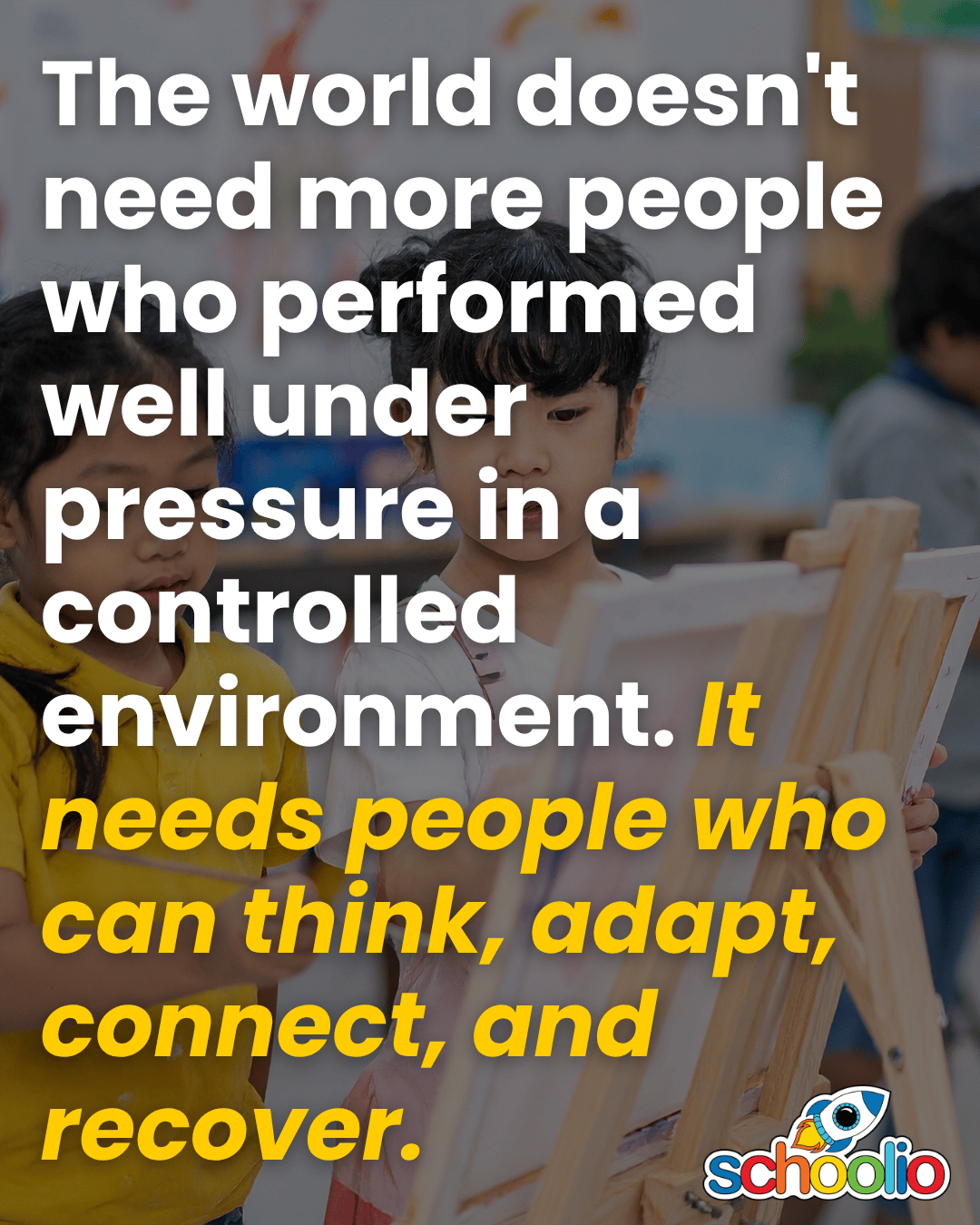
The world doesn’t need more people who performed well under pressure in a controlled environment. It needs people who can think, adapt, connect, and recover. Homeschooling provides the flexibility to focus on these skills. Parents can tailor their approach to each child’s needs, allowing for a more personalized and effective learning experience.

For instance, a homeschooling family might decide to spend a week focusing on community service projects. This not only teaches children about giving back but also helps them develop teamwork and leadership skills. Similarly, incorporating activities like debate clubs or theater can enhance public speaking and confidence.

We know how to build that. It starts at home. By redefining readiness, we prepare our children not just for tests, but for life. And isn’t that the ultimate goal of education?

Sathish

still learning, still unlearning

Reclaiming Wasted Potential in Homeschooling

This has been on my mind today…

Someone said it to me when I was young.

“You have so much potential. You just need to apply yourself.”

It was meant as encouragement.

It didn’t feel like it.


Potential, the way it was used, meant: you are not enough yet.

It was a gap. A deficit. A thing I was failing to become.

For years I carried it that way.


But I’ve been reclaiming that word.

Because potential — real potential — isn’t about falling short of someone else’s vision for you.

And it isn’t about succeeding at someone else’s vision for you either.


It’s about knowing who you actually are.

What genuinely makes you come alive.

And learning to chase that — unapologetically — without needing it to match what anyone else had in mind for you.


Helping Kids Find Their Path

That’s what we should be teaching our kids.

Not: live up to the potential we see in you.

Not: become the thing we think you can be, or ought to be.

But: your potential is limitless — and it belongs to you.

Help them find their own passion. Their own path.

And then get out of the way and let them follow it.

Even when it’s not the path you imagined.

Especially then.


Recognizing True Potential

Because a child who grows up knowing what makes them happy — and believing they’re allowed to pursue it — is not wasted potential.

They are potential, fully realized.

Just not in the way anyone predicted.

Consider a child who loves drawing more than anything else. Traditional schooling might emphasize math and science, but in homeschooling, you can nurture that artistic passion. Provide them with art supplies, enroll them in online art classes, or visit art museums together.

Every child I’ve encountered in this work has it.

Not the kind measured in test scores.

The kind that shows up when a kid is given a problem they actually care about.

When they’re trusted to figure something out.

When no one is standing over them deciding what they’re worth.

Imagine a child who loves animals. Instead of dismissing it as a phase, encourage them to volunteer at an animal shelter or start a small pet-sitting business. These experiences can ignite a lifelong passion for veterinary science or animal care.


Homeschooling: A New Perspective on Potential

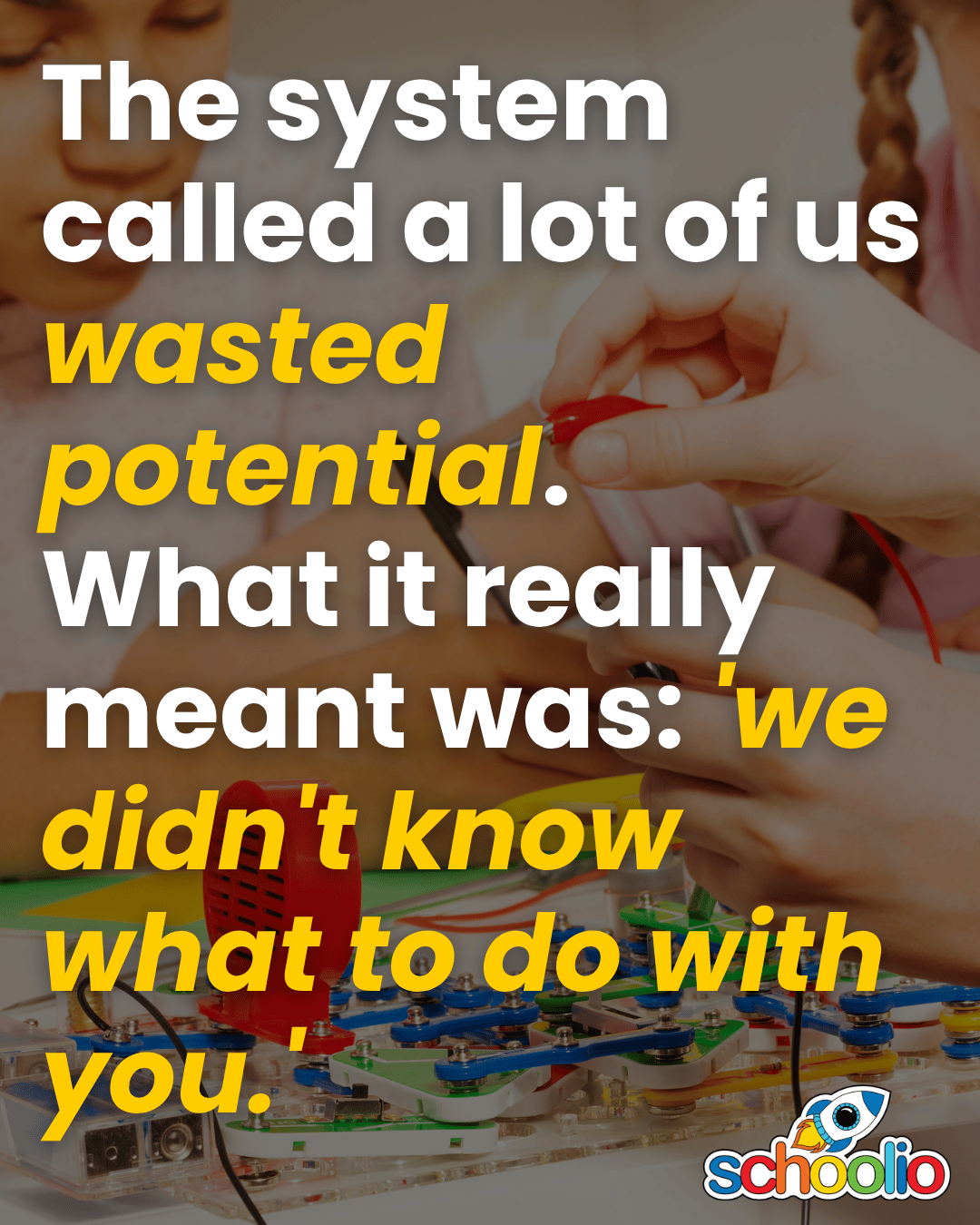
The system called a lot of us wasted potential.

What it really meant was: we didn’t know what to do with you.

Homeschooling, at its best, is a refusal to let that label land.

It says: your potential is not a deficit. Your potential is not an obligation to me as your parent, or to teachers, or to anyone else.

It is a direction.

And we will follow it together.

In homeschooling, you have the freedom to tailor your child’s education to their interests and strengths. If your child is fascinated by history, you can dive deep into historical documentaries, reenactments, and biographies. If they are drawn to coding, there are countless resources and coding camps available to explore.

Homeschooling allows for a personalized approach, ensuring that no child’s potential is wasted. It’s about creating an environment where children feel safe to explore, make mistakes, and grow at their own pace.

Sathish

still learning, still unlearning

My Kids Were “Chronically Absent”

I got the call more times than I can count about my kids being chronically absent.

“We just want to make sure we can help remove any barriers to attendance.”

Barriers.

I used to sit with that word after hanging up.

Because yes — there were barriers.

Just not the ones they were looking for.

Have you ever noticed that “chronic” usually means something that can’t be cured?

Chronic pain. Chronic illness.

So when the school labeled my kids “chronically absent,” I think they accidentally told the truth.

Because the thing keeping them home?

The school couldn’t fix it.

Understanding the Real Barriers to Attendance

The noise in the hallways that sent my child into sensory overload before first period even started. The fluorescent lights that hummed all day long. The constant transitions, the unpredictability, the chaos of 30 kids in one room. Can a school fix that?

Not really. Not for a child whose nervous system experiences it as an emergency — every single day.

Imagine a child with sensory processing disorder. The sound of chairs scraping on the floor, the echo of voices in a gym, or even the smell of the cafeteria can be overwhelming. These aren’t just minor inconveniences; they are significant barriers that make attending school a daily struggle.

And then there was the other thing that broke my heart.

When my ADHD child couldn’t sit still — couldn’t, not wouldn’t — the consequence was losing recess. The one part of the day their body actually needed. Taken away as punishment for being exactly who they are.

Consider a child with ADHD who thrives on movement. Recess is not just playtime; it’s a necessary outlet for pent-up energy. Removing it as a punishment is counterproductive and only adds to the stress of being in a classroom setting.

Bullying and Social Challenges

Bullying was its own chapter.

Autistic kids often don’t pick up on the unwritten social rules that everyone else seems to just know. They get left out. Made fun of. Sometimes targeted.

And the school’s solution was to pull my child aside and coach them on “fitting in better.” As if the problem was that they weren’t trying hard enough to be someone else.

Imagine a child who struggles to interpret social cues. They might not understand why their attempts to join a group are met with rejection. This isn’t about not trying; it’s about not having the tools to succeed in an environment that doesn’t accommodate them.

I don’t say any of this to be angry at teachers.

Most of the teachers we met were kind, tired, doing their best inside a system that wasn’t designed for our kids.

The system was the problem.

And no amount of calls home was going to change that.

Why We Chose Homeschooling

So yes — my kids were chronically absent. Because chronic means it doesn’t go away. And a school building that is fundamentally incompatible with how your child’s brain works? That doesn’t go away either.

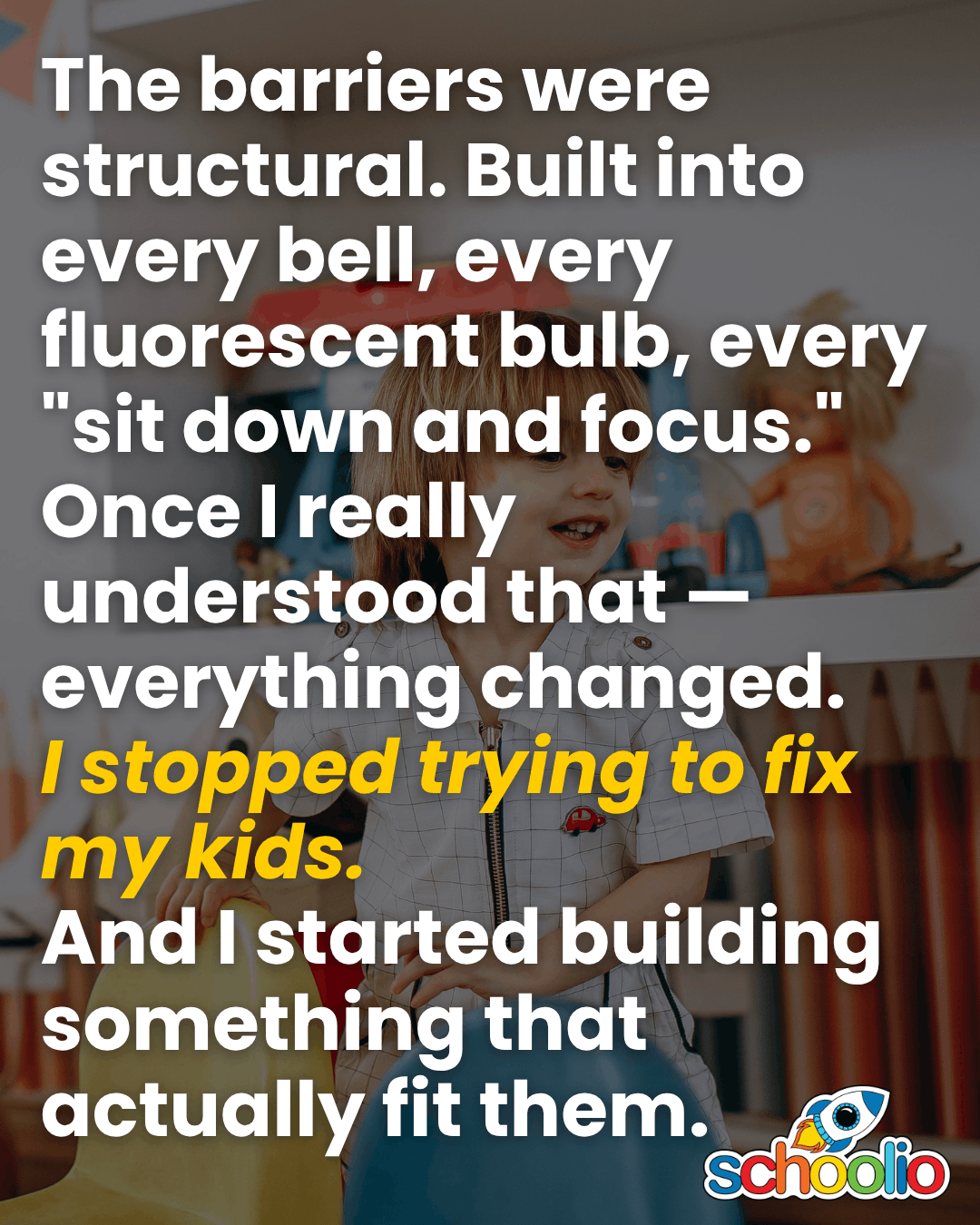
The barriers weren’t at home. The barriers were structural. Built into every bell, every fluorescent bulb, every “sit down and focus” and “you lost recess today.”

Once I really understood that — really let myself see it — everything changed.

I stopped trying to fix my kids.

And I started building something that actually fit them.

Homeschooling allowed us to create a learning environment tailored to their needs. We could control the sensory input, provide breaks as needed, and focus on their strengths rather than their challenges. For example, my child who loves nature could spend time learning science outdoors, turning a potential barrier into a source of joy and engagement.

That’s why we homeschool. And that’s why Schoolio exists.

Lindsey

certified special-ed educator, homeschooling mom, & co-founder of Schoolio

Homeschool Curriculum in Canada: A Comprehensive Guide

Choosing the right homeschool curriculum can feel overwhelming, especially when you’re trying to align it with the educational standards of Canada. Many parents find themselves stuck between wanting a comprehensive program and needing something flexible enough to fit their unique family dynamics. If you’re in this boat, you’re not alone, and there’s a way to navigate this with confidence.

Understanding Homeschool Curriculum in Canada

When it comes to selecting a homeschool curriculum in Canada, the first thing to understand is the provincial guidelines. Each province has its own educational standards, and while homeschooling allows for customization, it’s essential to ensure your curriculum aligns with these standards. This not only helps keep your children on track with their peers but also eases transitions should they ever enter or re-enter the public school system.

For instance, in Ontario, the curriculum guidelines emphasize language arts, mathematics, science, and social studies, while British Columbia includes a focus on indigenous education and environmental stewardship. Understanding these nuances can help tailor your homeschool curriculum to meet provincial expectations.

Several resources, like Schoolio’s Canadian curriculum, offer detailed guides to help you match your homeschooling efforts with provincial expectations. This is a great starting point for parents who want to feel confident in their educational approach.

Benefits of a Canadian-Focused Homeschool Curriculum

Opting for a Canadian-focused homeschool curriculum brings numerous benefits. Firstly, it ensures that your child learns about Canada’s history, geography, and cultural heritage in a way that’s relevant and meaningful. This is particularly important for social studies and history lessons, which can vary significantly from American curricula.

For example, a Canadian curriculum might include detailed studies of the Canadian Confederation, the role of the fur trade in Canadian history, and the significance of the Charter of Rights and Freedoms. These topics not only educate but also instill a sense of national identity and pride.

A Canadian curriculum also incorporates local currency, measurement systems, and environmental studies, making practical applications much easier for children to grasp. These relatable examples help children understand their world better and apply their learning to everyday situations. Imagine your child calculating change using Canadian coins or measuring ingredients for a recipe using metric units—these are practical skills that a Canadian curriculum can enhance.

Customizing Your Curriculum for Family Needs

One of the greatest advantages of homeschooling is the ability to tailor the curriculum to fit your family’s needs. Whether your child is a visual learner or thrives with hands-on activities, you can customize lessons to suit their learning style. This flexibility is particularly beneficial for families with children at different educational levels, allowing each child to progress at their own pace.

To start customizing your homeschool curriculum, consider these steps:

  • Identify your child’s learning style (visual, auditory, kinesthetic). For example, if your child is a visual learner, incorporate more diagrams, videos, and visual aids into their lessons.

  • Choose subjects that interest your child to boost engagement. If your child loves animals, consider including a unit on Canadian wildlife in your science curriculum.

  • Incorporate real-world learning experiences, like field trips and experiments. A trip to a local museum or a nature walk can bring lessons to life.

  • Adjust the pace according to your child’s comprehension and interest. If your child excels in math, allow them to advance quickly, while providing more time for subjects they find challenging.

Resources like Schoolio’s blog offer additional tips and ideas for customizing your curriculum.

Overcoming Common Homeschooling Challenges

Homeschooling presents its own set of challenges, but with the right mindset and resources, they are manageable. One common struggle is maintaining a structured schedule. It’s important to establish a routine that balances academic learning with breaks and extracurricular activities. This helps prevent burnout and keeps learning fresh and engaging.

Another challenge is finding a community. Connecting with other homeschooling families can provide support, ideas, and social interaction for your children. Many cities in Canada have homeschool groups that meet regularly, and online communities are also available. These groups can offer advice, organize group activities, and provide a sense of belonging.

Evaluating Your Child’s Progress

Assessing your child’s progress is fundamental in ensuring the effectiveness of your homeschool curriculum. Unlike traditional schools, where testing is often standardized, homeschooling allows for more personalized assessment methods. Consider using a mix of evaluations such as quizzes, projects, and oral presentations to gauge understanding.

It’s also important to have regular check-ins with your child about their learning experiences. This not only helps you understand their progress but also builds their self-assessment skills, which are valuable for lifelong learning. Encourage your child to reflect on what they’ve learned and discuss any challenges they face.

Choosing a solid homeschool curriculum in Canada doesn’t have to be overwhelming. With resources like Schoolio, you can craft an educational plan that’s both comprehensive and adaptable to your family’s needs. Check out Schoolio’s offerings to see how they can support your homeschooling journey with confidence.

Suggested internal links:

The Marketing Engine: How to Attract Families to Your New Microschool

TL;DR – Quick Answer:
Don’t just market ‘homeschooling’; market ‘outcomes and connection.’ Build authority by sharing your ‘Supportive Coach’ philosophy and use evidence-based curriculum to build trust.

The biggest challenge for a new microschool is **trust**. Parents are leaving a familiar (even if broken) system for something unknown. To win them over, your marketing needs to focus on solving the **’institutional burnout’** they are feeling. They aren’t looking for a better version of the public board; they are looking for a completely different rhythm.

Authority-Driven Growth

Share your ‘permission to pivot’ narrative. Explain why your school focuses on micro-bursts and emotional wellness. By using a certified, **evidence-based** curriculum like Schoolio, you give parents the peace of mind that their child is meeting standards while thriving in a flexible environment.

Product Focus: The Microschool Launch Guide

We’ve helped hundreds of founders launch. Our all-in-one bundles provide the ‘box’ so you can focus on the ‘delivery.’ [IMAGE: Schoolio Ontario Bundle with Launch Materials]

Confidence is the precursor to conversion. If parents see you have a plan, they will trust you with their child’s future.

Selling the Pivot, Not the Product

Parents don’t switch to a microschool because they want a new math book. They switch because they are in crisis. Their child is crying before school, their family dynamic is strained, and they feel like the ‘institutional 7-hour day’ is stealing their child’s childhood. Your marketing must speak directly to that pain. You aren’t selling ‘school’; you’re selling the ‘permission to pivot’ to a life where education fits the child, not the other way around.

Trust Through Transparency

The biggest barrier to enrollment is the fear of ‘falling behind.’ By using an evidence-based, teacher-certified curriculum like Schoolio, you provide a layer of institutional trust to your alternative model. You can show parents exactly how their child is meeting provincial or state standards through our digital tracking, while still maintaining the flexible, interest-led rhythm of your school. This transparency is the engine that converts skeptical observers into committed advocates.

Ready to take the next step?

Browse Curriculum Bundles

“My Kid Hates Writing.” Here’s What I Tell Every Parent.

“My Kid Hates Writing.” Here’s What I Tell Every Parent.


I see this in our community all the time:

“My child melts down when it’s time to write.”

“They say they hate writing.”

“It takes them an hour to write three sentences.”

“Writing is a battle every single day.”

And almost every time, the issue isn’t creativity.

It’s overload.

Here’s the shift that changes everything:

Separate creative thought from technical practice.


Why Writing Feels Like a Grind

When we ask a child to write a story, journal entry, or essay, we are actually asking them to do multiple complex tasks at once:

  • Generate ideas

• Organize thoughts

• Remember sentence structure

• Spell correctly

• Form letters

• Use punctuation

• Manage handwriting speed

• Regulate frustration

For neurodivergent kids — especially those with dyslexia, ADHD, dysgraphia, or motor challenges — that’s a traffic jam.

Their brain has a beautiful idea.

But their hand can’t keep up.

Or their spelling can’t keep up.

Or their working memory drops pieces of the sentence before it gets to the page.

And suddenly writing feels like:

GRIND.

Not because they hate stories.

Not because they aren’t smart.

Because their technical skills can’t keep pace with their thoughts.

That mismatch creates frustration.

And frustration turns into “I hate writing.”


Step One: Practice Technical Skills Separately

Technical writing skills are important.

But they don’t have to be practiced inside creative writing.

Grammar?

Worksheets or digital practice.

Spelling?

Targeted word lists.

Handwriting?

Copywork.

Copying quotes or passages from a favorite book is powerful because it removes the creative demand. The child can focus solely on:

  • Letter formation
  • Spacing
  • Neatness
  • Muscle memory

No thinking about what to say.

No worrying about ideas.

Just mechanics.

That’s much more manageable.


Step Two: Let Creative Flow Be Fast

When it’s time for your child to create something — let them use whatever tool allows their thoughts to move at the speed of their brain.

That might be:

  • Typing
  • Voice-to-text
  •  Speaking while you scribe
  • Recording themselves first

The goal is to let them experience:

The joy of storytelling.

The strategy of organizing ideas.

The power of expressing a thought fully.

Without getting stuck on spelling every third word.

If their brain is racing with ideas, don’t slow it down with letter formation practice.

Protect the flow.


You Can Combine — Without Overloading

For younger kids, you might:

  • Let them tell you a story while you scribe it in highlighter.
  • Later, have them trace over it for handwriting practice.
  • The creativity and the technical work happen — just not at the same time.
  • For older kids:
  • They might draft using voice-to-text.
  •  Then later go back to edit grammar and structure.

Still practicing technical skills.

Still building strong writing.

Just not forcing everything to happen simultaneously.


Why This Matters

When writing becomes a constant grind, kids start to believe:

“I’m bad at writing.”

“I’m not creative.”

“I hate school.”

But often, they don’t hate writing.

They hate bottlenecks.

They hate the feeling of their ideas being trapped behind slow mechanics.

When you separate the two, something beautiful happens:

They start enjoying thinking again.

They start taking creative risks.

They start seeing themselves as capable.

And once confidence builds?

Technical skill gets easier to practice.


If your child says they hate writing, try this shift:

Practice the mechanics separately.

Protect the creative flow.

Let their ideas move freely.

You’ll be amazed at how quickly the resistance softens when the traffic jam clears.


?

Lindsey

certified special-ed educator & co-founder, Schoolio

What Exactly Are “Strands” in Schoolio Academics? Let’s Break It Down

What Exactly Are “Strands” in Schoolio Academics? Let’s Break It Down


One thing that can be tricky for parents new to homeschooling is understanding what’s covered under the “umbrella” of a subject. Names like “Language Arts” and “Science” are important but we know there’s so many topics that fall under each.

Okay so… what does each subject actually include?!

“Math” isn’t just fractions.

“Science” isn’t just biology.

“Language Arts” isn’t just reading books.

Every core subject is actually made up of strands — smaller categories that build specific skills and knowledge.

And understanding those strands?

It helps you see what your child is really learning, what might need extra focus, and what they’re already mastering.


? At Schoolio, Here’s How We Break It Down:

We’ve organized our curriculum by subject and strand — so you’re not guessing what’s inside a course, or whether something’s missing. This is also part of our neurodivergent-friendly design, because when strands are separated into individual courses, you can mix & match grade levels between them.

Here’s what’s covered:

➗ Math

  • Number Sense & Numeration
  • Algebra, Patterning & Coding
  • Geometry & Spatial Sense
  • Data Management & Probability

? What this means: It’s not just computation. Your child also learns how to spot patterns, organize data, and apply logic in real-world scenarios.

? English Language Arts (ELA)

  • Writing Skills
  • Literature Study & Reading Comprehension
  • Grammar Foundations
  • Spelling

? What this means: Reading and writing are treated as distinct (and equally important!) skills — with grammar, vocabulary, and reading analysis woven in naturally.

? Science

  • Biology & Life Systems
  • Structures, Mechanisms & Engineering
  • Earth & Space Systems
  • Matter & Energy Systems

? What this means: Your child gets hands-on exposure to all areas of science — not just life science. And yes, there’s plenty of room for rockets and slime.

? Social Studies

  • History, Heritage & Citizenship
  • Geography, People & Cultures

? What this means: Learning about the world and our place in it — from past to present, and here to everywhere.

? Future Readiness (only at Schoolio)

This is our favorite subject — and one that most public schools completely overlook.

Strands include:

  • Social Skills & Emotional Intelligence
  • Financial Literacy & Money Sense
  • Business Studies
  • Emerging Technologies

? What this means: We’re not just preparing kids to pass a test. We’re preparing them for life.

From understanding how to budget or start a business…

To learning how AI and tech are shaping the future…

To building communication and emotional skills

— these are the lessons that stick.

? Electives

We also include:

  • Visual Arts, Music, and Drama
  • Sports and Physical Education

Because yes — creativity and movement matter, too.

? Why Strands Matter

When you break subjects into strands, a few amazing things happen:

  • You can see progress more clearly (“We’ve nailed Number Sense but need more Geometry practice”)
  • You can mix and match based on your child’s needs
  • You can build a balanced learning plan that doesn’t leave gaps
  • You can breathe easier, knowing you’re covering everything — without overloading

At Schoolio, we design with this in mind — so your homeschool isn’t a guessing game.

Instead, it’s clear, organized, and customizable — just like it should be.


? Lindsey

Certified Special-Ed Educator & Co-Founder, Schoolio

To the Weak, Everything Feels Like a Threat

To the Weak, Everything Feels Like a Threat


This has been on my mind today…


Every time education shifts forward, fear gets louder.

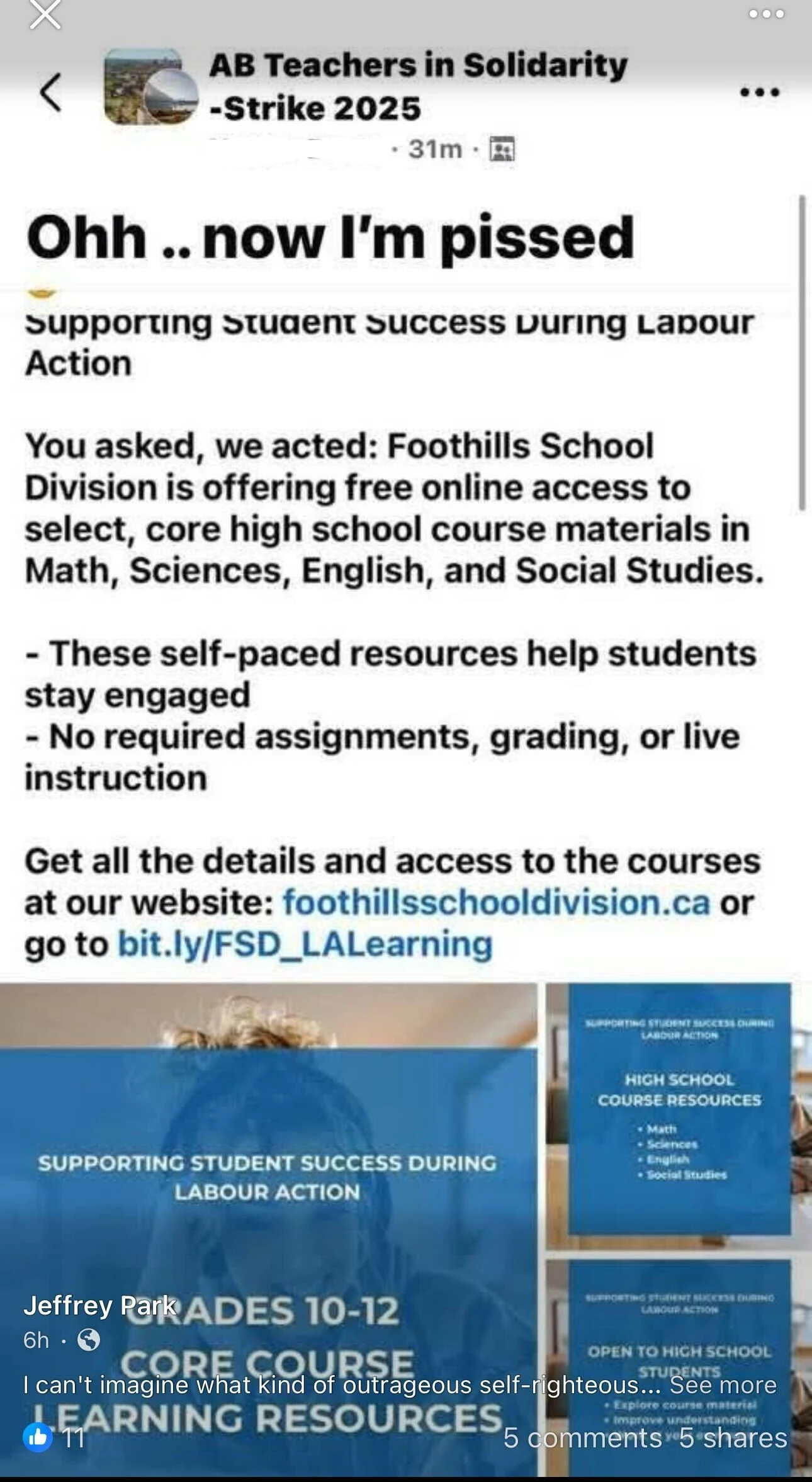
Teachers are angry that families are exploring alternatives during the Alberta strike. Some are even calling parents “disloyal” for turning to online resources. But let’s be honest — what else are families supposed to do when the system stops working?

The truth is, teachers are afraid. And I get it. They’ve been handed an impossible job inside a system that hasn’t evolved in 150 years. A system built for industrial workers, not creative thinkers. For compliance, not curiosity.

AI. Homeschooling. Microschools. Digital curriculum.

All of it is growing — fast.

And instead of seeing these tools as extensions of learning, too many educators see them as enemies.

Here’s the reality:

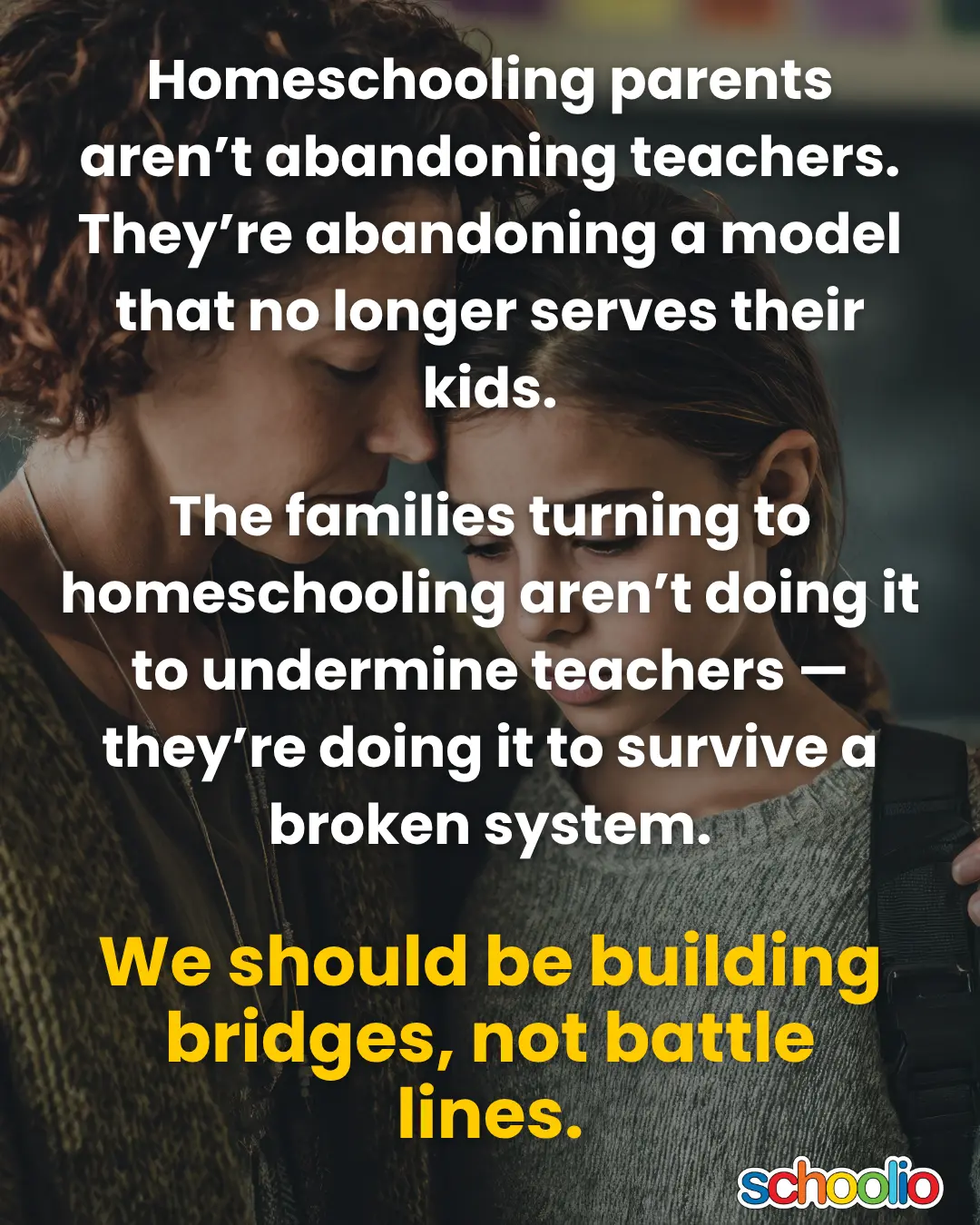
Parents aren’t abandoning teachers. They’re abandoning a model that no longer serves their kids.

Innovation in education isn’t an attack. It’s an answer.

The families turning to homeschooling or digital learning aren’t doing it to undermine teachers — they’re doing it to survive a broken system.

We should be building bridges, not battle lines.

Technology and teachers can coexist. But that requires courage — the kind that looks at change and says, “Let’s learn from it.”

Because the future of education won’t be built by those defending the old ways. It’ll be built by the ones bold enough to imagine new ones.

Alberta


Sathish
Still learning, still unlearning

Worried Homeschooling Is Too Expensive? Here’s Your Defense Over the Costs

Worried Homeschooling Is Too Expensive? Here’s Your Defense Over the Costs


Yes, homeschooling has costs — but so does public school. The difference? You control what you spend and why.

I hear from parents considering homeschooling all the time…

“I want to start homeschooling… but what if I just can’t afford it?”

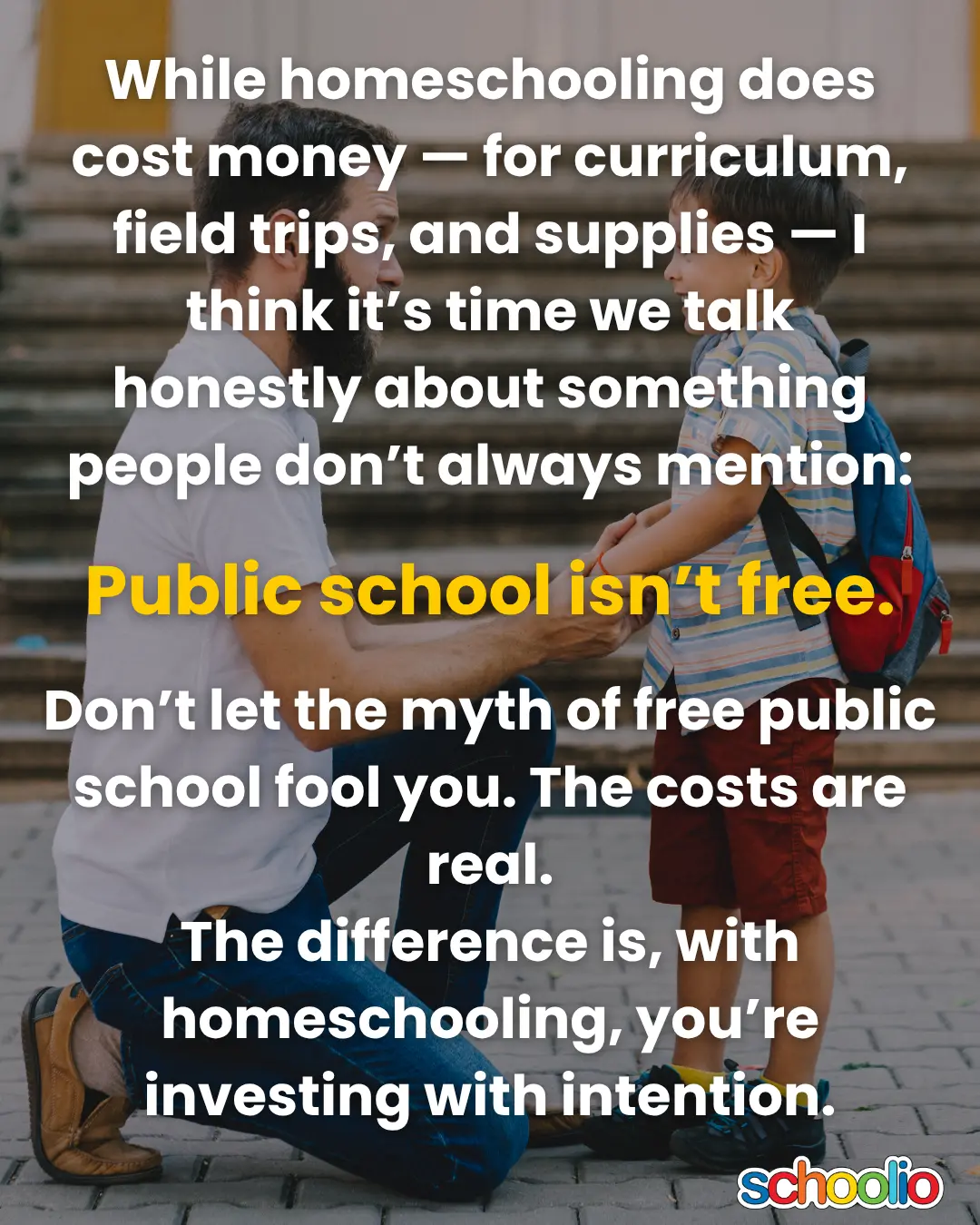
It’s a fair question. And while homeschooling does cost money — for curriculum, field trips, and supplies — I think it’s time we talk honestly about something people don’t always mention:

? Public school isn’t free.

The truth is, both paths have costs. But with homeschooling, you get to decide what you buy and how much you spend, based on your values and your child’s needs — not what’s written on a school form or fundraiser sheet.

Let’s break it down.


? How Much We Spend on Homeschooling

If you’ve met me, and a lot of you have, you probably know I’m an incurable Type-A planner. We also homeschooled our two kids on one income, as I know many of you are as well. For several years I tracked everything that was homeschool related, so I knew exactly how much we were spending on:

  • Curriculum
  • Field trips
  • Supplies
  • Anything we wouldn’t have spent otherwise if they were in school

But here’s the kicker…


vs. What We Spent in Public School (Hint: It Was More)

This spending tracking didn’t begin with homeschooling though- back when my kids were in public school, I also tracked our spending. Those years?

We spent almost $100 more per childfor free public school.

Here’s where that money went:

  • Back-to-school supplies (the specific ones required)
  • Indoor shoes, gym clothes, weather gear – and clothing replacements when they are lost and stolen
  • School events: BBQs, fairs, pizza day, candy cane day, milkshake day…
  • Valentines, classroom parties, book fairs, teacher gifts
  • Hot lunches and fundraiser purchases
  • Fad items and brand names your kids have to have in order to not be bullied

We weren’t even high-participation parents! We did just enough that our kids didn’t feel left out, but not every event or lunch or fundraiser.

And still? It added up.


? The Big Difference with Homeschooling: You’re in Control Now

Homeschooling gives you something public school doesn’t:

Control over what you spend — and what you get for it.

You decide:

  • Which curriculum to invest in (or whether to build your own)
  • How often you take field trips
  • Whether you spend more time or more money — whichever fits your family
  • What supplies, tools, or extras actually matter in your homeschool

You’re not just handing money over for a pizza party you didn’t ask for.

You’re choosing what best supports your child’s growth — and your family’s goals.


? Homeschooling Can Work on a Budget

You’ll spend either money or time — or some combination of both.

The beauty is: you get to choose what’s worth it.

Whether you’re middle-of-the-road spenders, doing things ultra-minimally with free resources and DIY everything, or have some room to buy back more time — there’s no one “right” budget for homeschooling.

But don’t let the myth of free public school fool you. The costs are real.

The difference is, with homeschooling, you’re investing with intention.

Lindsey

Certified Special Ed Educator & Co-Founder, Schoolio

When Schools Punish Curiosity, Families Choose Freedom

When Schools Punish Curiosity, Families Choose Freedom


This has been on my mind today…

I saw a post today from a school administrator frustrated that parents take kids out of school for vacations. “I can understand a death or family emergency,” he said, “but a cheaper vacation? Nope.”

That comment says everything about why so many families are leaving the system.

We’ve built schools that treat learning like a fixed location — a desk, a bell, a schedule. But learning doesn’t stop when you leave the classroom. It happens in airports, in museums, in street markets, and in quiet conversations between parent and child while exploring a new city.

When schools shame families for traveling, they’re not protecting education — they’re limiting it.

Learning on the road is world learning. It’s exposure, perspective, adaptability. It’s the kind of real-life curriculum no textbook can teach.

Families aren’t looking for rebellion. They’re looking for flexibility.

They want their kids to see the world and still stay connected to structured learning.That’s why platforms like Schoolio exist — to make learning portable, digital, and continuous. Whether you’re in a classroom or on the road, learning doesn’t have to pause.

If schools truly want to prepare kids for the world, they should start by letting them experience it.


Sathish
Still learning, still unlearning

Understanding ADHD Motivation in Kids: It’s Not Broken, Just Different

Understanding ADHD Motivation in Kids: It’s Not Broken, Just Different


“You just need to try harder.”
“If you’d only apply yourself.”
“You’d do it if you really wanted to.”

Sound familiar? If you’re raising or homeschooling an ADHD child, you’ve probably heard these words directed at them—or even caught yourself thinking them in moments of frustration. Unfortunately, our kids hear this kind of messaging a lot. In fact, research estimates that by age 12, ADHD children have heard around 20,000 more negative comments than their neurotypical peers.

That steady stream of criticism teaches ADHD kids that they’re lazy, unmotivated, or difficult. But here’s the truth: your child’s motivation isn’t broken. Their brain simply runs on a different operating system, and understanding how it works is the first step to helping them thrive.

How Motivation Works Differently in ADHD Brains

Neurotypical brains are generally motivated by rewards, consequences, and willpower. They can push through boring tasks because they know it will pay off in the end.

ADHD brains don’t respond to those motivators in the same way. Instead, their motivation is fueled by five unique drivers: urgency, novelty, interest, challenge, and purpose. When we try to push them with typical methods, it often backfires. But when we learn to work with their motivators, instead of against them, everything changes.

The 5 Key Motivators in ADHD Kids

1. Urgency

Ever notice your child suddenly works like a whirlwind right before a deadline—but can’t start two weeks earlier? That’s urgency at play. Their brain doesn’t register “later” as important—it needs “right now” to kick into gear.

How parents can help:

  • Break big tasks into smaller steps with shorter deadlines.

  • Use timers—turn chores into races.

  • Try body-doubling: sit beside them while you each work on something.

2. Novelty

ADHD kids thrive on newness. A new book, a new game, a new learning method? Instant focus. But once the shine wears off, their interest crashes. This isn’t stubbornness—it’s brain chemistry.

How parents can help:

  • Introduce small changes to routines (a new pen, studying in a new spot).

  • Rotate activities instead of relying on the same approach every day.

  • Lean into their love of trying new things—then build learning around it.

3. Interest

Have you ever been amazed at how your child can remember every detail of their favorite video game, but can’t recall what you just asked them to do? ADHD brains run on an interest-based nervous system. When they care, they can focus like a laser. When they don’t, it feels impossible to start.

How parents can help:

  • Connect “boring” tasks to your child’s passions.

    • Hate writing? Turn the essay into a comic strip or YouTube script.

    • Math struggles? Frame problems as Pokémon stats or Minecraft builds.

  • Let them dive deep into special interests—it strengthens focus muscles.

4. Challenge

Too easy = boring. Too hard = overwhelming. ADHD brains need the sweet spot in between, where a task feels like a puzzle to solve.

How parents can help:

  • Turn chores into challenges (“Can you beat yesterday’s cleanup time?”).

  • Use levels or point systems like a game.

  • Encourage self-competition, not competition with siblings or peers.

5. Purpose

Above all, ADHD kids need to know why they’re doing something. “Because I said so” rarely works. If a task feels meaningful, they can stick with it. If not, motivation evaporates.

How parents can help:

  • Reframe chores: cleaning a room = having a calmer, less stressful space.

  • Link schoolwork to goals they care about (Spanish = talking with new friends, watching shows without subtitles).

  • Talk about long-term benefits in a way that feels personal, not abstract.

Helping Your Child Feel Seen

When ADHD kids don’t respond to “normal” motivators, it’s not laziness—it’s wiring. And when they hear constant negative messages, it chips away at their confidence. But as a parent, you can flip the script.

By working with your child’s unique motivators—urgency, novelty, interest, challenge, and purpose—you’re not just helping them get through daily tasks. You’re teaching them how their brain works, building self-awareness, and showing them that their differences aren’t deficits.

Your child doesn’t need to “try harder.” They need to try differently—and they need adults who understand how to guide them there.

When Learning Becomes Theirs

When Learning Becomes Theirs


In traditional schooling, kids are taught to follow directions, do as they’re told, complete assignments as directed, and meet someone else’s expectations.

There’s no choice in what, when, or how they learn. They can’t even decide for themselves when to use the washroom.

And that’s a way of learning — but it’s not the same as learning how to:

  • Set personal goals
  • Reflect on growth
  • Ask great questions
  • Navigate challenges with persistence
  • Make choices about what (and how) they want to learn

That’s the difference between compliance and ownership.

When kids feel like school is something being done to them, resistance sets in.

When they feel like it’s something they’re actively building, everything changes.

I’ve seen this shift happen over and over in homeschooling. When you give kids a voice in their learning — whether it’s choosing which subject to start with, setting a goal for the week, or diving deep into something they’re curious about — they start to care differently.

They ask better questions. They push through challenges. They learn because they want to, not because they have to.

It’s not about giving up structure — it’s about sharing the steering wheel.

When we invite kids into the process of shaping their education, we’re not just teaching academics. We’re teaching self-awareness, confidence, and lifelong learning skills that reach far beyond any test score.

Because the ultimate goal isn’t to raise kids who can follow directions — it’s to raise humans who can direct their own lives.

? Lindsey

Certified Special-Ed Educator & Co-Founder, Schoolio