When My Daughter Hyperfocused on Dragons, This Is What I Did

When My Daughter Hyperfocused on Dragons, This Is What I Did

by Lindsey Casselman

From the moment I introduced 8-year-old Grace to the How to Train Your Dragon universe, she become OBSESSED with dragons. This wasn’t just an interest in the movies, it was a full-blown SPIN (special interest).

Dragons. Morning to night. Drawing them. Reading about them. Talking about them. Playing with the toys. Watching the movies. Wearing her dragon costume and sleeping with her dragon stuffies.

But dragons are not real, and not on the list of things to study in our homeschool. We were supposed to be learning about physical geography in Social Studies at that time, and frankly, no one was very excited about it.

Riveting stuff like landforms and regions of North America: plains vs. mountains, the Arctic vs. the Maritimes. The Schoolio course had an ongoing activity throughout where we were creating a booklet as we went through each region, one at a time. Learn the geography. Record the land features, water sources, vegetation, and animals for each.

She had zero interest.

To be honest? Neither did I.

But I’ve been at this long enough to know when it’s time to toss the plan and follow the spark instead. So one day, after reading the lesson to her aloud, I looked at her and said:

“What kind of dragon would live here?”

That was all it took.

Every lesson from that point on was golden. For each region, she studied the environment and designed a dragon that could survive there — down to the smallest detail.

The plains dragon was a dusty yellow and burrowed in wheat fields. It lived in underground dens and hunted at dusk, camouflaging in the tall grasses.

The Arctic dragon was brilliant white, blending into the snow and ice. It was slow-moving, conserving energy in the cold, and had thick scales to withstand frigid temperatures.
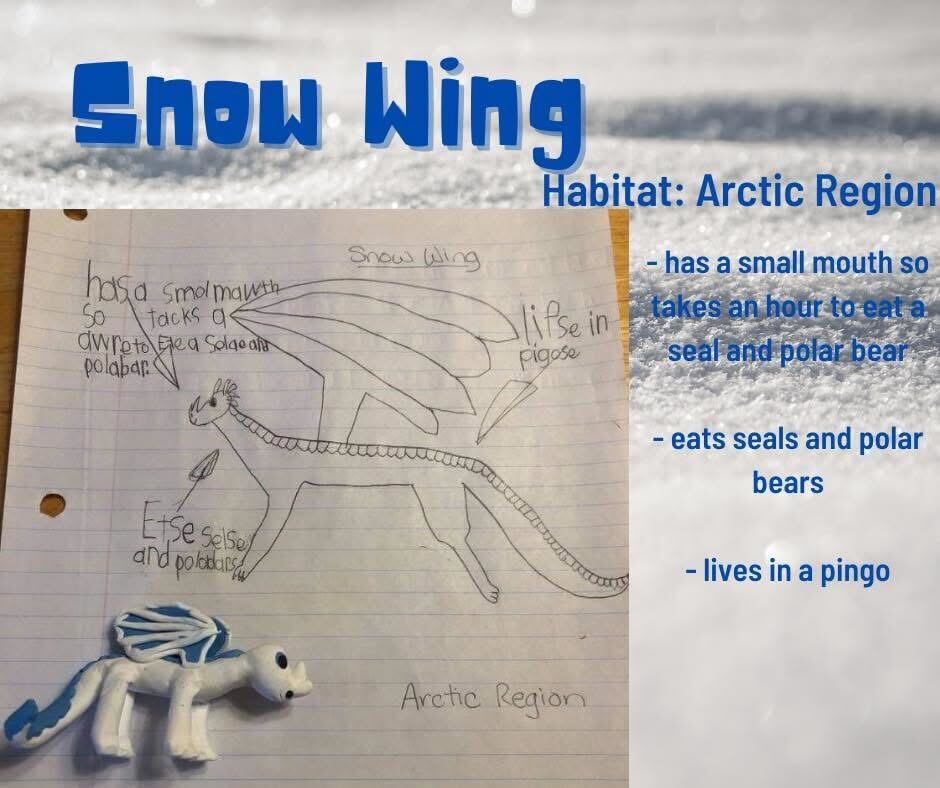
Snow wing
Snow Wing Dragon

The Maritime dragon? A shimmering blue sea serpent, waterbound and fast, feeding on fish and crustaceans, curled up in coastal caves during storms.
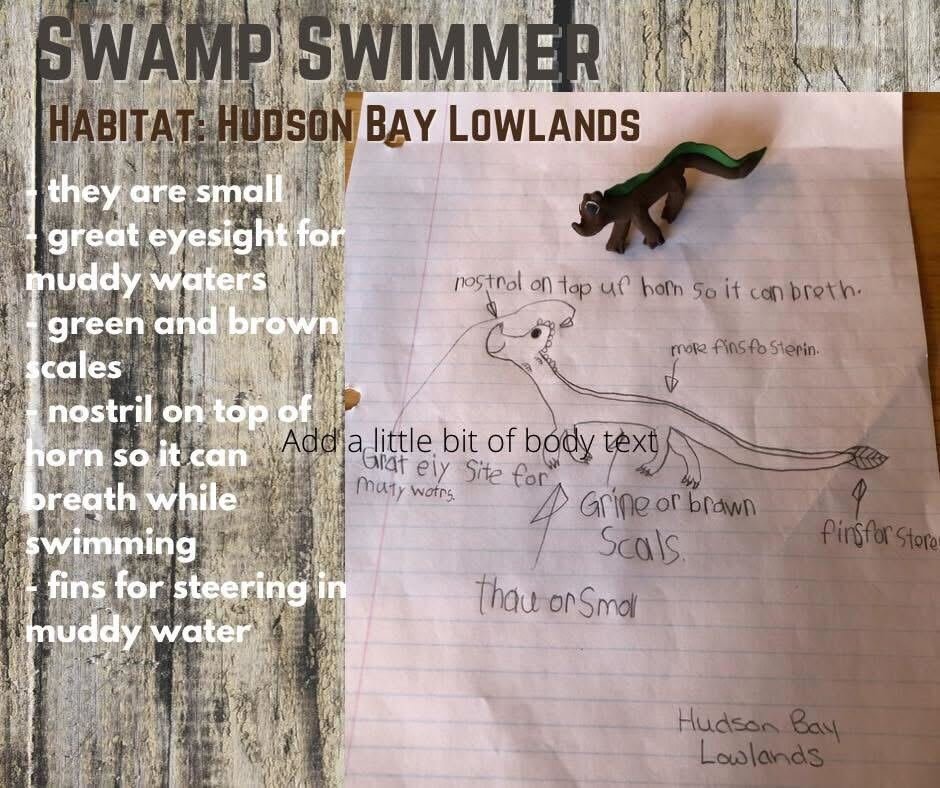
Swamp Swimmer
Swamp Swimmer Dragon

The mountain dragon was stone-grey and jagged, with thick claws that helped it cling to steep cliffs. She told me it would “echo-roar” through the valleys when it was angry.

Sea Wing
Sea Wing Dragon

She even brought out the clay and sculpted each of them — every single one. We had an entire dragon ecosystem on our homeschool table by the end of the week.

And she remembered everything.

Not just the dragons — the geography. The climate. The vegetation. The animals. The features of each region. It stuck.

Because when learning is connected to something meaningful — even something mythical — it matters. It lands. It lives in their brains and bodies in a way a worksheet never could.

We didn’t abandon the curriculum. We just used it differently. And isn’t that the whole point of homeschooling?

To follow the spark. To shift when something’s not working. To take a kid’s hyperfocus and say, “Yeah, let’s go there.”

Dragons and all.

? Lindsey

certified special-ed educator & co-founder, Schoolio
How I Learned to Stop Comparing My Homeschool to Public School

How I Learned to Stop Comparing My Homeschool to Public School

By Lindsey, certified special-ed educator & co-founder, Schoolio
When I think back on our homeschool journey, there’s one chapter I almost didn’t want to admit. It was the year Grace still couldn’t read.

She was nine. Nine years old, and reading hadn’t clicked. Every night, after she went to bed, I would lie awake spiraling. I thought I had ruined her or that I was the problem. Reading the benchmarks only made it worse. Public school laid out exactly what was expected by first grade. Yet there I was, years later, feeling like I had broken something in her by trying to do it all differently.

I tried everything. From phonics programs to full curriculum bundles, I spent money we didn’t really have on tools that promised results. Our printer groaned under the weight of all the worksheets. There were days I begged, bribed, and cried. And she hated all of it.

One day, after another tense battle over a workbook, Grace looked at me and said, “I hate reading. I hate books.”

It broke me.

I gave up. I stopped pushing. Honestly, I stopped trying. I said to myself, fine. She’ll be illiterate. We’ll figure it out later. But I couldn’t keep doing that to either of us.

A few months later, something unexpected happened. We downloaded a video game called Stardew Valley. It’s slow-paced, gentle, and deeply story-driven — but it has no spoken dialogue. Everything is written in captions. At first, she’d call me from the other room every few minutes to read something. I’d drop what I was doing and go help. Over and over.

Then, one day, the requests stopped. I realized she wasn’t calling anymore — she was reading it herself.

Within three weeks of playing that game daily, something had clicked. I watched my daughter — the one I thought I had failed — read fluently, joyfully, independently. And I cried again, but this time for a different reason.

It wasn’t that she couldn’t learn. It was that she didn’t learn the way I was taught to expect. She needed time, space, and motivation that was meaningful to her. She needed me to stop comparing her to arbitrary timelines built for someone else’s classroom.

Homeschooling gave her that chance.

Now, when I hear a parent panic because their kid isn’t “on grade level,” I get it. I really do. But I also want to gently offer: maybe the problem isn’t your child or your teaching. Maybe it’s the invisible comparison you’ve been carrying — the one that says there’s only one right way to learn, and it happens in a public school classroom, on someone else’s clock.

Grace taught me that’s not true. Learning is not linear. It’s not uniform. It’s not a race. Sometimes, letting go is the most loving, brave thing you can do — for both of you.

certified special-ed educator & co-founder, Schoolio
Why the Current School System Wasn’t Built for Neurodivergent Kids

Why the Current School System Wasn’t Built for Neurodivergent Kids

By Sathish, Founder of Schoolio

This has been on my mind today…

When I was a kid growing up in Singapore, the classroom was a machine — neat rows, rigid structure, and one right way to behave, think, and perform. You either followed the rules or you were labeled. I was restless. I couldn’t sit still. My energy and curiosity didn’t have a place in that space, and there were no words for why I struggled. Neurodiversity wasn’t a concept we understood. You were either teachable or a problem.

That stayed with me.

Decades later, I see the same story playing out in schools across North America. Parents tell me how their kids are being flagged for behavior issues, attention problems, refusal to comply — all symptoms of being wired differently in a system built for uniformity.

Let’s be honest. The current school system wasn’t designed with neurodivergent learners in mind. It was built for efficiency, not flexibility. For order, not curiosity. And that mismatch is costing kids their confidence.

I’ve spoken with families whose children were once constantly in the principal’s office, overwhelmed by sensory overload, crushed by the pressure of timed tests, or made to feel like failures for not sitting quietly through long lessons. Many of these same kids began to thrive the moment they left the traditional classroom.

Homeschooling, for them, wasn’t a backup plan. It was freedom. It was healing. And for many, it was the first time learning felt possible.

At Schoolio, we don’t pretend to know everything about every child. But we do know that education should flex to fit the learner — not the other way around. Our online homeschool programs were built to allow pacing changes, subject switches, breaks when needed, and curriculum that doesn’t punish kids for needing to move, think differently, or question the process.

Is homeschooling effective for neurodivergent kids? I’ve seen it change lives, children regain their self-worth, and repair the relationship between learning and joy.

It’s not about perfect lessons or checking every box. It’s about giving kids the space to show us how they learn. Once we stop trying to fix them, we see there was nothing broken to begin with.

Sathish

still learning, still unlearning

What Chloe’s Story Reminds Us About Mental Health and the Limits of Traditional School

What Chloe’s Story Reminds Us About Mental Health and the Limits of Traditional School

by Sathish

This has been on my mind today…

I read Chloe Jones’ story in The Big Issue recently, and it brought up something I’ve seen time and time again: when school no longer feels safe, kids find another way.

Chloe was labeled lazy. But what she was really carrying was anxiety. That invisible weight kept her from fully showing up at school — and instead of support, she was met with punishment. That’s the moment that broke my heart. Because that moment isn’t rare.

We’ve spoken with so many families at Schoolio who’ve lived a version of this. Their child wasn’t thriving, their mental health was deteriorating, and the school system just wasn’t equipped to respond with what was actually needed — understanding, flexibility, emotional safety.

So Chloe did what many brave students and parents do: she left.

She taught herself. She found community through her local Youth Zone. And she went on to earn top marks and awards at college. Her story doesn’t surprise me — but it inspires me. It shows what’s possible when a learner is finally given the freedom to move at their own pace, in an environment that feels safe.

This is why Schoolio exists. Not to replicate school at home, but to give families the tools to rebuild something better.

We’ve embedded social-emotional learning into the curriculum because it’s not optional anymore — it’s essential. We’ve designed our lessons to work digitally or offline so families can find a rhythm that works for them. And we make sure parents have community, because no one should have to do this alone.

Chloe’s success didn’t happen in a vacuum. She had motivation, yes. But she also had the space and support to heal while she learned.

That’s the balance we aim to strike at Schoolio — where mental health isn’t an afterthought, but part of the design. Where kids don’t have to choose between feeling okay and getting an education.

If you’re a parent, a microschool founder, or someone building alternative models of education — Chloe’s story is your reminder that the path forward isn’t just about curriculum. It’s about care. And that’s something we can all build around.

Sathish

still learning, still unlearning


? Want to support your child’s education and their mental health?

Explore our bookstore, check out our SEL program or join our 7-day trial to see how it feels in your home. 

When the System Breaks, Parents Step In

When the System Breaks, Parents Step In

by Sathish

This has been on my mind today…

The CBC story about Ontario stepping in to take control of four major school boards — including TDSB and TCDSB — hit hard, but it didn’t surprise me.

Mismanagement. Overspending. Broken trust.

It’s the kind of news that confirms what many parents have felt for a long time — the system isn’t just strained, it’s cracking. And when the system breaks, parents step in.

I’ve spoken with families in Toronto, Mississauga, Ottawa — parents who aren’t anti-school, they’re anti-chaos. They’re tired of seeing decisions made behind closed doors, while their children get shuffled, silenced, or lost in the mix.

When a school board needs to be taken over by the province, it’s not just a governance issue — it’s a signal to parents that no one’s steering the ship. And for some, the only real option left is to jump.

That’s why so many are turning to homeschooling. Not out of rebellion, but out of necessity. Not because they think they can do it all perfectly, but because they’ve lost faith that anyone else will put their kids first.

The truth is, the line between school and politics has always been blurry. But lately, it’s become hard to see the kids at all.

And here’s the part that worries me — in this vacuum of leadership, families are left choosing between two extremes. A system plagued by deficits, staff shortages, and closures. Or a DIY homeschooling path with no roadmap and no support.

But there’s a third path. And that’s where Schoolio comes in.

We’re not trying to replace the school system. We’re trying to build an alternative that works — something structured, supportive, and safe.

We align our curriculum with provincial standards because families deserve clarity. We offer live tutor support and parent communities because no one should homeschool alone. And we give you clear, trackable progress tools so you always know your child is moving forward — not just in academics, but in confidence and wellbeing too.

The bigger story in this government takeover isn’t about politics. It’s about trust. And once that’s broken, parents will do what they’ve always done — protect their kids, even if it means stepping into the unknown.

If that’s you — if you’re standing at that edge, wondering if it’s time to take back control — we’re here. Not with perfection, but with a plan. With people. With structure that puts your child at the center.

Because when the system breaks, we don’t give up. We build something better.

Sathish

still learning, still unlearning


? Want to see how Schoolio supports regulated, structured homeschooling in Ontario and beyond?

Explore our bookstore, check out our course catalog or join our 7-day trial to see how it feels in your home.

Why More Parents Are Choosing Homeschooling for Mental Health—and What That Really Means

Why More Parents Are Choosing Homeschooling for Mental Health—and What That Really Means

by Sathish Bala, CEO

This has been on our mind today…

A recent article by Spark Sunderland explored a growing trend that hits close to home: families choosing homeschooling in response to mental health challenges. And while we’re glad to see more parents empowered to make choices that protect their kids, we also believe this conversation deserves more depth—because the rise in homeschooling isn’t just about leaving something behind. It’s about building something better.

More and more parents are reaching out to us with stories that begin the same way: a child overwhelmed by the school day, battling anxiety, isolation, or burnout. In many cases, parents make the call to homeschool out of urgency. Something’s not working. Their child is struggling. And the home becomes a sanctuary—a way to reclaim peace, safety, and time to heal.

We support that decision. In fact, we know it works. Homeschooling can absolutely provide a calmer, more emotionally supportive space for kids who are anxious, neurodivergent, or simply overstimulated in traditional classrooms. But at Schoolio, we also believe that the why of homeschooling matters just as much as the how.

And that leads to two honest questions we think every parent should consider.

First: Is homeschooling solving the problem—or just stepping away from it?

Pulling a child out of school to avoid bullying, peer pressure, or academic stress is often necessary. But long-term success means doing more than removing the trigger. It means rebuilding confidence, developing coping skills, and creating a foundation for healthy social-emotional growth. That’s why our curriculum includes lessons in empathy, emotional regulation, collaboration, and mental health awareness—woven right into the learning process, not added on.

Second: Are parents getting enough support?

This is a big one. When you homeschool, the responsibility doesn’t just shift—it multiplies. You’re the teacher, the guide, the emotional anchor. During the pandemic, researchers found that homeschooling parents often experienced increased stress, burnout, and feelings of isolation. We’ve seen it firsthand. That’s why we’ve built tools that support the entire family. From flexible pacing options to community spaces where parents can share, ask questions, and breathe a little—we want to make sure no one is doing this alone.

We believe in homeschool as a long-term wellness solution—not a last resort.

When mental health is part of the conversation, it changes everything. Families need structure, but they also need grace. Children need routine, but they also need room to rest, reset, and re-engage at their own pace. And parents need more than a workbook and a to-do list. They need real partnership.

That’s why we’ve built Schoolio to meet those needs—with curriculum that honors the emotional wellbeing of the learner, and tools that protect the emotional wellbeing of the parent too.

Because no one should have to choose between learning and healing.

Sathish

still learning, still unlearning


? Curious How Schoolio Supports Mental Health?

Explore our bookstore, check out our SEL program or join our 7-day trial to see how it feels in your home.

How to Start Homeschooling in Texas (2025 Guide)

How to Start Homeschooling in Texas (2025 Guide)

by Sathish

This has been on my mind today…

I’ve spoken with so many families lately who are thinking about making the jump to homeschooling—especially as we launched in Texas and met many of the local families who were ready to start but had never heard of Schoolio before. And while every story is different, the emotions are often the same. One parent told me, “I want to homeschool, but I’m scared I’ll mess it up.” Another said, “We feel like school isn’t working, but what if I can’t give them what they need at home?”

These aren’t small fears. They’re real. And deeply rooted in the way many of us were raised to believe that learning only happens inside a classroom, led by certified professionals with years of training. So to say, “I’m going to homeschool my child,” feels like breaking a rule we didn’t know we were allowed to question.

But here’s what’s been powerful to watch. I’ve seen those same parents a few months later—different posture, different voice, different mindset. One tells me her son is finally reading because he wasn’t forced into a pace that didn’t work for him. Another shares how her daughter stopped having stomachaches every morning now that learning happens at home. They’re not perfect. They’re not experts. But they’re doing it.

That’s the magic. Homeschooling isn’t about doing school at home. It’s about doing what works—for your child, your values, your rhythm as a family. And in Texas, the path to begin is surprisingly simple. The biggest step isn’t paperwork. It’s choosing to believe that you can guide your child’s education in a way that works for both of you.

So here’s what you need to know.

Texas is one of the most homeschool-friendly states in the country. There’s no registration process. No district approval. No testing requirements. You don’t need to submit plans or portfolios. You simply need to teach a few required subjects using a written curriculum. That’s it.

Here are the basics:

  • Homeschooling in Texas is legally recognized as “private education.”
  • You’re required to teach reading, spelling, grammar, math, and good citizenship.
  • There’s no formal notice of intent needed, unless your child is already enrolled in public school. In that case, you’ll just need to withdraw them by notifying the school.

That’s all.

Of course, just because it’s simple on paper doesn’t mean it feels simple emotionally. Starting is the hardest part—not because the laws are complicated, but because the fear is real. What curriculum do I choose? How do I make a schedule? What if I don’t cover everything?

That’s why we built Schoolio—to make it easier for families to get started and stay supported. Whether you want a complete curriculum bundle, an online homeschool program, or just a flexible homeschool planner to design your own flow, you’ll find tools that don’t add pressure, but help you feel capable.

Because that’s the real shift. Homeschooling works best not when you try to recreate the system at home, but when you create something new—something human, flexible, and designed around how your child learns best.

So if you’re in Texas and wondering how to start homeschooling, here’s the truth: you already have. That moment you paused and asked, “What’s best for my child?”—that’s where it begins.

Sathish

still learning, still unlearning

How I Built a Homeschool Schedule That Didn’t Burn Us Out

How I Built a Homeschool Schedule That Didn’t Burn Us Out

by Lindsey

When I think back on our homeschool journey, I remember the spiral-bound planner I bought during that first summer. I had every hour penciled in. Math at 9. Language at 10. Science after lunch. I thought if I could just replicate the structure of a school day at home, we’d be successful. I was trying so hard to “do it right.” But right for who?

What followed were weeks of power struggles. One of my kids melted down every time we had to switch subjects. The other would hyperfocus on one thing and resist everything else. I found myself repeating the same sentence over and over: “We’re behind.” I felt behind. All the time. And so did they.

One day, I remember snapping at my youngest over handwriting. She was crying. I was too. We closed the books and walked away. I sat on the couch, defeated. And that night, after they’d gone to bed, I looked at the planner and realized it wasn’t designed for us. It was built on someone else’s idea of learning. Not mine. Not my kids’.

That’s when I started paying attention to something else—not the clock, but their energy. Their moods. When they were curious. When they were tired. When they needed to move. I swapped strict scheduling for rhythms. Short lessons. Wiggle breaks. Slow mornings. Outside time. And something amazing happened—we all calmed down.

They started learning more. Not because I was teaching harder, but because they were finally able to receive it. And I started feeling more like their guide and less like their warden.

That’s when we started using a flexible homeschool planner. One that gave us space to adjust. One that didn’t guilt-trip us with empty checkboxes, but reminded us to focus on the whole child. I used to think we had to cover every subject, every day, in order to be doing homeschooling the “right” way. Now, I know better.

There are still days where we only get through half a lesson, or days when everyone’s too grumpy to do anything academic. But that’s okay. Because I’ve learned that building a homeschool schedule is less about fitting everything in and more about building a life where learning fits.

And that’s what makes it sustainable. That’s what makes it stick.

certified special-ed educator & co-founder, Schoolio
What Is “Enough” in Homeschooling?

What Is “Enough” in Homeschooling? 

by Lindsey

When I think back on our homeschool journey, one day in particular still stands out like a smudge on the calendar. One of those days where everything just starts off on the wrong foot. No one slept well. The kids were fighting before breakfast. There wasn’t enough coffee in the world to get me centered. And the second I called them to the table to start school, the whining began.

I could feel it coming—low frustration tolerance all around, myself included. Math was the breaking point. Tears, tantrums, and a very dramatic pencil toss across the room. We all lost it a little that morning. Not our best moment. I threw in the towel. I had to. No one learns when they’re emotionally dysregulated. So instead of pushing through, I called it. We put on jackets, walked outside, and just… let go.

It took a while, but we all started to settle. There’s a kind of reset that happens when you’re outside, when the pressure to perform and achieve and “get it done” lifts off everyone’s shoulders. They started to build an obstacle course in the backyard. At first it was just a way to burn off energy. But then I saw it. They were measuring and planning. They were problem-solving. They were testing different ideas, adjusting materials, explaining their thoughts to each other. Without even realizing it, they were doing geometry, physics, and engineering—all in bare feet with sticks and cones.

If they’d been in school that day, I know exactly how it would have gone. They would’ve been just as frustrated, just as unfocused, and they wouldn’t have had the option to take a break. They would’ve had to sit through the rest of the day, disconnected and overstimulated, trying to mask their feelings. At home, they get space to breathe. To stop. To move. To recover. And in doing that, they often end up learning more deeply and more meaningfully than they ever could with a workbook in front of them.

It reminded me of something I know as a special-ed educator, but sometimes forget as a parent: learning doesn’t have to look a certain way to be valid. Progress doesn’t always come in neat packages. Some days, “enough” isn’t checking off every subject—it’s knowing when to pause. It’s recognizing when your child’s brain and heart need care before content.

That day, we didn’t finish our lessons. But we learned a lot. And that was enough.

Certified Special-Ed Educator & Co-founder, Schoolio