How Many Hours Should You Homeschool Each Day?
One of the first questions I hear from new homeschool families is this: “How many hours should we be doing every day?” It’s a question that often carries a lot of weight, as parents worry about whether they’re doing enough. And I always smile a little because the answer is often fewer hours than they’re expecting. Understanding how many hours are truly needed can bring a sense of relief and clarity to your homeschooling journey.
Why so much less than traditional school?
Think about what a six-hour school day actually looks like. There’s the morning routine — getting settled, taking attendance, announcements. Transitions between subjects, between classrooms, between activities. Lining up. Waiting. Bathroom breaks for the whole class. Behavior redirection when someone is off task — which in a class of thirty kids, is almost always someone. Lectures delivered to the whole group at a pace that works for the middle — too fast for some, too slow for others. Work periods where half the class is waiting for the other half to catch up. By the time you strip all of that away, the actual focused learning happening in a traditional school day is a fraction of the clock time.
At home, with one child — or even a few — you cut almost all of that out. No transitions. No waiting. No redirecting twenty-nine other kids. Just your child, you, and the lesson. That’s why two hours at home can cover what takes six hours at school. For example, a focused math lesson that might take an hour in a classroom can often be completed in 20 minutes at home.
What they taught me in teacher training
When I was getting my education degree, one of the most useful things my professors taught me was this: You can expect a child to give you their focused attention for as many minutes as they are years old. An eight-year-old? Eight minutes of genuine sustained attention. A six-year-old? Six minutes.
Now — that doesn’t mean a lesson is only that long. It means something needs to happen as a reset every few minutes. A change of location. A switch from listening to doing. A question asked and answered. A quick movement break. Anything that breaks the sustained attention and gives the brain a little refresh. Even traditional school isn’t six straight hours of focused learning. It’s dozens of tiny resets strung together across a day. Homeschool is no different — and once you understand that, the whole day starts to make a lot more sense.
For instance, a science experiment might involve a quick setup, a period of observation, and then a discussion. Each part offers a natural break and reset for the child’s attention.
So how long should homeschool actually take?
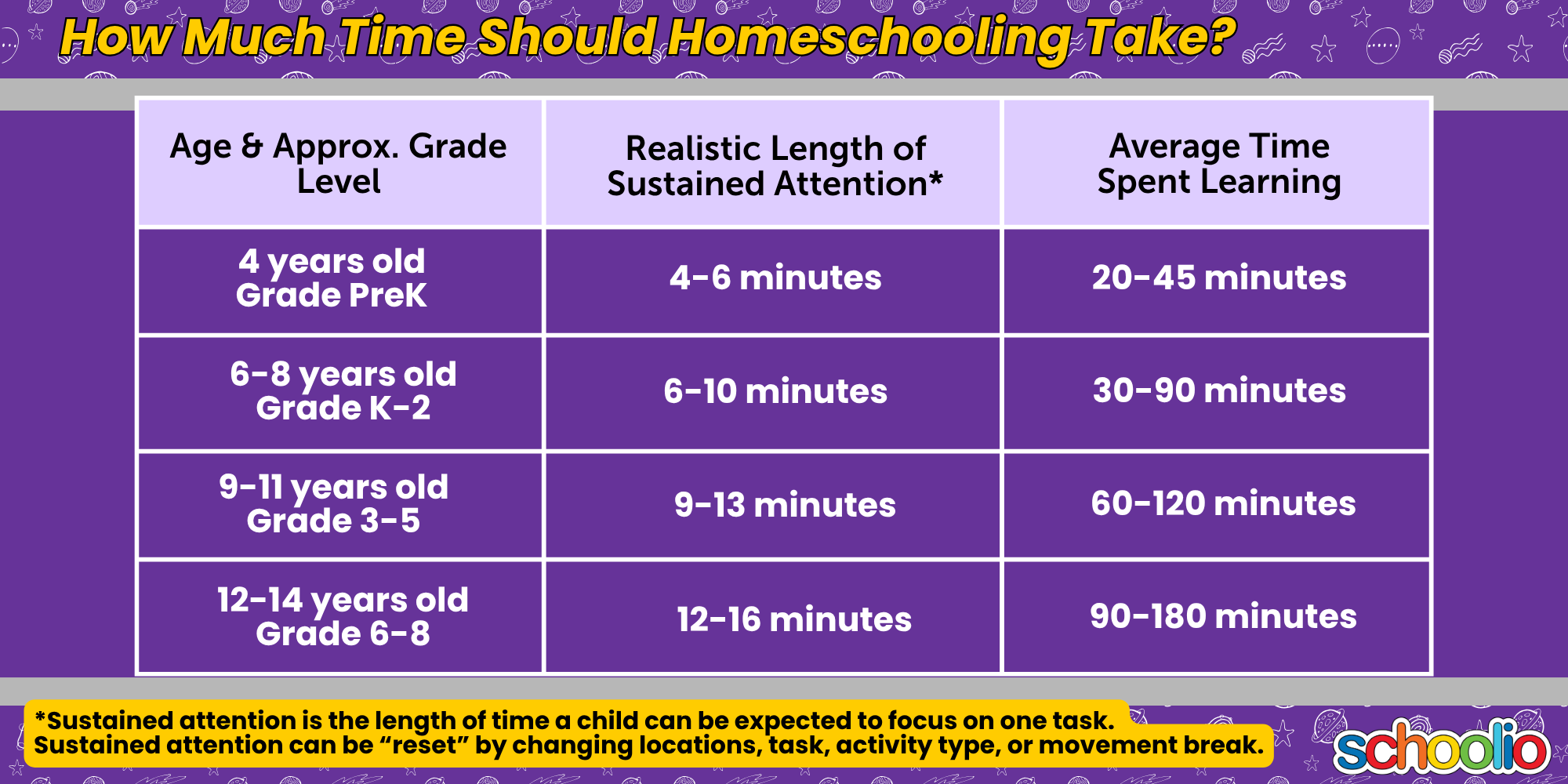
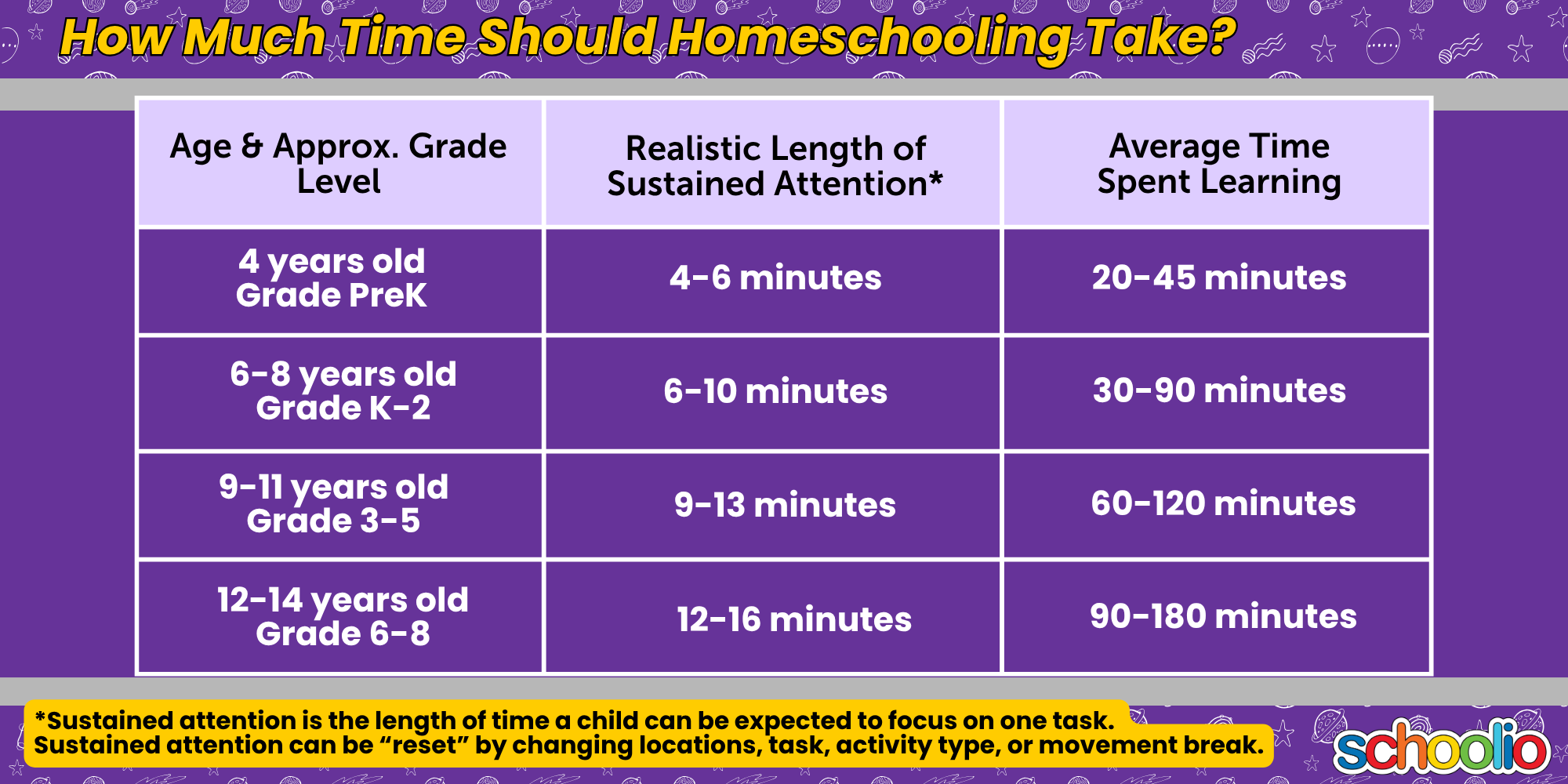
Here are some rough guidelines that the homeschool community has generally come to agree on. Think of these as a loose norm, not a rulebook. (See the chart below for a full breakdown by age and grade.)
PreK (Age 4) 20–45 minutes total. Sustained attention of just 4–6 minutes at a time. Play is the curriculum at this age. Keep it light, keep it moving. Activities might include storytelling, simple crafts, or a nature walk.
Kindergarten to Grade 2 (Ages 6–8) 30–90 minutes total. Sustained attention of 6–10 minutes. Short, varied activities work best. Reading, then building, then drawing — keep switching it up. A typical day might start with a reading session, followed by a hands-on math activity, and then a creative art project.
Grades 3–5 (Ages 9–11) 60–120 minutes total. Sustained attention of 9–13 minutes. Kids this age can handle a little more depth, longer projects, and starting to follow their own curiosity. You might introduce a research project on a topic of interest, encouraging independent learning.
Grades 6–8 (Ages 12–14) 90–180 minutes total. Sustained attention of 12–16 minutes. More independent work starts here — reading, research, writing — but it still shouldn’t feel like a grind. Consider incorporating a mix of structured lessons and self-directed study, like a science project or a book report.
A note for neurodivergent learners
If your child has ADHD, autism, or sensory processing differences, these numbers may look quite different — and that is completely okay. For many neurodivergent kids, sustained attention windows are shorter, and the need for resets is more frequent. That’s not a problem to fix. That’s information to work with. Twenty minutes of real engagement will always beat ninety minutes of struggle. Tailor your approach with flexible schedules and sensory-friendly activities.
The bottom line
Seat time is not the same as learning time. If your child is engaged, curious, and absorbing what you’re working on together — you’re doing it right. Even if it only took an hour. Even if it looked nothing like school. That’s kind of the whole point. Remember, the beauty of homeschooling is its flexibility and the ability to adapt to your child’s unique learning style and pace.