You made a chart.
You bought the stickers.
You explained the rules carefully, made the reward something they actually wanted, and felt genuinely hopeful.
By day three, it had completely fallen apart.
If this sounds familiar, you are not alone. And more importantly — you didn’t fail. The system failed your child. Traditional reward systems often don’t work for ADHD kids. Backwards rewarding and rewarding deadlines can be game-changers for them.
The Problem With “Earn It First”
Most reward systems follow the same basic structure: do the thing, then get the reward. Work first, fun later. Finish your chores, then we’ll talk about the park. Get your schoolwork done, then you can have screen time.
This model assumes that children can hold a future reward in mind, feel motivated by it, and push through discomfort to eventually get there.
For neurotypical kids, that works reasonably well.
For ADHD kids, it’s like asking someone to run on an empty tank. The want is real. The effort is real. But the wiring just doesn’t support it.
Here’s why.
It’s Not Motivation. It’s Dopamine.
ADHD brains don’t have a motivation problem — they have a dopamine problem.
Dopamine is the neurotransmitter that drives focus, follow-through, and the feeling that something is worth doing. In neurotypical brains, the promise of a future reward releases just enough dopamine to get moving. The brain can feel the reward coming, even if it’s days away.
In ADHD brains, that system works differently. Their dopamine response is driven by what is immediate, interesting, novel, or urgent. A reward at the end of the week might as well be a reward in another lifetime. Their nervous system can’t feel it yet — so it can’t be motivated by it.
This is why you can watch your child genuinely want to earn something, and still be completely unable to make themselves start. The want is real. The problem isn’t attitude or effort.
It’s brain chemistry.
And once you understand that, the whole picture changes.
Backwards Rewarding and Rewarding Deadlines for ADHD
When we stop trying to force the ADHD brain into a neurotypical reward system, and start building systems that work with how it’s actually wired, things begin to shift.
These two strategies do exactly that.
Backwards Rewarding
Backwards rewarding flips the traditional model completely.
Instead of earn the reward, it becomes: here’s the reward — now let’s do the thing.
You give the dopamine hit first.
Before the math lesson, your child gets 20 minutes of free play. Before they tackle a writing task, they watch one episode of their favourite show. Before a difficult afternoon, you go outside together first.
This sounds counterintuitive. It might even feel like giving in.
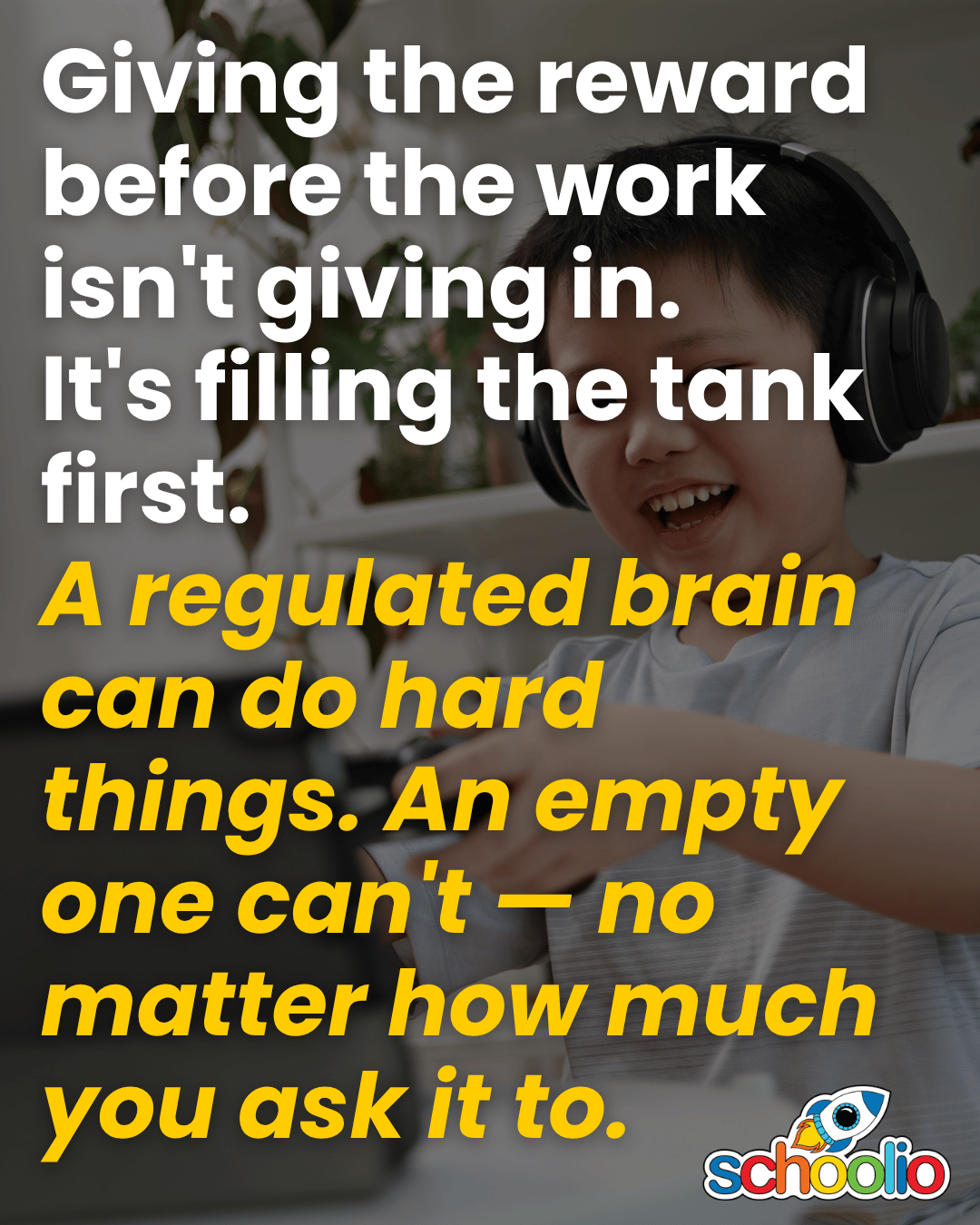
But what you’re actually doing is filling the tank.
When an ADHD brain is already regulated, stimulated, and satisfied, shifting into a less-preferred task becomes genuinely possible in a way it simply wasn’t before. You’ve given their nervous system what it needed to have capacity. Now there’s something left in the tank to spend on the hard thing.
It’s not a reward for compliance. It’s regulation before demand.
In practice, it looks like this:
Instead of “Finish your reading and then you can play outside,” try “Let’s go outside for a bit first — get some fresh air and move your body — and then we’ll come in and do reading together.”
Instead of “No screens until your work is done,” try “You’ve got 15 minutes of free time right now. When the timer goes, we’ll get started.”
You’re not removing accountability. You’re removing the barrier that was making starting impossible in the first place.
Rewarding Deadlines
A rewarding deadline pairs the completion of a task with something immediate, specific, and meaningful — not a vague promise somewhere in the future, but a concrete plan the child can see and feel coming.
The key difference between a rewarding deadline and a traditional deadline is what’s driving the urgency.
Traditional deadlines work through pressure and consequences. Get this done, or else. For an ADHD nervous system that’s already struggling to regulate, adding threat to the equation usually makes things worse. Cortisol spikes. Anxiety takes over. And suddenly your child can’t think clearly enough to do the thing you needed them to do.
A rewarding deadline does the opposite. It creates urgency — one of the five core ADHD motivators — while tying that urgency to something the child wants, rather than something they fear.
In practice:
Instead of “You need to finish this by noon,” try “If we finish school by noon, we can go to the park right after.”
Instead of “Get your chores done or you’re losing screen time,” try “Get your chores done before Dad gets home and we’ll all play a board game tonight.”
The difference sounds small. The neurological impact is not.
That second version activates the brain’s reward-seeking circuitry. It creates a real, felt pull toward completion. And it makes the future reward feel close and certain — which is exactly what the ADHD brain needs to get moving.
A few things that make rewarding deadlines work:
The reward has to be specific, not vague. “Something fun” doesn’t land. “We’ll make tacos and pick a movie together” does.
It has to be immediate. Not tomorrow. Not this weekend. Right after.
And it has to be something they actually care about — not something you assume they should care about.
This Isn’t About Lowering the Bar
It needs to be said, because parents often worry about this.
Using backwards rewarding and rewarding deadlines doesn’t mean you’re letting your child off the hook. It doesn’t mean the work doesn’t happen or the expectations don’t exist.
It means you’re changing how you get there — not whether you get there.
The task still gets done. The learning still happens. The accountability is still real.
What changes is that you stop demanding your child run on empty, and start making sure they actually have the fuel they need first.
That’s not lowering the bar. That’s understanding your child.
Why This Matters in Your Homeschool
One of the most powerful things about homeschooling a neurodivergent child is the freedom to build your days around what actually works for your kid.
You can start with movement before academics when the morning is rough. You can front-load the reward when their capacity is low. You can design rewarding deadlines that feel collaborative and real, instead of threatening and distant.
At Schoolio, our lessons are intentionally short and flexible — built to fit around your child’s natural regulation patterns rather than fight against them. That makes it genuinely easy to structure a morning where free time comes first, a lesson comes second, and something they love is waiting on the other side.
Working with your child’s brain isn’t taking the easy way out.
It’s the most effective thing you can do.
The Real Reframe
When your ADHD child can’t start a task, can’t push through, can’t seem to care about the reward you spent time setting up — it’s not defiance. It’s not laziness.
It’s a capacity problem.
Their nervous system doesn’t have enough regulated fuel in that moment to do the hard thing. No amount of pressure or persuasion changes that.
But filling the tank first does.
And giving them something real and immediate to move toward does.
That’s not a workaround. That’s the whole point.
When we start supporting capacity instead of demanding compliance, things begin to shift.
Slowly at first.
And then all at once.
Want to go deeper on how ADHD motivation actually works? Read our post Understanding ADHD Motivation in Kids: It’s Not Broken, Just Different.