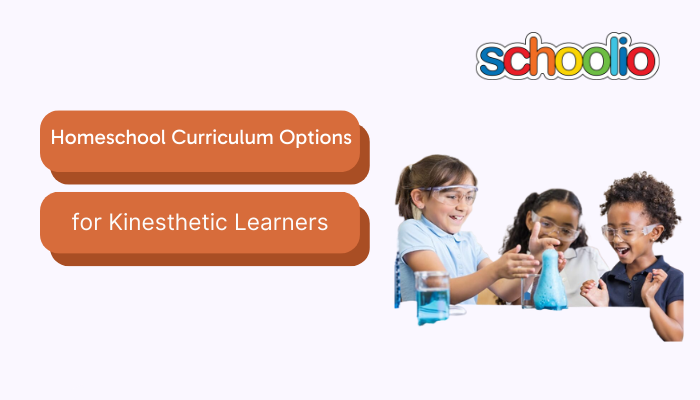
Are you tired of watching your child not doing well with traditional learning methods? If your idea of a ‘school desk’ usually involves glitter, glue, and a whole lot of mess, you’re probably parenting a kinesthetic learner!
Does your kinesthetic learner thrive on hands-on activities but seems disinterested with conventional curriculum? If so, you’re not alone. Many parents face the same situation. Nevertheless, here is the good news!

There are curriculum options designed specifically for kinesthetic learners that can turn homeschooling into an engaging and dynamic experience.
Now, to select the right homeschool curriculum for hands-on learners, it is essential to understand what requires special attention. This step will help you figure out what complements your kid’s special requirements and simplify the “How” so you can find the right option.
Let us discuss this in detail!
How To Find The Right Homeschool Curriculum For Hands-On Learners?
Teaching kinesthetic learners is different compared to visual and auditory learners. Kinesthetic learners thrive on movement and hands-on activities, which can require more planning and resources.
However, some really good programs are available to homeschool hands-on learners! Schoolio offers ample opportunities for a homeschool curriculum for hands-on learners.
Perks of homeschooling your children offer great monitoring chances, experimenting, and ample amount of time to adjust to the curriculum.
By addressing these key points, you can make homeschooling fun and enjoyable for your kids. Furthermore, what is more wonderful than your unique little learner not having to fit into any box? Yes, they do need extra effort; let’s understand what?
- Need for Active Engagement:
Kinesthetic learners often don’t respond well with traditional teaching methods that rely heavily on listening (auditory) or watching (visual) without physical interaction. They may become restless or disengaged during lectures or when reading from a textbook.
Solution:
- Add some easy physical activities, experiments, art projects, and craft activities. This will keep kinesthetic learners engaged and actively participating.
- Allow for flexible seating options such as standing desks, exercise balls, or floor seating to help your child be at ease while learning.
- Utilize interactive technology such as educational apps, touchscreen devices, and virtual reality. These tools can provide interactive and immersive learning experiences that appeal to kinesthetic learners.
- Resource-Intensive Lessons:
Creating lessons that engage kinesthetic learners often requires more materials and space.
Solution: Engaging kinesthetic learners with resource-intensive lessons can be challenging, but with some creative solutions and strategic planning, it can be manageable.
- Join or create a network with other homeschooling families to share resources.
- Take advantage of community resources such as libraries, museums, and local businesses. Many offer free or low-cost materials, workshops, and educational kits.
- Create your own educational materials using inexpensive items. For example, use household items for science experiments or craft projects.
- Invest in multi-purpose manipulatives across different subjects. Items like Lego blocks, playdough, or dry-erase boards for a variety of educational activities.
- Assessment Methods:
Standardized tests and traditional assessment methods may not accurately reflect the abilities of kinesthetic learners. They often perform better in assessments that allow for the demonstration of skills through projects or hands-on activities rather than written tests.
Solution:
- Instead of traditional tests, assign projects that allow your children to demonstrate their understanding through hands-on activities. For example, building models, creating art pieces, conducting experiments, or presenting research projects.
- Include cooking projects, constructing models, or role-playing historical events.
- Create assessments that mimic real-world scenarios and applications of knowledge. Like simulated business projects, community service projects, or mock science fairs.
Schoolio’s assessment methods include a variety of hands-on projects, ensuring a more accurate reflection of your child’s abilities.
- Curriculum Flexibility:
Kinesthetic learners benefit from a flexible curriculum that allows for customization and adaptation based on their interests and learning styles. This can be more time-consuming for educators to design and implement compared to more rigid, traditional curricula.
Solution :
- Design a curriculum in which modules or units that can be rearranged or tweaked based on the learner’s interests and progress.
- Allow your kids to choose projects based on their interests, ensuring they are motivated and engaged.
- Include options like writing a book report, creating a diorama of a scene, acting out a chapter, or designing a new book cover.
Schoolio’s flexible modules make it easier for parents to tailor the learning experience to their child’s unique needs.
Understanding these points is crucial for parents and educators to support kinesthetic learners effectively. By recognizing and addressing these unique needs, You create a more inclusive and engaging learning environment for your kiddos.
As it is said, every child is special in their own distinct ways!
Understanding Kinesthetic Learners
Kinesthetic learners are a unique bunch. They learn best by doing, touching, and experiencing. Homeschool curriculum for hands-on learners includes activities like painting, building, and creating can sometimes be at odds with the typical sit-and-read or listen-and-learn educational methods.

A homeschool curriculum for hands-on learners should provide flexibility and opportunities for active participation to keep their minds and bodies engaged. Do you want to dig deeper into these amazing homeschool curricula for hands-on learners? Then, let’s go!
Unit Studies and All-in-One Curriculum
- Schoolio:
Schoolio is a versatile curriculum designed for children from kindergarten through 8th grade. It is an excellent, interactive, and engaging educational program. Also, this platform provides a variety of lessons and activities that cater specifically to kinesthetic learners. This curriculum ensures that kids stay actively involved in their education through hands-on projects and dynamic learning experiences.
Schoolio’s comprehensive curriculum covers all core subjects, including math, science, language arts, and social studies. The program’s flexibility allows for customization based on each child’s interests and learning pace, making it an ideal choice for homeschooling families. By incorporating interactive lessons and engaging projects, Schoolio helps kinesthetic learners thrive and develop a love for learning.
- Easy Peasy All-in-One Homeschool!
This curriculum is a lifesaver for busy parents. Designed for children from preschool through high school, Easy Peasy offers a minimal prep time approach. It includes activities such as narration, picture studies, living books, copy work, and fun projects that cater to kinesthetic learners. The variety of activities ensures that learning stays interactive and engaging.
- Moving Beyond the Page
Perfect for kids aged 4 through 14, Moving Beyond the Page takes learning to the next level with its moderate prep time and wealth of resources. This curriculum includes manipulatives, projects, science experiments, hands-on math, colorful books, puzzles, activity pages, and discussions.
- Tapestry of Grace
Tapestry of Grace is designed for kindergarten through 12th grade and involves significant prep time, ideally over the summer. This curriculum features living books, hands-on activities, discussions, crafts, and optional group activities. It also encourages the involvement of Dad each week, making it a family affair.
- Time4Learning
An online curriculum for pre-K through high school, Time4Learning requires no prep time. It offers a variety of resources and activities, including printable worksheets, games, activities, animated lessons, instructional videos, and multimedia activities. This option is perfect for tech-savvy families looking for a comprehensive and interactive learning experience.
Reading, Literature, Spelling & Grammar
- All About Reading
All About Reading is an interactive, multi-sensory program for children from pre-K through 4th grade. It requires little to no prep time and includes discussion, hands-on activities, read-aloud sessions, and illustrated readers. This curriculum ensures that learning to read is a fun and engaging process for your kinesthetic learner.
- Logic of English
Aimed at children aged 4 to about 10, Logic of English offers easy-to-teach lessons using multi-sensory methods. It is a great way to introduce young learners to the joys of Reading and writing interactively and engagingly.
- All About Spelling
This program, with seven adjustable levels, uses a multi-sensory approach to teaching spelling. Hands-on activities and engaging lessons ensure that your child is actively involved in their learning process.
- Schoolhouse Rock
For elementary and middle school kids, Schoolhouse Rock uses music videos to teach parts of speech and grammar rules. With fun songs, catchy tunes, silly situations, and dancing to music, learning grammar becomes a dynamic and enjoyable experience.
- Winston Grammar
Winston Grammar is suitable for grades 4 through 12 and involves minimal prep time. It employs an interactive approach where your children learn through moving, seeing, hearing, and speaking, making grammar lessons lively and memorable.
Writing & Handwriting
- WriteShop
WriteShop offers resources for kids from kindergarten to high school, requiring minimal prep time. Different levels include WriteShop Primary, which features crafty publishing ideas and oral activities; WriteShop Junior, which covers reports, poetry, and creative activities; and WriteShop I & II, which focuses on graphic organizers and varied lessons.
- Handwriting Without Tears
This program, for pre-K through 5th grade, involves minimal prep time and activities such as playing, singing, and building letters at early levels. Developmentally appropriate materials are used in later levels, making handwriting practice a hands-on and enjoyable task.
Math
- Horizons Math
Horizons Math caters to children from pre-K through 12th grade with resources and activities like stories, poems, games, manipulatives, and illustrated lessons. This curriculum keeps math interactive and fun, ensuring that kinesthetic learners stay engaged.
- CTCMath (online)
Suitable for kindergarten through 12th grade, CTCMath requires no prep time and includes tutorials, demonstrations, diagrams, charts, printable worksheets, certificates, interactive questions, and multi-sensory activities. This online option is perfect for those who prefer a tech-based approach to learning.
- Math U See
Math U See focuses on children from kindergarten to 12th grade, with prep time ranging from minimal to moderate. It includes manipulatives, overlays, videos, and hands-on experiences, making math a tactile and engaging subject.
- Right Start Math
Right Start Math, for kindergarten through 8th grade, involves moderate prep time and offers manipulatives, games, activities, and worksheets. This curriculum focuses on making math a hands-on and enjoyable experience for kinesthetic learners.
Science
- Apologia’s Exploring Creation Series
Apologia’s Exploring Creation Series aims at children from kindergarten to 6th grade, with minimal to moderate prep time. It includes conversational Reading, experiments, creative assignments, discussion, notebooking, drawing, coloring, bookmaking, and cut-and-paste activities. This curriculum makes science exploration fun and interactive.
- The Rainbow (by Beginnings Publishing)
Designed for junior high children, The Rainbow involves moderate prep time for labs and offers entertaining readings, laboratory experiments, word problems, and various activities. This curriculum is perfect for kinesthetic learners who love hands-on science experiments.
Social Studies/History
- BiblioPlan
BiblioPlan is suitable for children from kindergarten to 12th grade, with moderate to high prep time. It includes research, writing assignments, timelines, maps, hands-on activities, coloring pages, and history cards. This curriculum brings history to life with engaging and interactive lessons.
- History Revealed Series (by Diana Waring)
The History Revealed Series is for elementary through high school children. It features living books, hands-on activities, geography, music, art, science, discussion, and writing. This curriculum ensures that learning history is engaging and interactively.
- Mystery of History
Mystery of History caters to children from kindergarten to 12th grade, with moderate to high prep time. It includes audio CDs, worksheets, maps, reading lists, coloring pages, challenge cards, notebooking, timeline activities, and crafts. This curriculum makes history an exciting and hands-on subject.
- Story of the World (with optional activity books)
Story of the World aims at kids from 1st to 8th grade. With optional activity books, it includes map activities, games, coloring pages, cooking projects, crafts, experiments, and puzzles. This curriculum offers a comprehensive and interactive approach to learning history.
STEM
- Robotics
Robotics is suitable for various grades and focuses on robotics and engineering through hands-on builds. This curriculum is perfect for kinesthetic learners who enjoy constructing and problem-solving.
- ThinkPlay Construction Sets
ThinkPlay Construction Sets offer problem-solving builds and STEM-focused activities. These sets provide a hands-on approach to learning engineering and design principles.
- Zoob Constructs
Zoob Constructs include various build options that enhance problem-solving skills. These activities keep kinesthetic learners engaged and actively involved in their learning.
- Engino Builds
Engino Builds focuses on vehicles and simple machines, providing hands-on engineering activities that are perfect for kinesthetic learners. This curriculum encourages creativity and problem-solving through interactive builds.
Let’s wrap up by exploring how you can effectively implement the homeschool curriculum for hands-on learners to create a fulfilling and dynamic learning experience for your child.
Conclusion
Homeschooling a kinesthetic learner does not have to be a hard path. By choosing the right curriculum that caters to hands-on activities and interactive learning, you can make education an exciting and engaging experience for your child.
Whether it is through science experiments, creative assignments, or hands-on math lessons, these curriculum options ensure that your kinesthetic learner thrives in a homeschooling environment.
Expert-curated programs by Schoolio ensure that your kinesthetic learner thrives in a homeschooling environment. There is a 7-day free trial available for you to make an easy decision according to your child’s needs.
Happy homeschooling!
Also Read: Free Homeschool Daily Planner Templates for Daily Organisation