Schoolio Summer Series Week 3: Insect Investigations ??

Schoolio Summer Series Week 3: Insect Investigations – Fun and Educational Activities for Kids

Welcome to Week 3 of the Schoolio Summer Series! If you missed Week 2, don’t worry—each week in the Schoolio Summer Series is designed as a standalone adventure, so you can jump in at any time. This series is a fantastic way to keep your kids engaged and learning throughout the summer!

Every week of the Schoolio Summer Series features a new theme packed with resources, a day-by-day schedule, and exciting activities. On Fridays, we share the upcoming week’s plan, including lessons, crafts, and more, all laid out in an easy-to-follow schedule. This allows you the weekend to gather supplies and print any materials you need.

We’re thrilled to provide everything you need for a fun and educational summer program. Let’s dive into Week 3 of the Schoolio Summer Series: Insect Investigations!

Schedule:

Monday ?

Morning Session
Lesson 11: Differences Between Butterflies and Moths

  • Schoolio Curriculum: All About Butterflies pg. 20-24
  • Associated Curricular Activity: Real World Moth and Butterfly Identification
  • Additional Activity: Set up moth lights to observe nocturnal pollinators. For tips on setting up, visit: Go Mothing! – Science Friday.

Afternoon Session
Lesson 12: How Do Bees Make Honey?

  • Schoolio Curriculum: Bees & Honey pg. 35
  • Associated Curricular Activity: My Honeybee Book (Complete: How Honey is Made)
  • Additional Activity: Paint small clay pots with colorful designs and plant pollinator-friendly flowers or herbs.

Daily Outing
Field Trip Idea: Visit a local farmers’ market to see honey, beeswax products, and pollinator-friendly plants. Discuss the importance of supporting local agriculture and pollinator habitats as part of the Schoolio Summer Series.

Tuesday ?

Morning Session
Lesson 13: Why Are Butterflies Important?

  • Schoolio Curriculum: All About Butterflies pg. 25-27
  • Associated Curricular Activity: Butterfly Diary
  • Additional Activity: Take photos of butterflies and bees in your garden or on a local nature walk.

Afternoon Session
Lesson 14: Why Are Bees Important?

  • Schoolio Curriculum: Bees & Honey pg. 5-6
  • Associated Curricular Activity: What Do Bees Do?
  • Additional Activity: Become a Pollinator Detective! Research bee and butterfly species, their life cycles, and their vital role in pollination. Explore these resources: National Geographic Kids, BBC Bitesize, WWF-UK.

Daily Outing
Field Trip Idea: Explore a local nature center with guided hikes or nature walks focused on native plants and pollinators. Learn to use field guides and binoculars to spot butterflies and bees, enhancing your experience with the Schoolio Summer Series.

Wednesday ?

Morning Session
Lesson 15: Where Do Butterflies Live?

Afternoon Session

Lesson 16: How Is Honey Harvested?

Schoolio Curriculum: Bees & Honey pg. 36-40

Associated Curricular Activity: Centrifugal Force Experiment

Additional Activity: Sample various types of honey. For tips visit: Honey Tasting – Tempt Your Taste Buds OR honey tasting lesson

Daily Outing

Field Trip Idea: Visit a zoo or nature reserve with exhibits featuring native and exotic butterflies and bees. You can learn about global pollinator diversity, conservation efforts, and habitat preservation.

Thursday ?

Morning Session

Lesson 17: Food for Butterflies

Schoolio Curriculum: All About Butterflies pg. 31-33

Associated Curricular Activity: Butterfly Food 

Additional Activity: Make butterfly feeders using sugar water or fruit to attract butterflies for observation. For tips visit: Make a Butterfly Feeder — Edmonton & Area Land Trust OR Butterfly Feeders – Science World OR Make DIY butterfly feeder for garden (12 easy projects)  

Afternoon Session

Lesson 18: Life in the Hive: Autumn and Winter

Schoolio Curriculum: Bees & Honey pg. 41-42
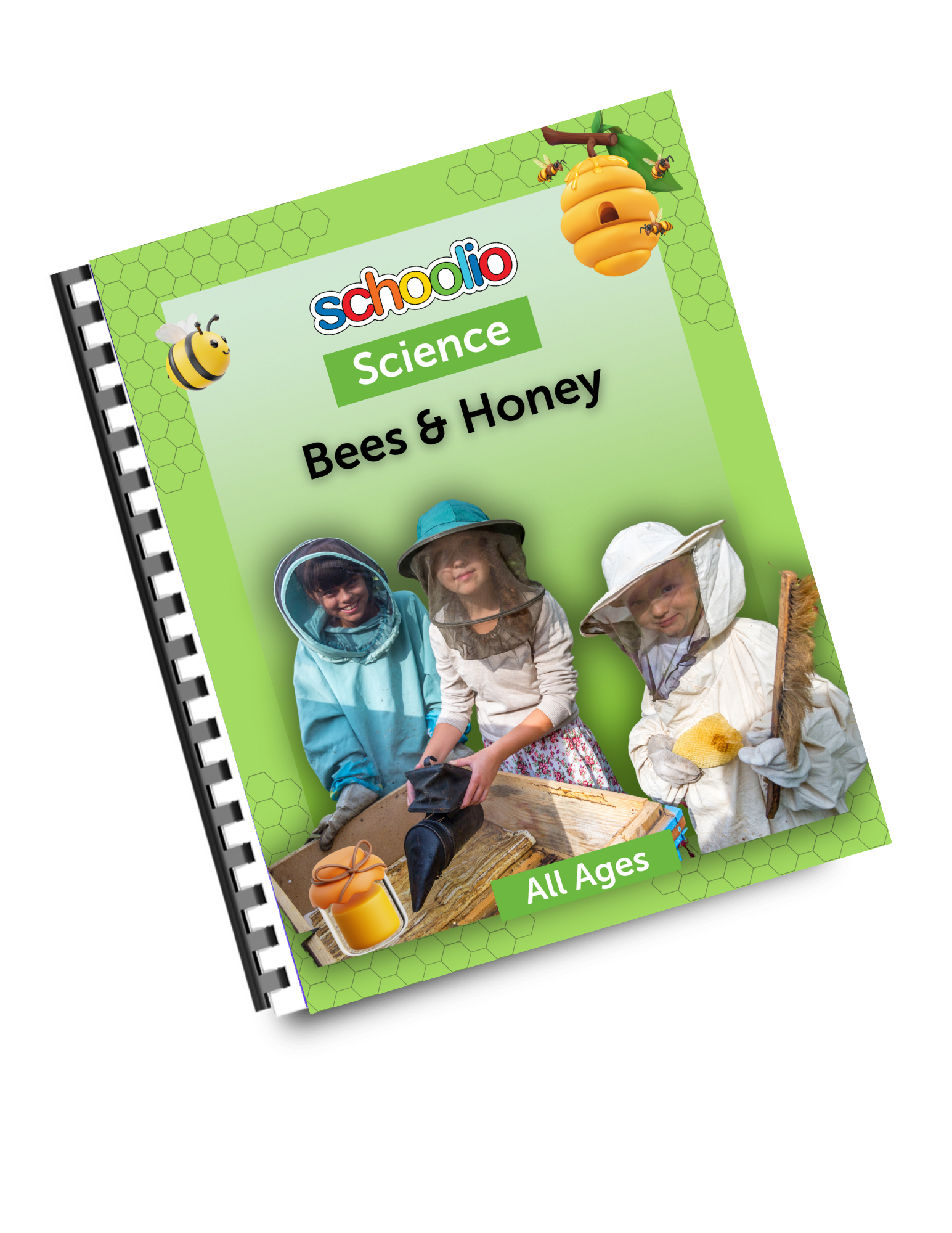
Bees and Honey

Associated Curricular Activity: My Honeybee Book (Complete: Autumn and Winter Season)

Additional Activity: Learn how to make candles using beeswax sheets. For tips visit: How To Make Beeswax Candles – Shaye Elliott

Daily Outing

Field Trip Idea: Visit an urban beekeeping initiative or rooftop apiary in a city setting. You can learn about urban beekeeping practices, see beehives in urban environments, and discuss urban pollinator conservation.

Friday ?

Morning Session

Lesson 19: Butterfly Migration

Schoolio Curriculum: All About Butterflies pg. 34-37 All About Butterflies

Associated Curricular Activity: Butterfly Facts 

Additional Activity: Write pollinator poems inspired by bees and butterflies, focusing on their beauty, importance, and conservation. For different types of poems visit: Poetry Templates for Elementary Students – Erin Waters EDU 

Afternoon Session

Lesson 20: Bees and Society

Schoolio Curriculum: Bees & Honey pg. 43-45

Associated Curricular Activity: Save the Bees Presentation

Additional Activity: Design and decorate posters with facts about bees, butterflies, and other pollinators. Include tips for creating pollinator-friendly gardens and reducing pesticide use to promote conservation efforts.

Daily Outing

Field Trip Idea: Go on a virtual tour of a butterfly conservatory or bee hive 

Butterfly Conservatory: Virtual Tour – Cambridge Butterfly Conservatory 

Bee Hive: Virtual 360 Honey Bee Hive | Ask A Biologist 

Embark on a Summer Adventure!

Does your child love exploring nature or have a curiosity about the world around them? Our Insect Investigations camp offers an exciting summer filled with discovery and learning. Together, we’ll spark a passion for caring for the environment and inspire the next generation of conservation champions.

Don’t miss out on the chance to explore the wonders of nature with Schoolio’s Summer Series. Enroll now and watch your child grow into a confident explorer and advocate for our valuable pollinators.

Share the Excitement!

We’d love to see your kids in action during our Schoolio Summer Series! Share photos of your little explorers by emailing them to us or using the hashtag #SchoolioSummer on social media.

Let’s make this a summer to remember, full of wonder, learning, and a dedication to protecting our planet’s biodiversity. See you at the Schoolio Summer Series: Insect Investigations!

Join us in nurturing curiosity and fostering a love for nature!
Summer Means Creativity

Schoolio Guest Blog by Meredith Blunt.

Do you feel like this too? As if we all hold our collective breath from the end of May until the summer solstice then everyone exhales and hollers (or maybe whispers with glee) ‘SUMMER!!!!’ Summer means permission to sleep in, to somehow end every gardening session in a water fight. It means watching movies too late and looking for the wonderful signs of nature in the bright blossoms everywhere. We know we’re about to get time with our favourite people, time with ourselves. And, oh my, time with our kids.

Before I share some of my ideas for summer fun with you, maybe an introduction is in order!

I’m Meredith, a relatively new homeschooler and a Schoolio fan since mid- 2020. I’d been researching if homeschooling was a fit for us along with following homeschooling blogs and social media accounts for years. The pandemic was the final push to take the leap. It is our biggest and best silver lining of the last 18 months!


We live in a smaller but awesome city in Ontario. My kids and I have wrapped up grade 7 and grade 4. This year has been transformative for all of us, they are becoming the students we always knew they could be and I’ve found confidence in a place I never would have guessed.


Homeschooling has put me on a passion path. I love communicating, learning and sharing ideas about education, child honouring, art, dogs…gosh, I’m a sucker for the pups. I love it when parents help each other out with great ideas about how to entertain and grow our young humans. There are a few blog posts that could spawn from this paragraph! But for now, back to summer!

Summer means creativity.

Finding ways to spend time together, fostering those great curiosities kids express and restoring your own energy. Perennial favourite activities for us are swimming, biking and camping – even if it’s just in the backyard.


Among our newer favourites is a good nature hike. We love discovering a trail or conservation area we haven’t been to before. We can spend hours beside a creek or in a forest. Apps like AllTrails help us find places to go and take on a hike appropriate for our skill level. We’re fairly new to it but I’ve got to mention it, geocaching is like a big treasure hunt and we’ve had really good times doing it! Both kids love tracking the caches down and there’s a neat thrill of connection and contribution when you add a little to a cache. We use the Cachly app.

Second, and for us a lovely little bike ride away, is the library! Our library worked hard to adapt to the restrictions of the pandemic, and we’ve made great use of the programs they offer! The programs we’ve accessed have ranged from art classes, science weeks with kits you pick up from the library to build the experiments, reading challenges, coding clubs, trivia nights and that is just to name a few. Typically offered for free, and run by wonderful engaged community members, they are great opportunities to explore an interest and connect with like-minded folks in your neighbourhood. The library was a great support and resource for our school year and continues to be a source of fun in the summer.

Thirdly, boredom. Yep. I know, in this day and age bored tends to go hand in hand with screens, YouTube and Minecraft. You may feel a little worn down by the tech battles, I know I do! It is a good place to take a firm stance though. Not an altogether ban on screens, but just enough so that their brains move into a different gear. Again…this is a whole other blog topic but let’s get back to boredom! Read “I’m Bored” – Let Your Kids Be Bored This Summer


My 10-year-old will take a big walk with me (I don’t make him; he will just join me sometimes – I walk when I’m bored) and talk about everything on his mind. He still loves reading together too, which our backyard hammock is perfect for! We’re reading Mrs. Frisby and the Rats of NIMH. My nearly 13-year-old will shoot hoops with her friends or take a walk to the neighbourhood corner store and get a slushie. She’ll practice her ukulele or create tiny clay models of mushrooms and bird nests. She’ll also nap! So jealous.


Fostering independence, supporting their comforts and creative exploring is so important for those kiddos and you! Let them show you who they are interested in growing up to be. It’s good for you to be bored too. This is where your brain, which has been going a mile a minute since you’ve embraced the responsibility of homeschooling, gets a rest and some restorative time.

Summer, in line with the other seasons, is about doing what works for your family. Spending time in ways that fulfill needs, and raises the happiness quotient. Slap on the sunscreen, remember to stay hydrated, and let us know how your summer is going. Share with us what you and your kids love to do during the summer months!

Schoolio Guest Blog

“I’m Bored” – Let Your Kids Be Bored This Summer

When the “I’m bored” complaints start to roll in.

Summer break has started and with it comes a flurry of excitement and potential plans. Beaches, swimming pools, playgrounds, and water fights, may just be some of the exciting activities calling your kids names.

My kids always get so  thrilled for summer and the potential it holds. They can’t wait for less structure, and more opportunity to just play. That said, it always appears that a couple weeks – or sometimes even days – into summer break my kids start with the “I’m bored” complaints. And with that the boredom train is in full motion.

Actually, as I’m writing this my son just walked up to me and said, “I’m bored!” What’s a parent to do? Hand them a tablet? Have a list of fun activities to do? Drop everything and take them somewhere incredibly entertaining? Chances are, after another year of homeschool/virtual learning, the last thing you want to do is have an epic schedule packed with activities. But you also don’t want to let them sit in front of a screen all day. So, what do you do?

Should you have a schedule for each day?

What’s your go-to going to be? Have a beautifully curated schedule for every single day? Filled with extraordinary activities, crafts, snacks and fun? Or, are you going to just let your child be completely bored all summer? Maybe a happy medium between the two? What’s your plan for the ‘I’m bored’ days?

First of all, let’s just address the elephant in the room. When our children complain it makes us uncomfortable. I mean, it’s supposed to, right? From when your child was born, you learned to help them. You fed them, changed them, cared for them, entertained them, whenever they needed it. So, naturally when your child begins to whine that they are just so bored, you want to solve this issue for them too. In those moments, it’s all too easy to just hand them the tablet to calm their cries of boredom and solve the temporary issue.

But you don’t need to do that!

Guess what? You don’t need to do that. See, obviously there are complaints that we need to take seriously from our children. But boredom? That’s not one of them. According to Dr. Vanessa Lapointe, boredom is actually really good for your child. She says: “Children need to sit in their own boredom for the world to become quite enough that they can hear themselves.” It makes us uncomfortable though, right?

I mean, as a mom I want my kids to be happy. I want to help them in every single way that I possibly can. So, when they complain I feel the need to fix it, even when it’s just boredom related.

However, constantly entertaining your children isn’t a source of help, but rather a source of harm. Before you freak out. Stop. I’m not saying there’s anything wrong with planning fun activities for your kids, that’s excellent! But, you just don’t need to do it all the time! Because that’s usually recipe for parental burn-out.  (Unless that’s truly your jam then go for it.)

Boredom isn’t bad.

“Children need time to themselves – to switch off from the bombardment of the outside world, to daydream, pursue their own thoughts and occupations, and discover personal interests and gifts. Letting the mind wander from time to time is important for everybody’s mental wellbeing and functioning.” Says Dr. Theresa Belton.

It’s true, in today’s world kids do have a much harder time with boredom than in generations before them. Why is that? Well, the answer is pretty obvious. Technology being one of the biggest killers of boredom. Following closely behind are extracurricular activities. We’ve essentially created a world where children have highly structured lives, with basically no time to just be.

What are the benefits of boredom for my child?

  1. Boredom inspires creativity and imagination. Research has found that people who are given a bunch of boring tasks to complete actually show more imagination when they’re then asked to take part in a creative thinking activity?
  1. Boredom teaches Resilience. Allowing your kids time to just be bored and have to ‘entertain’ or ‘amuse’ themselves is an excellent way to help your child develop resilience.
  1. Letting your kids be bored actually helps them develop problem-solving skills!
  1. Being bored can help your child learn how to build relationships.
  1. Boredom can improve mental health. Because being too busy (even as an adult) isn’t good.
  1. Boredom makes childhood happier. What? Really? Yes! Think about. When you remember back to your own childhood years, Aren’t some of your best memories the simple ones? The ones where you were creative from boredom? Chances are that’s a yes.

Many of the activities that we think would make our kid’s childhoods magical, aren’t. Because simplicity is the way to go, always!

What can you do this summer with the ‘I’m bored’ cries? Start with this.

  1. Set aside one day a week for an activity detox. That means no structured activities.
  1. Task them with creativity. (Check out ‘The Ultimate I’m bored items list’ to have around the house. Listed below).
  1. Limit the teach toys.
  1. Send them outdoors (and go out with them). If you don’t live in a location where your child can venture outside alone. Then take them to a park, let them run wild. Try not to jump in, instead just sit and watch them. If you have a backyard, let them have fun back there while you enjoy a cup of tea inside, or on the patio.
  1. Be a good role model. Our kids mirror what we do. So, if you find yourself grabbing for your phone every chance you get. That’s going to be what they want to do. Try to avoid that. Instead let them see you reading, writing, drawing, and creating. When they see you being creative, it encourages them to do the same.

Try this ‘I’m Bored Checklist’, next time your kids want screen time. Once they start going through the listed items, they might just find their own source of entertainment through the beauty of being creative and using their imagination


Get The ‘I’m Bored Checklist’

Check out The Ultimate I’m Bored Items List! And, try to keep a steady supply of these items.

I'm Bored items List

For some fun lessons to help keep your kids entertained this summer. Check out the Schoolio Special Interest Units 

Here are a few excellent resources about how boredom can be good for your kids!