As homeschooling parents, we constantly seek unique and engaging ways to bring education to life. The upcoming solar eclipse offers a perfect opportunity to explore a range of subjects, from the science behind celestial events to their cultural significance around the world. Here are ten enriching and fun ways to learn about the solar eclipse with your kids.
1. Dive into the Science
Begin with the basics: what is a solar eclipse? This natural phenomenon occurs when the moon passes between the Earth and the sun, temporarily obscuring the sun from our view. Discuss the different types of solar eclipses – total, partial, and annular – and investigate the celestial mechanics in play. Simple models using a lamp (sun), a basketball (Earth), and a smaller ball (moon) can demonstrate the alignment needed for an eclipse.
2. Explore Historical and Cultural Perspectives
Solar eclipses have fascinated humanity for millennia, often interpreted as omens or significant spiritual events. Delve into stories from various cultures, such as the ancient Greeks, who believed eclipses were signs of angry gods, or the Vikings, who thought eclipses occurred when a wolf was attempting to eat the sun. This exploration offers a rich, interdisciplinary learning experience, merging astronomy with history and mythology.
3. Prioritize Safety
Emphasize the importance of never looking directly at the sun without proper protection, even during an eclipse. Discuss the science of why eclipse viewing can be dangerous and how to use eclipse glasses. Alternatively, demonstrate how to make a pinhole projector out of simple household items for safe viewing.
4. Get Creative with Art
Encourage your kids to express what they’ve learned or feel about the eclipse through art. They can draw or paint the eclipse as they imagine it, create a comic strip about the event, or even build a model. Artistic expression not only solidifies their learning but also allows them to connect emotionally with the event.
5. Write Inspired by the Eclipse
Invite your children to write poems, stories, or essays inspired by the eclipse. They could pen a narrative from the perspective of someone experiencing an ancient eclipse or compose a poem that captures the eerie beauty of the event. This activity enhances writing skills while deepening their engagement with the topic.
6. Conduct Hands-on Science Experiments
There are numerous experiments to illustrate concepts related to eclipses. For example, explore the properties of light and shadow by using objects of different shapes and sizes to cast shadows, simulating how the moon blocks sunlight during an eclipse. You can also experiment with lenses and mirrors to demonstrate how light can be bent and reflected, simulating the corona visible during a total solar eclipse.
7. Uncover the Mathematics
The predictability of eclipses is a mathematical marvel. Introduce older children to the basic principles of how astronomers use the Saros cycle to predict eclipses. For younger kids, simple activities involving counting, measuring time, or using geometric shapes to model an eclipse can make the Math tangible and engaging.
8. Share Eclipse Myths and Legends
Storytelling can be a powerful tool for learning. Share myths from different cultures that explain solar eclipses, such as the Vietnamese myth of a frog eating the sun. After exploring various stories, encourage your kids to create their own myth explaining an eclipse, blending creativity with cultural exploration.
9. Plan Your Eclipse Day
Make the day of the eclipse an educational event. Start with a themed breakfast, followed by a review of safety viewing practices. Then, watch the eclipse using your chosen safe viewing methods. After the eclipse, engage in reflection activities, discussing what you observed and felt. This approach turns the eclipse into an immersive educational experience.
10. Download the FREE Schoolio Mini Unit
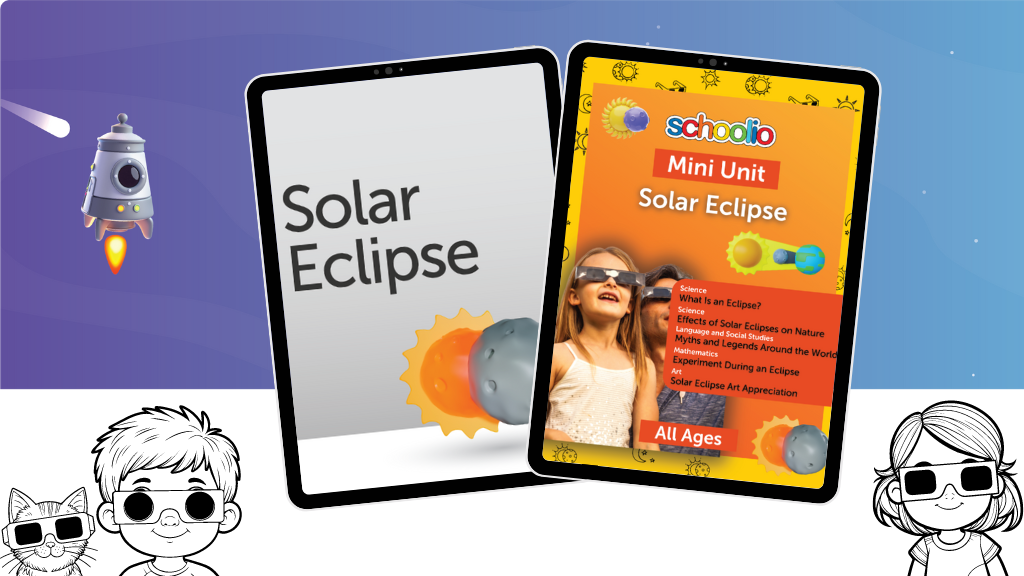
To ensure you have a well-rounded educational journey leading up to the eclipse, download the FREE Schoolio Mini Unit all about the Solar Eclipse. This resource is packed with ready-to-go lessons that cover the science, history, and cultural significance of solar eclipses. It’s an excellent way for your kids to get excited and informed about the event, providing structured learning alongside the activities suggested above.
Conclusion
Learning about the solar eclipse can be an enriching experience for both you and your children. By combining science, history, art, and storytelling, you can create a multidisciplinary curriculum that captivates their imagination and fuels their curiosity. Use this celestial event as a springboard for discovery, and don’t forget to download the Schoolio Mini Unit for a comprehensive guide to teaching about the eclipse. Happy learning, and clear skies for your eclipse day!