
What Actually Helps PDA Kids Learn (And What Makes It Worse)

What Actually Helps PDA Kids Learn (And What Makes It Worse)


If you’re parenting a PDA kid, you already know this:

The more you push, the harder they push back.

And if you’re new to homeschooling a PDA or ADHD child, you might be thinking:

“If I just get the schedule right…”

“If I just stay consistent…”

“If I just hold firm…”

It should get easier.

But sometimes it doesn’t.

Sometimes it gets worse.

Because what looks like defiance is usually nervous system overwhelm.

And rigid structure — the kind we were taught is “good teaching” — can actually backfire.

Let me tell you what I’ve learned the hard way.


What Makes It Worse

Rigid scheduling.

“You do math at 9:00. Reading at 9:30. Writing at 10:00.”

For a PDA brain, that can feel like a trap.

Not a routine — a demand.

And when the nervous system perceives demand, it goes into threat mode.

Cue resistance.

Shutdown.

Negotiation.

Meltdowns.

It’s not laziness.

It’s not manipulation.

It’s autonomy panic.

The more tightly you grip, the more their brain fights for control.


What Actually Helps

Choice.

Not chaos. Not zero expectations.

Choice inside structure.

There’s a big difference.

Instead of:

“You have to do math right now.”

Try:

“Here are the three things that need to get done today. What would you like to do first?”

That one shift changes everything.

A to-do list feels very different from a command.

A list says:

“These things exist.”

A command says:

“You must.”

And for PDA kids, that distinction matters.


Why Order and Timing Matter Less Than Agency

One of the biggest mindset shifts for me was realizing this:

It doesn’t matter if math happens at 9am or 2pm.

It matters that it happens without a power struggle.

If unlocking lessons at midnight gives your child the ability to wake up and decide their own order? That’s not “spoiling” them.

That’s restoring autonomy.

If Open Exploration-style days — where they can choose what to work on — reduce anxiety and increase engagement? That’s not lowering standards.

That’s designing learning around a nervous system instead of against it.

And when you remove the demand, something surprising happens.

They often choose to do the work.

Not because they were forced.

Because they felt safe.


But Isn’t That Too Much Freedom?

This is the fear I hear all the time.

“If I give options, won’t they just avoid math forever?”

Maybe for a day.

Maybe even for a week.

But when learning isn’t wrapped in threat, resistance fades.

And when math is a concept-based lesson — not a 40-minute ordeal — it becomes approachable.

You can slow it down.

Break it apart.

Turn one writing lesson into four days.

Make one math concept last a week with hands-on work.

Completion matters more than speed.

Engagement matters more than compliance.


The Real Goal

The goal isn’t obedience.

It’s ownership.

When a child feels like learning is being done to them, resistance sets in.

When they feel like they are building something themselves, everything changes.

PDA kids especially need to feel like they are choosing — even inside non-negotiables.

We’re not removing expectations.

We’re removing the battle.

And that shift?

It changes the whole house.


If you’re in the thick of it right now, please hear this:

You’re not doing it wrong.

You’re parenting a brain that needs autonomy like oxygen.

Design around that.

And watch what happens.

? Lindsey

certified special-ed educator, homeschool mom, & co-founder of Schoolio
Why “Focus” Doesn’t Always Look Like Sitting Still

Why “Focus” Doesn’t Always Look Like Sitting Still


There was a season in our homeschool when math facts were… let’s just say painful.

Every time I pulled out the worksheets, I’d get groans. Wiggling in the chairs. The inevitable: “Do we have to do this?”

One day, instead of pushing through another tense math session at the table, I tried something different. We went outside. Onto the trampoline.

The kids bounced while I called out math facts. “What’s 7×6?” Bounce. Bounce. “42!” “What’s 9×8?” Bounce. Bounce. “72!”

Suddenly, the resistance melted away. They were laughing, shouting out answers between jumps, and begging for the next question. The energy that had been working against us at the table was now working for us.

And it hit me:

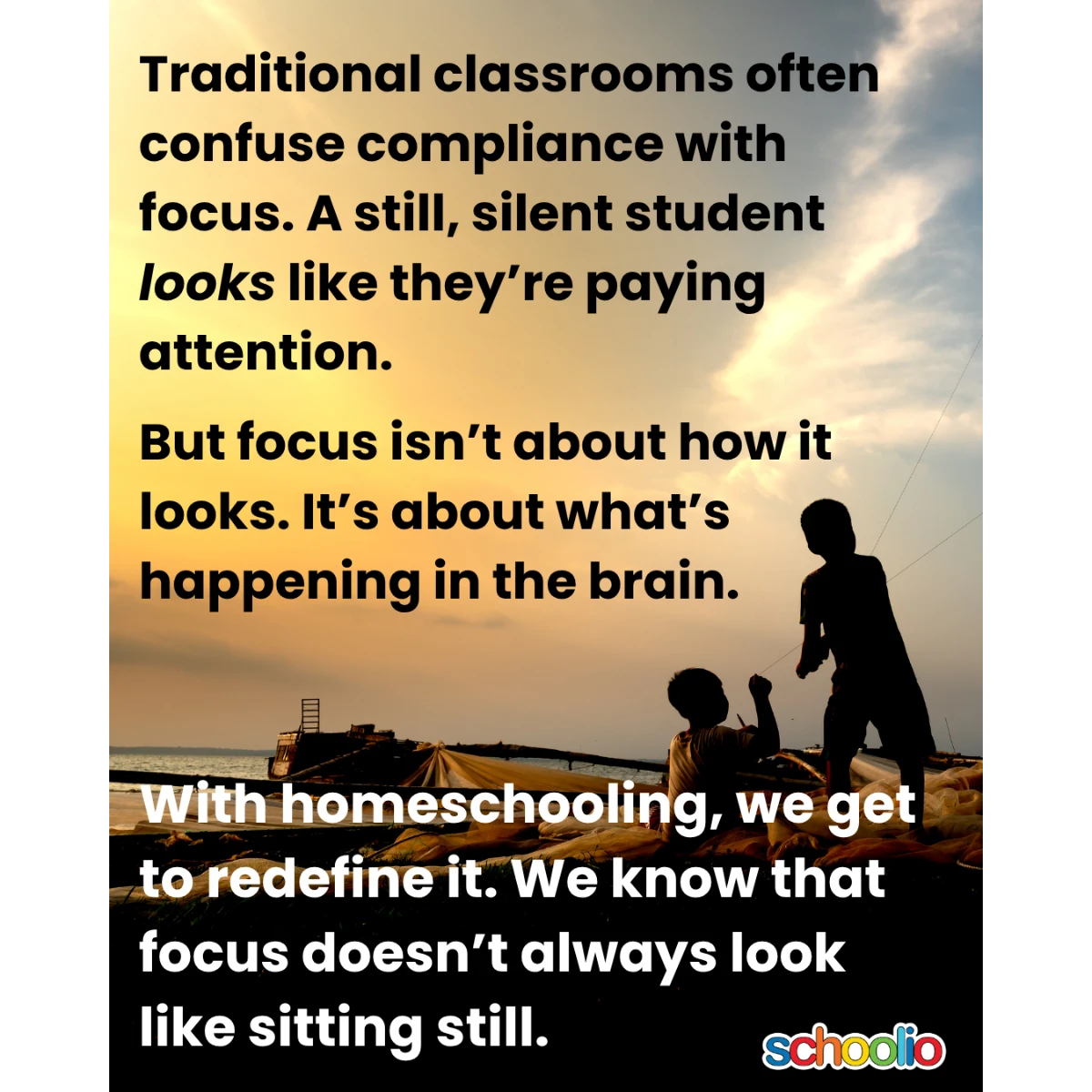
Focus doesn’t always look like sitting still.

For neurodivergent kids especially, learning can happen best in motion. While doodling. While bouncing. While tapping a pencil. While upside down on the couch. The movement isn’t a distraction — it’s the doorway to attention.

Traditional classrooms often confuse compliance with focus. A still, silent student looks like they’re paying attention. But how many times are they zoning out, daydreaming, or working hard just to appear calm?

At home, we get to redefine it.

✔ Focus can look like doodles in the margin while listening.

✔ Focus can look like bouncing on a trampoline while memorizing math facts.

✔ Focus can look like humming quietly while reading.


The truth is, focus isn’t about how it looks. It’s about what’s happening in the brain.

So if your child can’t sit still — maybe don’t fight it. Maybe lean into it. Movement can be the bridge between frustration and fun, resistance and retention.

Because focus doesn’t always look like stillness. Sometimes it looks like joy.


? Lindsey

Certified Special-Ed Educator & Co-Founder, Schoolio

When Homeschooling Isn’t Working: Signs, Changes, and Support

When Homeschooling Isn’t Working: Signs, Changes, and Support

When homeschooling isn't working

Home education has become a popular choice for many families, offering a personalized approach to learning for children. However, like any educational method, homeschooling comes with its own set of challenges. As a homeschooling parent myself, I understand firsthand that sometimes things don’t go as planned. Whether your child is facing academic struggles, social difficulties, or if you’re feeling overwhelmed. It’s crucial to recognize when homeschooling isn’t working and take appropriate steps.

When homeschooling isn’t working: Identify the Indicators

Recognizing when homeschooling isn’t effective can vary for each family. However, some common signs include:

1. Limited academic progress

If your child is facing academic challenges and not progressing, it may indicate the need for a different learning approach.

2. Resistance to learning

A lack of enthusiasm for learning could be a signal that your child needs a change in the material or teaching method.

Schoolio Family Plan

3. Social struggles

Isolation is a concern for some homeschooled children, making it important to ensure opportunities for social interaction with peers.

4. Difficulty with the curriculum

If you find it challenging to keep up with the curriculum, it may be time to reassess your homeschooling approach.

5. Burnout or feeling overwhelmed

Feeling burnt out or overwhelmed may indicate that homeschooling is not working for you or your child, highlighting the need for a shift.

Embrace Change Without Fear

If you observe these signs, don’t hesitate to make a change. Homeschooling is flexible, and adjustments are part of the process. Consider:

1. Enrolling your child in traditional school

Transitioning to public or private school can provide more social opportunities and exposure to diverse learning styles.

2. Exploring different homeschooling approaches or curriculums

Trying out various homeschooling methods or curriculums allows you to find the one that suits your child best through trial and error.

3. Seeking support through a tutor or homeschooling co-op

Hiring a tutor or joining a homeschooling co-op can provide academic support and opportunities for socialization and group learning.

Schoolio e-books

4. Taking a break from homeschooling

If burnout is a concern, taking a break from homeschooling can provide the time needed to recharge and gain a fresh perspective.

Remember, what works for one family may not work for another; prioritize what’s best for your child and family.

Connect for Support

Homeschooling can be isolating, but seeking support from other homeschooling parents or online communities can provide valuable advice and encouragement. If academic challenges persist, consider consulting a professional tutor or educational therapist for targeted support and resources.

Persevere

Despite its challenges, homeschooling can be a fulfilling journey. If you ever feel discouraged, remember why you chose homeschooling. Take a break, regroup, and return with a renewed perspective. Homeschooling is a unique journey, and it’s about finding what works best for your child and your family. Remember, homeschooling has its complexities, and it’s acceptable to acknowledge when it isn’t working. Embrace change, seek support, and recall your initial reasons for choosing homeschooling. Armed with these insights, you’ll be better prepared to navigate the highs and lows of home education.

Schoolio Learning Resources