When “Bad Teacher” Comedy Isn’t a Laughing Matter

When “Bad Teacher” Comedy Isn’t a Laughing Matter


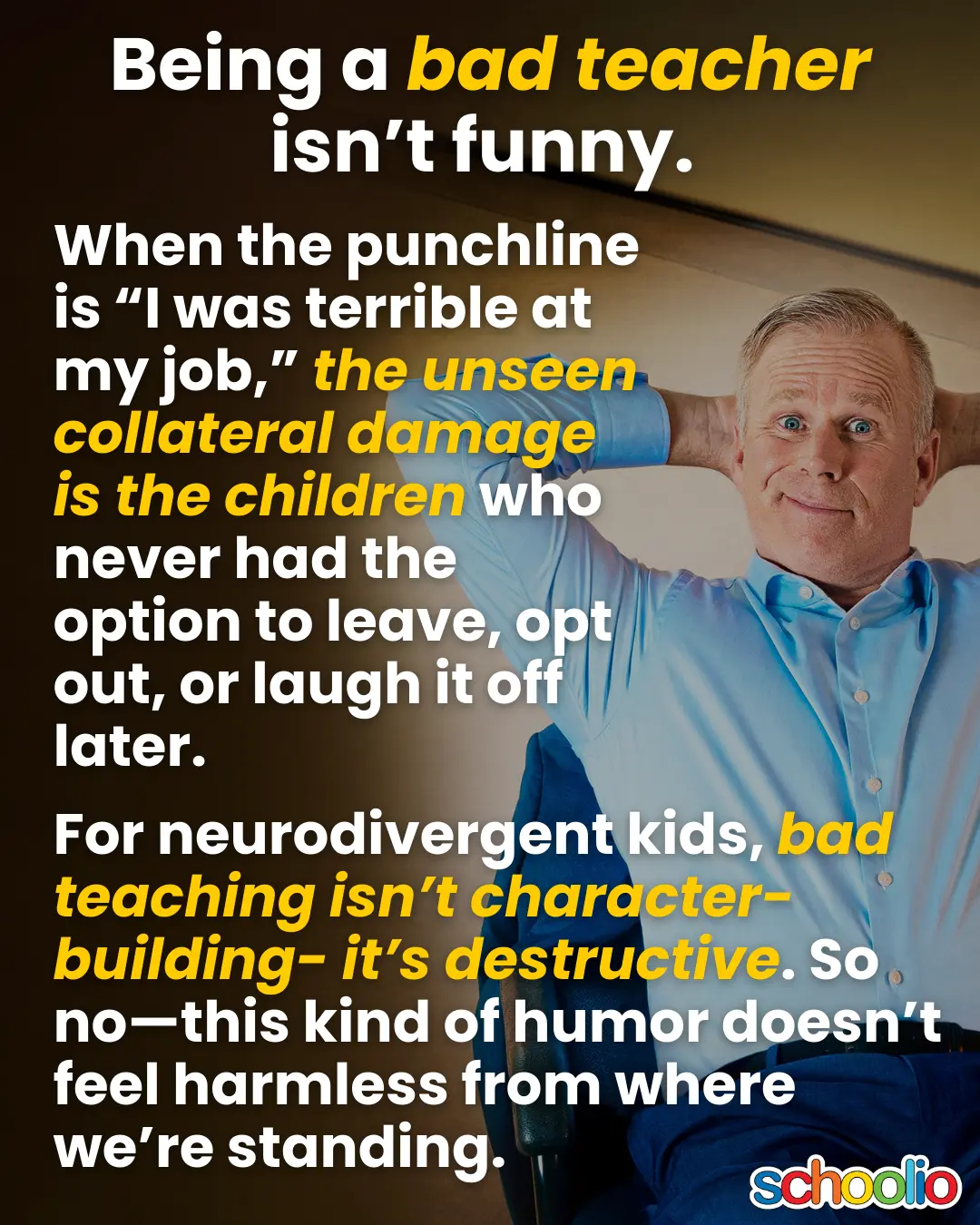
My social media feeds are full of education-related content. Lately, I’ve noticed an increase in comedians like Gerry Dee (Mr. D)—alongside a growing wave of TikTok and Instagram “former teacher” creators—who are building successful careers around the idea that being a bad teacher is funny, relatable, and ultimately harmless.

But today’s Mr. D video in my TikTok feed hit differently, as I had just finished sitting next to my daughter in the kitchen for over an hour while she painfully cried her way through an essay that an apathetic teacher assigned at the last minute as a “punishment” to the class for not paying enough attention to him- without any instruction around the skills needed for this essay. For my autistic and dyslexic child, who takes every word literally and straight to heart, and has loads of anxiety around handing in her absolute best work, this pressure and lack of support sent her into meltdown mode.

There are several comedians who’ve built entire lanes around “I was bad at my old job / the system was a joke / authority doesn’t matter” humor. My issue isn’t with comedy about work in general. It’s with ex-teachers making light of how poorly they did their jobs—and how little they cared while doing them.

That kind of humor punches down.

It celebrates apathy.

And it shows a complete lack of concern for who was harmed in the making of that joke: the vulnerable children they were responsible for.

Yes, I understand why these jokes land.

Most of us have had that teacher.

The disorganized one.

The checked-out one.

The one who survived the school day purely on sarcasm and vibes.

We’re conditioned to laugh and say, “Yep. That’s just school.”

But here’s the part that never makes it into the punchline:

For some kids—and some families—that teacher isn’t a funny memory.

They’re the reason everything fell apart.


Why “Bad Teacher” Comedy Is a Unique Problem

This is the core issue these jokes orbit around, whether intentionally or not.

Teaching is one of the only professions where:

  • The audience (kids) can’t leave
  • The harm is delayed and largely invisible
  • The most vulnerable are affected first
  • And society shrugs and says, “That’s just school.”

For neurodivergent kids in particular:

  • There is no buffer
  • No “later we’ll laugh about this”
  • No neutral experience

A teacher who is unstructured, dismissive, or proudly unprepared isn’t quirky—they’re destabilizing.

A chaotic classroom isn’t funny when your nervous system relies on predictability to feel safe.

Sarcasm isn’t clever when language is processed literally.

“Figure it out” isn’t empowering when executive function is already a daily battle.

So when a comedian builds a career celebrating that archetype, it doesn’t land as satire.

It lands as dismissal.


“That’s Just School” Is Not a Neutral Statement

One of the most damaging parts of this genre of humor is how effectively it reinforces the idea that bad teaching is a harmless rite of passage.

We laugh.

We relate.

We normalize it.

And in doing so, we erase the kids who couldn’t survive that environment.

I work with—and parent alongside—families whose children didn’t just dislike school.

They burned out.

They shut down.

They developed anxiety so intense they couldn’t enter the building.

These families didn’t leave school because they were anti-education.

They left because continuing would have meant sacrificing their child’s mental health.

So when we laugh at jokes about incompetence in classrooms, we’re not just laughing at a system—we’re laughing past the kids who were harmed by it.


The Line Being Crossed

This is the distinction that matters:

Comedy about systems failing = fair

Comedy about authority over powerless kids = requires responsibility

This isn’t about being unable to take a joke.

And it’s not about policing comedy.

My frustration isn’t with humor.

It’s with who the joke protects.

When the punchline is “I was terrible at my job,” the unseen collateral damage is the children who never had the option to leave, opt out, or laugh it off later.


Why This Hits Different for Our Community

For neurodivergent kids, bad teaching isn’t character-building.

It’s often the start of years of self-doubt, resistance to learning, and internalized shame.

So no—this kind of humor doesn’t feel harmless from where we’re standing.

It feels like another reminder of why so many of us chose a different path.

Why homeschooling wasn’t a lifestyle choice, but a lifeline.

Why “relatable” stories about bad teachers land very differently when you’ve seen the damage up close.

Good teaching matters.

Competent teaching matters.

Neurodivergent-aware teaching matters most of all.

And for families like ours, that truth isn’t funny at all.


Lindsey Casselman

Certified Special Ed Educator & Co-Founder, Schoolio

Why Your ADHD or Autistic Child “Practices” Conversations (and Why That’s Not a Bad Thing)

Why Your ADHD or Autistic Child “Practices” Conversations (and Why That’s Not a Bad Thing)


Have you ever noticed your child repeating the same sentence over and over before a phone call?

Or whispering what they’re going to say before walking into a room?

Or replaying conversations long after they’re over, worrying they said the “wrong” thing?

If so, you’re likely seeing scripting — a very common and very human coping strategy for autistic and ADHD kids.

And no, it’s not something you need to stop or “fix.”


What Is Scripting, Really?

Scripting is when someone mentally rehearses words, phrases, or entire conversations ahead of time. For neurodivergent kids, especially autistic and ADHD kids, it’s a way to prepare for social situations that feel unpredictable, overwhelming, or high-stakes.

Think of it like this:

Most people can improvise socially without much effort. For neurodivergent kids, social interactions often require conscious processing. Tone, timing, facial expressions, word choice — it’s a lot to manage all at once.

Scripting helps reduce that load.


Why Neurodivergent Kids Script

Scripting isn’t about being robotic or inauthentic. It’s about safety.

Many ADHD and autistic kids have experienced:

  • Being misunderstood
  • Saying the “wrong” thing and being corrected or teased
  • Feeling embarrassed or rejected after social interactions

Over time, their brains learn: Preparation feels safer than guessing.

Scripting gives them:

  • A sense of control
  • Predictability in an unpredictable world
  • Time to organize thoughts before speaking
  • A way to reduce anxiety before social demands

For some kids, scripting is the difference between engaging socially and avoiding it altogether.


What Scripting Feels Like for Kids

From the inside, scripting often feels like:

  • “If I practice, I won’t mess this up.”
  • “If I know what to say, I won’t get in trouble.”
  • “If I’m prepared, I’ll be less embarrassed.”

It’s not about manipulation or performance — it’s about self-protection.

And for kids who already struggle with emotional regulation, rejection sensitivity, or social anxiety, that protection matters.


When Scripting Is Helpful

Scripting can be incredibly supportive when it:

  • Reduces anxiety before social interactions
  • Helps kids advocate for themselves
  • Allows them to participate when they otherwise might shut down
  • Builds confidence through successful interactions

Many kids use scripting to:

  • Practice greetings
  • Prepare for phone calls
  • Navigate classroom discussions
  • Rehearse how to ask for help

In these cases, scripting is a tool, not a problem.


When Scripting Can Become Stressful

Like any coping strategy, scripting can become overwhelming if it turns rigid.

Some kids may struggle when:

  • Conversations don’t follow the “planned” path
  • Someone responds unexpectedly
  • They feel pressure to say things exactly right

When that happens, you might see:

  • Increased anxiety or shutdowns
  • Frustration when plans change
  • Avoidance of social situations altogether

This doesn’t mean scripting caused the problem — it means the need for safety is still very high.


How Parents Can Support Scripting (Without Making It Worse)

The goal isn’t to eliminate scripting — it’s to support it gently while building flexibility over time.

1. Normalize It

Let your child know scripting is okay.

“You’re practicing because you want it to go well. That makes sense.”

Shame increases anxiety. Normalization reduces it.


2. Practice Together

Role-play conversations in a low-pressure way.

  • Practice asking questions
  • Practice different responses someone might give
  • Practice what to do if things don’t go as planned

This builds flexibility without removing safety.


3. Teach “Backup Plans,” Not Perfection

Instead of perfect scripts, help your child develop:

  • A few flexible phrases
  • Exit strategies (“I need a minute”)
  • Repair phrases (“Can I try saying that again?”)

These tools reduce panic when conversations shift.


4. Don’t Force Spontaneity

Pushing kids to “just go with the flow” often backfires. Spontaneity grows naturally when safety increases — not when pressure does.


5. Celebrate the Effort

Scripting takes mental energy. Acknowledge that.

“I know that took courage.”

“You worked really hard to prepare for that.”

Feeling seen matters.


The Big Picture

Scripting isn’t a sign that your child lacks social skills.

It’s a sign that they’re working very hard to connect.

When supported with empathy, scripting can:

  • Increase confidence
  • Reduce anxiety
  • Serve as a bridge toward more flexible communication

Your child isn’t broken for needing extra preparation. They’re adapting — and that’s something worth honoring.

Fear Says “Fit In.” Values Say “Stay Firm.”

Fear Says “Fit In.” Values Say “Stay Firm.”

This has been on my mind today…

Most of us were raised with fear dressed up as discipline.

Fear of standing out.

Fear of falling behind.

Fear of being different — or being too much of something.

When I was growing up, that fear had a thousand voices:

“Don’t talk back.”

“Respect your elders.”

“Just do what you’re told.”

“Don’t embarrass the family.”

South Asian homes are particularly good at this — teaching you to blend in so well that, one day, you wake up and realize you don’t even know what you stand for. You’ve become a collage of other people’s expectations. You chase safety instead of passion. Approval instead of purpose.

That’s why, now as a father, I keep coming back to one truth:

Fear says “fit in.”

Values say “stay firm.”

And if I want my kids to stay firm — to know who they are, to know when to walk away, to know what matters even when it’s unpopular — then I have to show them how.

Not lecture them.

Not shame them.

Not compare them to anyone else.

Just live it.

That means letting them speak, even if I disagree.

Letting them dress how they want, even if I don’t get it.

Letting them explore paths I didn’t choose — or couldn’t.

It also means apologizing when I parent from fear instead of from values.

Because I still catch myself doing it.

If you’ve chosen to homeschool, to opt out of the system, to rewire how learning happens in your house — then you already know this feeling. The discomfort of not fitting in. The awkward pauses in family conversations. The well-meaning but judgmental stares from old friends.

Let them come.

Let fear have its moment.

But then let your values speak louder.

You didn’t choose this path because it was easy. You chose it because it was right.

And if your kids learn anything from you, let it be this:

The world doesn’t need more people who know how to fit in.

It needs more people brave enough to stay firm.

Sathish

still learning, still unlearning

When Your Homeschool Program Stops Working

When Your Homeschool Program Stops Working


Lately, I’ve been hearing the same story from homeschool parents:

“We’ve used this program for years, but after the latest update it just isn’t working for us anymore. The kids hate it. I feel stuck. What else is out there?”

If that’s you, you’re not alone.

Sometimes a program that served you well in one season stops fitting in the next. Maybe your kids have grown and their needs have changed. Maybe what felt simple and reliable at first now feels limiting. Maybe the content just doesn’t line up with the kind of education you want your child to have.

That doesn’t mean you’ve failed. It just means your homeschool is evolving — and your tools need to evolve with it.

That’s why more and more families are switching to Schoolio.

Not because we’re “perfect” (no program is), but because Schoolio was designed to support the things that matter most in a modern homeschool:

Flexibility: Mix and match grade levels across subjects, skip ahead in one area and slow down in another, and create a program that fits your child instead of forcing your child to fit the program.

Future-Readiness: We go beyond the basics of math, science, and reading. Schoolio includes courses like Financial Literacy, Emotional Intelligence, and Emerging Technology — so kids don’t just learn to pass tests, they learn to thrive in the real world.

Neurodivergent-Friendly Design: Short, bite-sized lessons. Minimized distractions. Hands-on and interest-based options. Schoolio was created by homeschooling parents who know what it’s like to teach ADHD, autistic, and otherwise unique learners — because we’ve lived it.

At the end of the day, switching programs can feel like a big leap. But sometimes, it’s exactly the reset your homeschool needs.

If your current program no longer feels like a fit, that’s not the end of the story — it’s the start of building a homeschool that works better for you today.


? Lindsey

Why “Focus” Doesn’t Always Look Like Sitting Still

Why “Focus” Doesn’t Always Look Like Sitting Still


There was a season in our homeschool when math facts were… let’s just say painful.

Every time I pulled out the worksheets, I’d get groans. Wiggling in the chairs. The inevitable: “Do we have to do this?”

One day, instead of pushing through another tense math session at the table, I tried something different. We went outside. Onto the trampoline.

The kids bounced while I called out math facts. “What’s 7×6?” Bounce. Bounce. “42!” “What’s 9×8?” Bounce. Bounce. “72!”

Suddenly, the resistance melted away. They were laughing, shouting out answers between jumps, and begging for the next question. The energy that had been working against us at the table was now working for us.

And it hit me:

Focus doesn’t always look like sitting still.

For neurodivergent kids especially, learning can happen best in motion. While doodling. While bouncing. While tapping a pencil. While upside down on the couch. The movement isn’t a distraction — it’s the doorway to attention.

Traditional classrooms often confuse compliance with focus. A still, silent student looks like they’re paying attention. But how many times are they zoning out, daydreaming, or working hard just to appear calm?

At home, we get to redefine it.

✔ Focus can look like doodles in the margin while listening.

✔ Focus can look like bouncing on a trampoline while memorizing math facts.

✔ Focus can look like humming quietly while reading.


The truth is, focus isn’t about how it looks. It’s about what’s happening in the brain.

So if your child can’t sit still — maybe don’t fight it. Maybe lean into it. Movement can be the bridge between frustration and fun, resistance and retention.

Because focus doesn’t always look like stillness. Sometimes it looks like joy.


? Lindsey

Certified Special-Ed Educator & Co-Founder, Schoolio

Stop Trying to Fix What Was Never Broken: Rethinking Autism and Blame

Stop Trying to Fix What Was Never Broken: Rethinking Autism and Blame


This has been on my mind today…

The latest debates around Tylenol and autism feel like déjà vu. Another attempt to eliminate something we don’t fully understand. This time, the theory is that avoiding acetaminophen during pregnancy could somehow prevent a child from being autistic. And while the internet grabs onto that narrative like it’s gospel, I can’t help but think of the damage it’s doing — not just to scientific truth, but to every child being born into a world where their neurodivergence is seen as a defect.

Autism was discovered long before Tylenol hit pharmacy shelves. The spectrum existed before there were labels, diagnoses, or heated panels on morning talk shows. What’s new isn’t autism. What’s new is our panic around accepting it.

I grew up in Singapore, where the approach to childhood “issues” was very different — but carried the same dangerous root: blame. If you weren’t performing well in school, it wasn’t because you learned differently or were overwhelmed or needed support. You were lazy. Disrespectful. A problem.

My parents believed this. So did my teachers. My inability to focus or sit still or memorize math formulas wasn’t something to understand — it was something to beat out of me. Literally.

I was hit at home. Disciplined at school. Shamed in front of peers. I remember hearing the word potential thrown around like it was a threat — like I could have been something, if I just tried harder. The system, they said, was fine. I just didn’t fit it. That was my fault.

Now I’m older, a father, and an educator building a company that works with thousands of students — many of them neurodivergent. And I see the same root problem, just dressed differently.

Instead of beating kids into conformity, we now try to scare parents out of having children that are different in the first place. Avoid this. Don’t take that. Follow these rules and maybe, just maybe, your kid won’t be one of those.

But that’s not progress. That’s erasure.

Autism isn’t something to get rid of. It’s something to understand. Neurodivergent kids aren’t broken. They’re brilliant. But only if we stop trying to fix them.

We need to stop treating difference like a disease. We need to stop hiding behind policies and prevention myths and start asking better questions. Like: How do we build schools, communities, and systems that allow all kids — not just the compliant ones — to thrive?

At Schoolio, that’s our mission. Not just because it’s good pedagogy, but because it’s personal. I know what it feels like to be punished for the way your brain works. I also know what it feels like to unlearn all of that — to parent differently, build differently, lead differently.

So no, I don’t believe Tylenol is the problem. And I don’t believe discipline should be violent, whether physical or emotional. I believe in kids. I believe in learning environments that adapt to the child — not the other way around.

This isn’t about prevention. It’s about permission — to be different, to be seen, to be accepted.

Let’s stop blaming. And start building.


Sathish

still learning, still unlearning

What Dopamine Deficiency Looks Like in ADHD Kids

What Dopamine Deficiency Looks Like in ADHD Kids


Because ADHD brains don’t release or regulate dopamine effectively, kids often live in a state of chronic “dopamine hunger.” Just like being low on food makes you hungry, being low on dopamine makes the brain crave stimulation.

For ADHD kids, that deficiency can show up as:

  • Inattention: Struggling to stay engaged with boring or repetitive tasks.
  • Restlessness: Constantly moving, fidgeting, or seeking stimulation.
  • Mood swings: Irritability, frustration, or feeling flat when dopamine is low.
  • Low motivation: Finding it nearly impossible to start tasks without external stimulation.
  • Emotional sensitivity: Stronger reactions to rejection, failure, or disappointment.

For your child, it may feel like a constant itch they can’t scratch—an internal restlessness that only eases when something exciting, novel, or rewarding captures their attention.


Dopamine-Seeking Behavior: It’s Not Their Fault

When your child bounces from one activity to another, gets “hooked” on video games, or melts down when asked to do something boring, it’s easy to feel like they’re being defiant or careless. But here’s the truth: their brain is driving them to seek dopamine in the same way hunger drives you to eat.

This is why ADHD kids often:

  • Hyperfocus on video games or special interests.
  • Struggle to stop stimulating activities.
  • Seek out novelty and excitement.
  • Resist boring or repetitive tasks, no matter how important.

It’s not a lack of discipline—it’s survival. Their brain is looking for the fuel it needs.


How Dopamine Affects Learning and Behavior

Dopamine deficiency in ADHD can impact every part of your child’s life:

  • Attention: Without dopamine, focusing feels nearly impossible.
  • Behavior: Kids may act impulsively, even dangerously sometimes, always chasing the next burst of stimulation. Dopamine-seeking risky behaviors can be especially problematic for teenagers.
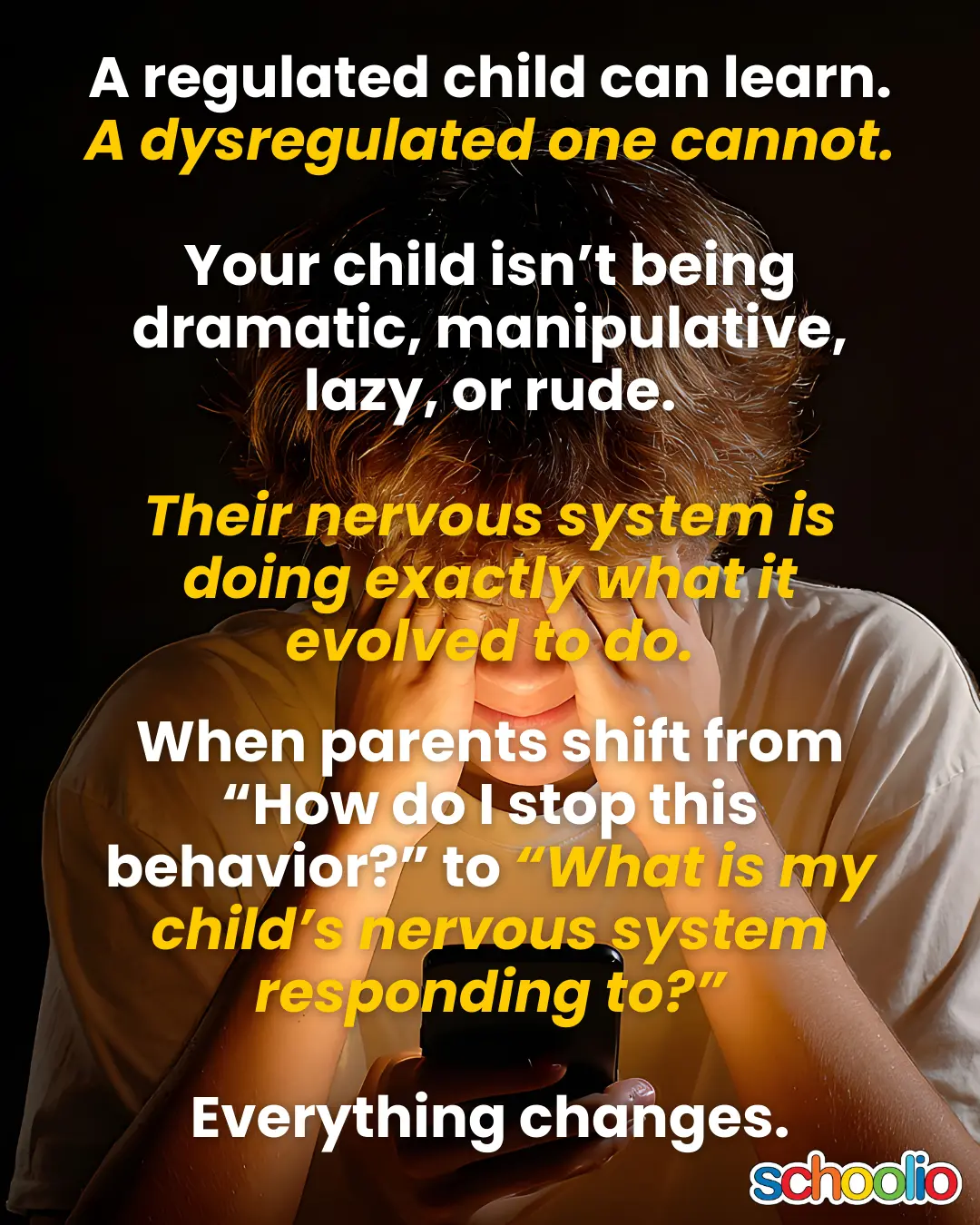
  • Learning: Learning is always harder when your body is lacking a needed brain chemical, just like with anxiety, depression, or trauma. A dysregulated brain cannot learn, so focus on mental and emotional stability first.
  • Emotions: Dopamine imbalance can make moods more volatile and rejection harder to handle.

When we frame these struggles as brain chemistry—not willpower—it changes everything.


Strategies for Supporting Your Child’s Dopamine Needs

The good news: there are ways to help regulate your child’s dopamine levels and create a homeschooling environment that works with their brain instead of against it.

1. Build in Small Rewards

Break tasks into smaller steps, and celebrate progress often. Rewards don’t have to be big—a sticker, praise, or a short break can be enough to trigger dopamine.

2. Backward Rewarding

“Backward rewarding” is a practice that works well for ADHD kids because it gives them the dopamine they require upfront. We typically reward for work well done- at the end of the task- but without dopamine, no amount of desire, will-power, or motivation will make your child capable of performing the task. For example, 30 minutes of video games before you start school, along with a 30 minute reward at the end, might have math going much more smoothly then with the end-reward only. (Make sure you make the time limit clear before they start, and set timers to remind of the end coming multiple times to make the transition happen.)

3. Use Movement

Physical activity boosts dopamine. Try starting the school day with a walk, dance break, or jumping jacks. Build movement into lessons whenever you can.

4. Lean Into Interests

Remember, interest = dopamine. Whenever possible, tie schoolwork to your child’s passions. If they love animals, use animal examples in math problems or writing prompts. Don’t be afraid to go “off-book” when pulling their interests into your learning. Remember when I turned our geography into dragons? That’s what we’re going for!

5. Add Novelty

Switch up routines occasionally—study in a new spot, use a different color pen, or bring in hands-on projects. Small changes can spark big dopamine boosts.

6. Prioritize Sleep and Nutrition

Dopamine regulation depends on healthy sleep cycles and steady nutrition. Work toward consistent bedtimes and balanced meals with protein to support brain chemistry.

7. Use Tech Wisely

Screen time provides big dopamine hits, which is why it can be so hard for ADHD kids to stop. Instead of banning screens completely, use them strategically—incorporate educational apps, set clear boundaries, and use them as short, structured rewards. Always give multiple warnings for transitions off screens


A Homeschooling Lens

Homeschooling gives you the freedom to design a learning environment that supports your child’s dopamine needs instead of punishing them for them. That means:

  • Flexible schedules to account for energy highs and lows.
  • Interest-driven projects that keep motivation high.
  • Frequent breaks for movement and stimulation.
  • Celebrating effort, not just outcomes, to give consistent dopamine boosts.

Your child doesn’t need to be “fixed.” They need understanding. When you see their restlessness, hyperfocus, or boredom through the lens of dopamine deficiency, it stops looking like defiance and starts looking like what it truly is: a brain craving balance.

With patience, creativity, and neurodiversity-affirming strategies, you can help your child feel less hungry for dopamine—and more successful in learning and in life.

Something is breaking—and the cracks are no longer subtle.

Something is breaking—and the cracks are no longer subtle.

Something is breaking—and the cracks are no longer subtle. This week, Ontario’s Education Minister Paul Calandra said the quiet part out loud: “We have to change the way school boards behave.” In his remarks to the legislature, he called out dysfunction, political distractions, and a lack of unified leadership across the province. The full article is worth reading here.

When politicians start publicly questioning the structure of an entire education system, it’s not a small thing. It signals something deeper—a disconnection between families and the institutions meant to serve them. Between what students need, and what schools are able—or willing—to provide.

At Schoolio, we’ve heard this unraveling for years. Quietly at first. A parent unsure if their neurodivergent child will ever be supported. A teacher burned out from fighting for basic classroom resources. A school board spending more on internal legal battles than on inclusive programming. And now, those whispers have grown into something louder. More urgent.

The traditional school model is struggling under the weight of complexity it can no longer carry. Bureaucracy, politics, budget cuts, and reactive policies are not a foundation for innovation or well-being. When boards debate flags and book bans while special education runs deficits, it’s not just the system that’s broken—it’s the trust.

This isn’t about abandoning schools—it’s about acknowledging that they no longer serve every child equally. It’s about making space for alternatives that are working right now, for real families, in real time.

Homeschooling, once dismissed as fringe, is now a lifeline. Microschools are quietly multiplying. Parents are reclaiming agency not out of rebellion, but out of necessity. And at Schoolio, we’ve built a platform to meet them there. A hybrid curriculum that blends structure with flexibility. A place where emotional safety, real-world skills, and learning readiness are just as important as test scores.

The question isn’t whether the old model can be fixed. The question is: will we keep asking families to wait?

Because they’re not waiting anymore.

They’re moving forward—with or without the system.

And Schoolio is walking beside them.

Sathish
still learning, still unlearning

When Little Things Feel Too Big: Frustration Intolerance in ADHD & Autistic Kids

When Little Things Feel Too Big: Frustration Intolerance in ADHD & Autistic Kids

Does your child melt down the moment something doesn’t go their way? Maybe a math problem is “too hard,” or the Wi-Fi glitches during their game, and suddenly you’re facing tears, yelling, or complete shutdown.

For many ADHD and autistic kids, this isn’t just “having a short fuse.” It’s called frustration intolerance — a real struggle where even small challenges feel unbearable. And if you’re parenting or homeschooling a child who experiences it, you know how exhausting (and heartbreaking) it can be.


What Is Frustration Intolerance?

Frustration intolerance means struggling to cope with situations that are difficult, unpleasant, or don’t go as planned. Instead of “pushing through,” kids may:

  • Explode in anger or tears.
  • Refuse to keep going (“I quit!”).
  • Withdraw completely and shut down.

It’s not about being dramatic. It’s about their brain hitting a wall — and not yet knowing how to climb over it.


Why Neurodivergent Kids Struggle More

For ADHD and autistic kids, frustration intolerance often shows up bigger and louder because of how their brains process the world. Here’s why:

1. Executive Functioning Differences

Planning, organization, emotional control — all of these “thinking skills” are harder for many ND kids. When a task feels overwhelming, their ability to regulate frustration can collapse fast.

2. Sensory Sensitivities

Bright lights, loud noises, scratchy clothes — sensory overload lowers tolerance. Once they’re maxed out, even a tiny frustration feels huge.

3. Dopamine and Motivation

For kids with ADHD, dopamine regulation plays a big role. Tasks that feel boring, slow, or unrewarding become almost impossible to stick with, triggering fast frustration.

4. Rigid Thinking

For many autistic kids, when things don’t go as expected, it’s hard to adapt. A simple change — like math problems being harder than yesterday — can cause them to feel stuck and defeated.


How It Shows Up in Daily Life

Parents of frustration-intolerant kids often see:

  • Homework battles that spiral into tears.
  • Meltdowns over minor inconveniences.
  • Avoidance of activities that might be “too hard.”
  • Perfectionism or quitting early to avoid failure.

If this sounds like your child, you’re not alone. And there are ways to help.


Helping Your Child Cope With Frustration

The good news? Kids can learn to tolerate frustration better — with support, practice, and patience. Here are some strategies you can start using today:

1. Teach Emotional Regulation Tools

Breathing exercises, mindfulness, or fidgets help kids calm their nervous system before frustration takes over. Practice during calm moments so the tools are ready when needed.

2. Break Tasks Into Smaller Steps

Instead of “Write your essay,” try “Brainstorm three ideas.” Smaller steps feel doable — and success builds momentum.

3. Set Realistic Expectations

Match goals to your child’s current capacity. Celebrate small wins and progress, not just the final result.

4. Create a Calm Space

Reduce sensory overload by offering a quiet, comfortable spot for learning or calming down.

5. Use Visual Supports

Schedules, checklists, and timers help make tasks concrete and predictable. Kids feel less overwhelmed when they can see what’s happening and what’s next.

6. Model Problem-Solving

Show them how you handle frustration. Talk through challenges out loud: “This isn’t working. Let’s try another way.” Role-play different solutions together.

7. Stay Patient and Supportive

Setbacks are part of the process. When your child is overwhelmed, validate their feelings: “I can see you’re frustrated. That’s okay.” Then gently guide them toward coping strategies.


Why This Matters

Frustration intolerance doesn’t just impact schoolwork — it shapes how kids see themselves. Without support, they may start believing: “I can’t do hard things.” But with the right tools, they learn that challenges aren’t the enemy — they’re opportunities to grow.


A Hopeful Reminder

If your child struggles with frustration, it doesn’t mean they’re lazy, dramatic, or incapable. It means their brain needs extra scaffolding to build tolerance. And as a parent — especially a homeschooling parent — you have the unique chance to create a space where frustration isn’t the end of the story, but the beginning of resilience.

✨ Want to learn more about frustration intolerance and how it connects to executive dysfunction in neurodivergent kids? Read the full article here ? https://schoolio.com/blog/frustration-intolerance-in-adhd-and-austistic-kids/.

The Hidden Struggles of Neurodivergent Learners in Traditional Classrooms

As a homeschooling mom to neurodivergent learners, and having once been a neurodivergent kid myself in a traditional school, I have seen firsthand how those traditional school environments can be incredibly challenging for children who think and learn differently. While many aspects of school are difficult for any child, neurodivergent learners often face a unique set of obstacles that can make their school experience range from difficult to completely intolerable. If you’re considering the switch to homeschooling your neurodivergent child, then understanding these challenges can help you better support your child and make informed decisions about their education.

Sensory Issues for Neurodivergent Learners

One of the biggest challenges for neurodivergent learners in traditional classrooms is dealing with sensory issues. Overstimulation or under-stimulation in typical classroom environments can range from a low-level constant distraction to downright torture. Imagine sitting in a classroom where the fluorescent lights buzz incessantly, the noise levels are unpredictable, the temperature is uncomfortable, and there is a constant expectation to remain still and quiet. For many neurodivergent learners, these sensory inputs can be overwhelming and can make it nearly impossible to focus on learning. For others, the lack of sensory stimulation like movement and vocal stims is equally hard to manage. Neurodivergent learners are often expending energy to simply tolerate the environment, before they even try to add learning to their mental load.

A boy hides under a desk in a classroom, looking like an overstimulated neurodivergent learner .

Emphasis on Academic Achievement Can Be Harmful for Neurodivergent Learners

Traditional schools place a heavy emphasis on academic achievement as the sole measure of success or failure. Obviously, that’s why kids are there, right? There are no grades given for personal character traits like effort, initiative, responsibility, community-mindedness, empathy, resiliency, or others. This narrow focus can be particularly detrimental to neurodivergent learners who may excel in other areas but struggle academically. Not only is success or failure of the child measured only by academic achievement, but we also make grade-earning restricted to only those whose brains are able to perform under constant pressure and are able to demonstrate knowledge in a specific, standardized test format. Traditional schools do not typically allow for variation in proof-of-comprehension for kids, and our neurodivergent learners can suffer massive self-esteem issues, feeling like failures despite their unique strengths and abilities.

A neurodivergent learner boy struggles with a test in a classroom.

Lack of Differentiated Instruction and Knowledge Proof for Neurodivergent Learners

One-size-fits-all teaching methods and assessments fail to accommodate the diverse learning styles of neurodivergent learners. In overcrowded and underfunded classrooms, teachers are often unable to provide the necessary accommodations that these students need to succeed. As a former teacher, I understand the limitations of what can be done within the traditional school system. Teachers have a lot of kids to deal with and many may be in need of extra support. Neurodivergent learners specifically may need different types of instruction, explanations, or ways to demonstrate their knowledge and prove retention, but they also may not be the loudest student, or most problematic behavior-wise, meaning they can be easily overlooked. It is much easier to accommodate your child’s specific and unique learning needs in a homeschooling setting and adjust activities, instructions, and proof-of-knowledge requests to meet their needs.

Conformity-Based Behavior Expectations

Traditional schools often emphasize strict behavior that requires children to sit still, be quiet, and wait their turn. While these expectations can be challenging for any child, they are especially difficult for neurodivergent learners who may have to exert a tremendous amount of mental and physical effort to conform. The classic instructions—sitting “criss-cross applesauce”, keeping hands in their lap, quiet lips, quiet hands, feet still, lining up, and not speaking out during instructional periods—can be almost if not actually impossible for some neurodivergent learners. When they struggle to meet these expectations, they often find themselves in trouble, not because they don’t want to behave, but because they literally can’t.

A row of children sit quietly with textbooks and hands in laps.

Collective Punishment and Privilege Removal

Collective punishment, where the entire group is punished for the behavior of one or a few, is a common practice in traditional schools aimed at enforcing conformity through peer pressure. While this practice does tend to get results in a classroom, this approach can be particularly damaging for neurodivergent learners. For the child who was behaving well, this practice feels like an injustice. Neurodivergent learners, specifically our autistic kids, have a stronger sense of justice and fairness, and being punished for a “crime” they didn’t commit can be especially overwhelming for them- possibly leading to a meltdown or After School Restraint Collapse. For the child who was misbehaving but couldn’t help it, which we often see in our ADHD kids who need movement, stimulation, and lack impulse control, it creates resentment among their peers and hurts them socially- an area they likely already struggle in. Similarly, the removal of privileges such as recess, gym, and art—activities that are often most beneficial and most important to neurodivergent learners—is frequently used as the leverage to enforce conformity. These opportunities for movement, freedom, and creative expression are vital for all children’s well-being, and for our neurodivergent learners’ ability to regulate, and are usually the first to be taken away as punishment, seen as “fun” rather than “important”, like other academic subjects.

Social Challenges for Neurodivergent Learners

Navigating the complex social dynamics of traditional schools is challenging for most children, but it is especially daunting for neurodivergent learners. The social labyrinth of school life—making friends, understanding social cues, and fitting in—can be a source of significant stress and anxiety. Neurodivergent learners often struggle with these unspoken social rules, leading to feelings of loneliness and isolation and often express themselves differently than their neurotypical peers, leading to misunderstandings and rejection.

A young girl in a classroom looks dejected as her classmates point and laugh at her.

Limited Movement and Physical Activity

Traditional classrooms typically offer limited opportunities for movement and physical activity, because we overemphasize the importance of academics, and present academic learning in limited ways, such as listening to lectures, watching videos, and reading. The ability to move our body and engage in physical exercise is crucial for the health and well-being of all people, but is especially essential for neurodivergent learners, particularly those with ADHD. For example, physical exercise helps ADHD Hyperactive-Impulsive Type to exert some of the extra energy they naturally have, and physical exercise helps the ADHD Inattentive Predominant Type as well by causing dopamine to be released in the brain, which literally helps them to focus and concentrate. The expectation to sit still for long periods can be especially challenging for our neurodivergent learners who need to move to stay focused and engaged. The lack of physical activity not only impacts their ability to learn but also their overall physical and mental health.

Young boy, possibly neurodivergent learner, in a classroom looking very frustrated.

Homeschooling: A Great Alternative for Neurodivergent Learners

Homeschooling is an amazing alternative for neurodivergent learners, because you can create a flexible and accommodating environment tailored specifically to your child’s unique needs. In a homeschool setting, parents can create a learning environment free from the sensory overloads often found in traditional classrooms. They can adjust the pace of learning to match their child’s individual needs, incorporate movement breaks, and use teaching methods that cater to their child’s strengths.

Mother helps son with school work. Boy is a neurodivergent learner wearing headphones.

Homeschooling allows for differentiated instruction, ensuring that neurodivergent learners receive the accommodations they need to thrive academically. Programs specifically designed for neurodivergent learners, such as Schoolio, can help parents provide different instruction and activity types, and learn more about their neurodivergent learner. Homeschooling also eliminates the negative aspects of conformity-based behavior expectations, collective punishment, and privilege removal. Instead, homeschooling fosters a supportive atmosphere where children can learn in a way that makes sense to them, reducing stress and anxiety associated with traditional schooling. 

Mother and daughter learning happily on a laptop together accomodating neurodivergent learner needs..

Socially, homeschooling provides the opportunity for neurodivergent learners to interact in smaller, more controlled settings, with more consistent and immediate feedback from empathetic adults as guidance. This helps them build meaningful relationships without the pressure of navigating complex school social hierarchies. This personalized approach can significantly enhance their self-esteem and overall well-being.

Conclusion

Understanding the challenges that neurodivergent learners face in traditional classrooms is the first step towards creating a more supportive and accommodating learning environment for them. As homeschooling parents, we have the opportunity to tailor our teaching methods and environments to meet the unique needs of our children, allowing them to thrive in ways that wouldn’t be possible in a traditional classroom. By recognizing and addressing these challenges, we can help our neurodivergent learners reach their full potential and develop a love for learning that will last a lifetime!

Is Your Neurodivergent Learner Struggling in a Traditional Classroom?

You don’t have to watch your child struggle anymore. Homeschooling provides the flexibility, support, and accommodations neurodivergent learners need to thrive. With Schoolio, you can create a customized learning experience that celebrates your child’s strengths and supports their challenges.

Start your homeschooling journey today!

? Learn More About Schoolio

10 Tips to Help Your Neurodivergent Child Complete Chores

10 Effective Tips for Helping Your Neurodivergent Child Complete Chores – Schoolio’s Guide

Getting kids to complete chores can be challenging, and it can be even more so for neurodivergent (ND) children who might have unique needs and preferences. Here are 10 tips to help your neurodivergent child complete chores in a way that respects their needs and encourages positive outcomes, incorporating neurodivergent-friendly strategies from Schoolio.

1. Create a Visual Schedule

Neurodivergent children often benefit from visual aids. A visual schedule or checklist can help them understand what tasks need to be completed and in what order. Use pictures or icons along with words to make it more engaging and easier to follow.

  • Tip: Place the visual schedule in a prominent location, such as the refrigerator or their bedroom wall.

Schoolio’s Approach: Schoolio’s custom courses and lessons can be used to create a chore schedule that is seamlessly integrated into your child’s learning day.

2. Break Tasks into Smaller Steps

Large tasks can feel overwhelming. Breaking chores down into smaller, manageable steps can make them more approachable. For example, instead of “clean your room,” break it down into “pick up toys,” “make the bed,” and “put clothes in the hamper.”

  • Tip: Use a step-by-step list or a series of small cards that your child can move from a “to-do” pile to a “done” pile.

Schoolio’s Approach: Schoolio’s bite-sized lessons break entire courses down into manageable pieces. This maximizes attention, focus, and engagement while improving retention. As kids grow accustomed to the short learning model, you’ll find they are less apprehensive and resistant to completing their learning for the day.

3. Use a Timer

Timers can help neurodivergent children manage their time better and stay focused. Set a timer for each task to provide a clear start and end point. This method can also make chores feel like a game.

  • Tip: Use a fun, visual timer that your child enjoys, such as a sand timer or a digital one with a visual countdown.

Schoolio’s Approach: Schoolio’s learning sessions can be mirrored with chore time, using timers to create short, focused periods for completing tasks. Timers are especially helpful for kids who struggle in a subject area. They don’t feel like they have to work until it is done, but just as long as the timer lasts.

4. Offer Choices

Giving your child some control over their chores can increase their willingness to participate. Offer them choices about which chores to do first or how they would like to do them. This can help them feel more empowered and less resistant.

  • Tip: Provide a list of chores and let your child pick which ones they want to do each day.

Schoolio’s Approach: Schoolio’s interest-based learning selections provide children with choice, aligning tasks with your child’s interests and strengths. Empowering your child to have some control over both learning and chores encourages them to take more responsibility for the task.

5. Incorporate Interests and Strengths

If your child has specific interests or strengths, try to incorporate these into their chores. For example, if they love animals, caring for a pet might be a suitable chore. If they enjoy building, they might help with simple household repairs.

  • Tip: Turn chores into a fun activity that aligns with their interests to keep them engaged and motivated.

Schoolio’s Approach: Schoolio’s activity variation is similar take on this strategy. By offering kids a variety of ways to demonstrate their knowledge, we let them showcase their strengths and feel good about what they are doing, leading to more enjoyment. 

6. Provide Clear Instructions

Neurodivergent children often need clear, concise instructions. Avoid vague requests and instead, be specific about what you want them to do. Demonstrate the task if necessary.

  • Tip: Use simple language and give one instruction at a time to avoid overwhelming them.

Schoolio’s Approach: Schoolio’s emphasis on Social-Emotional Learning helps kids (and you!) learn to use clear communication skills, conflict resolution, and improve perseverance and resiliency- all skills needed in academics and in life.

7. Use Positive Reinforcement

Positive reinforcement can be highly effective. Praise your child for completing chores and consider using a reward system. Rewards can be anything from stickers and extra playtime to a small treat.

  • Tip: Create a reward chart where your child can earn points for each completed chore, which they can exchange for a reward.

Schoolio’s Approach: Similar to Schoolio’s custom-designed Student Success Plans, create a reward system that tracks progress and celebrates achievements, motivating your child to complete their chores.

8. Establish a Routine

Consistency is key for many neurodivergent children. Establish a daily or weekly routine for chores to help them understand when and what to expect. A consistent routine can reduce anxiety and increase compliance.

  • Tip: Incorporate chore time into their daily schedule at a consistent time each day.

Schoolio’s Approach: Just as Schoolio emphasizes structured learning, a consistent chore routine can provide the stability and predictability that neurodivergent children thrive on.

9. Make Chores Fun

Turning chores into a fun activity can make them less of a burden. Play their favorite music, turn it into a game, or work alongside them to make the experience more enjoyable.

  • Tip: Use a point system or create a chore bingo game where they can mark off tasks as they complete them.

Schoolio’s Approach: Schoolio’s engaging and interactive learning sessions can inspire fun and creativity in chore completion, making it a positive experience.

10. Be Patient and Flexible

Understand that it might take time for your child to get used to doing chores. Be patient and provide gentle reminders. Flexibility is crucial; if a particular approach isn’t working, be open to trying new strategies.

  • Tip: Regularly assess what is working and what isn’t, and be willing to adjust your approach as needed.

Schoolio’s Approach: Just as Schoolio offers flexible and adaptive learning plans, be prepared to adapt your chore strategies to find what works best for your child.

Conclusion

Helping your neurodivergent kid get their chores done can be challenging, but with the right strategies and support, it can become a positive and manageable part of your routine. By creating a supportive and structured environment, offering clear instructions, and incorporating their interests, you can help your child develop important life skills while contributing to the household.

With resources and strategies inspired by Schoolio’s neurodivergent-friendly program, you can create a chore routine that is engaging, effective, and tailored to your child’s unique needs. Remember, the goal is to make chores a positive experience that fosters independence and responsibility. With patience, creativity, and flexibility, you can find the methods that work best for your child and family.

Schoolio is Transforming K-8 Education with an Innovative and Holistic Approach

Schoolio is Transforming K-8 Education with an Innovative and Holistic Approach

Schoolio is Transforming K-8 Education with an Innovative and Holistic Approach

Schoolio empowers Parents and Teachers with incredible educational resources. The groundbreaking educational startup Schoolio is revolutionizing learning. Doing so by making it accessible, engaging and holistic for children and parents across the USA and Canada. Aligned with Canadian & US educational standards, Schoolio is Transforming K-8 Education with an Innovative and Holistic Approach by empowering parents to take charge of their children’s education, ensuring they
have the right resources at their fingertips.

A Comprehensive Curriculum


Focused on students enrolled from Pre-Kindergarten, Kindergarten till 8th Grade, Schoolio offers a comprehensive curriculum encompassing math, language, science, and social studies. That caters to the needs of both homeschooled and traditionally schooled students. The curriculum has been designed with a holistic approach to education by the inclusion of Social-emotional learning (SEL), physical and mental health, cutting-edge technologies, and financial literacy topics.

Social-Emotional Learning (SEL) and Electives

Schoolio realized the need for Social and emotional learning (SEL), especially during the COVID-19 pandemic. A recent survey revealed that 70% of youth rate their ability to cope with challenges as medium to very low. This clearly makes SEL more critical than ever. In addition to the core curriculum, Schoolio boasts a vibrant electives library. From where parents and students can explore a wide array of interest-based courses that keep young minds excited about learning through hands-on activities and engaging videos. Doing so brings vibrance for learning to basic concepts like multiplication, the water cycle, division, and vocabulary.

Schoolio is Transforming K-8 Education with an Innovative and Holistic Approach Using Various Metrics

Their content delivery approach, other than live or pre-recorded, for self-paced learning, audio and/or video modes extend to cutting-edge technologies like AR (Augmented Reality) and VR (Virtual Reality). Similarly, realizing the importance of diverse modes of assessments, evaluations are made using various metrics rather than relying solely on standardized testing methods. Ensuring that education is accessible to all through an engaging experience. Schoolio has been joined by more than 5,000 parents across Canada and the US, benefiting from Schoolio’s offerings and the flexibility it offers. Schoolio’s emphasis on community is another key factor in their homeschooling success.

Education Should Adapt to the Student’s Needs

The team behind Schoolio firmly believes that education should adapt to the needs of the individual student, and their approach to learning caters to this principle. Schoolio also stresses reward-based learning, ensuring that students are rewarded and appreciated for their valiant efforts and have the full opportunity to control the content they engage with. “We are redefining education,” says Sathish Bala, CEO and Founder of Schoolio. “We believe that the role of the school is to provide a diverse range of educational content and opportunities to learners using a variety of acquisition methods. It is essential that all stakeholders, including parents, teachers, tutors, coaches, and the learners themselves, actively participate in shaping the educational journey”.

Tailored Programs is Another Way Schoolio is Transforming K-8 Education


Furthermore, Schoolio also offers tailored programs to address the unique learning needs of neurodivergent children. Their services in this regard include grade-level customization, bite-sized learning sessions for maximum engagement and alternative learning strategies and knowledge demonstration methods. Schoolio’s dedication to reimagining education and providing holistic, flexible, and rewarding learning experiences is transforming the way Canadian and US parents
approach K-8 education.

Learn about the importance of teaching history to your kids.

To learn more about Schoolio and its innovative solutions, visit their website at
http://schoolio.com or send an email to sathish@schoolio.com.

For updates, follow Schoolio on social media:
Facebook: https://www.facebook.com/schooliolearning
Instagram: https://www.instagram.com/schooliolearning
Linktree: https://linktr.ee/Schooliolearning

Media Contact
Company Name: Schoolio
Contact: Sathish Bala, CEO
Email: sathish@schoolio.com
Website: www.schoolio.com
City: Toronto
State: Ontario
Country: Canada

Schoolio: A Pragmatic Approach to Amplifying Your Child’s K-8 Education

Learn interesting facts about Online Learning!