Self-Regulation Over Bans

Self-Regulation Over Bans

This has been on my mind today…

I keep seeing the same debate come up in different forms. Ban the phones. Lock them away. Remove the distraction.

And I understand the instinct.

When something feels out of control, we reach for control.

But I am not sure control is the same thing as capacity.

As parents, especially homeschooling parents, we are not just trying to create quiet rooms. We are trying to raise children who can function in a loud world. And the world they are growing into is not analog. It is always on. Always connected. Always competing for attention.

Banning a device can create temporary calm. But it does not automatically build self regulation.

That is the harder work.

The truth is, the system most of us grew up in was not designed for devices in every pocket. Technology was layered on top of a structure that was built for scarcity of information. So of course there is friction.

But pretending devices are purely harmful ignores reality. This generation learns, connects, creates, and even earns through digital tools. The issue is not technology itself. It is distraction. It is design. It is intention.

There is a difference between a child using a math app for 20 focused minutes and scrolling an algorithm built to hijack attention.

One builds skill.

The other fragments it.

In a homeschool setting, we have something powerful that traditional systems often lack. Flexibility. We can decide not just if a device is used, but how and why.

Instead of asking, “How do I eliminate screens?” maybe the better question is, “How do I teach my child to manage them?”

That might look like:

Clear time boundaries.

Purpose driven usage.

Conversations about how algorithms work.

Practicing focus in short, intentional blocks.

Because self regulation is not learned in isolation. It is learned in context.

The real goal is not to control every input. It is to build internal strength. If our kids are going to function in a digital world, they have to practice focus within it, not be shielded from it entirely.

That takes nuance. It takes patience. And it takes modeling the habits we want them to build.

Homeschooling gives us the space to rethink these patterns instead of reacting to them.

And maybe that is the opportunity. Not panic. Not total bans. But thoughtful capacity building in a world that is not slowing down.

Sathish

still learning, still unlearning

Don’t Let School Convince You You’re Not Smart

Don’t Let School Convince You You’re Not Smart


My daughter and I spent several hours tonight studying for her math test tomorrow.

She’s neurodivergent. She struggles in math and English because of dyslexia and dyscalculia. There were a lot of tears. And at one point she said something that broke my heart:

“I wish I could just be as smart as everyone else.”

?

So I told her the truth.

Sweetie, everyone has hard things and easy things. Everyone.

This is your hard thing. Reading and numbers are harder for you. They just are. But that doesn’t mean you aren’t smart.

Here’s what no one tells you about school:

School is centered around reading and numbers.

Independent reading is how one adult manages thirty kids in a classroom. Tests are how large groups are measured quickly. The whole structure depends on literacy and numerical processing.

So if reading and numbers are your hard things, school will feel hard.

That doesn’t mean you’re not smart.

It means the system is built around your area of challenge.

And here’s another truth about school:

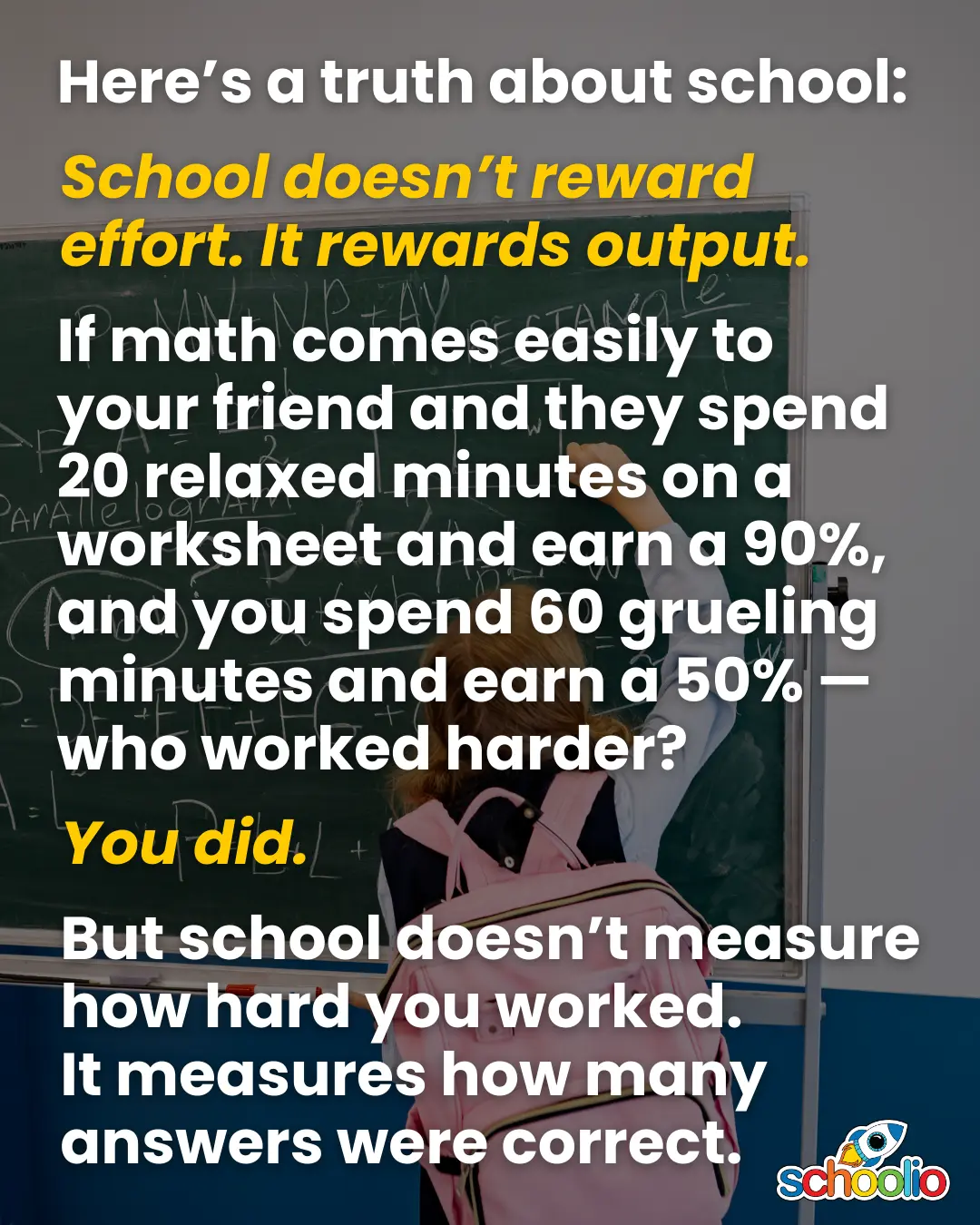
School doesn’t reward effort. It rewards output.

If math comes easily to your friend and she spends 20 relaxed minutes on a worksheet and earns a 90%, and you spend 60 grueling minutes and earn a 50% — who worked harder?

You did.

But school doesn’t measure how hard you worked.

It measures how many answers were correct.

Now imagine something different.

If school were centered around creativity…

or engineering-thinking…

or musical instinct…

or empathy and thoughtfulness…

or responsibility and trustworthiness…

You would be at the top of the class.

You would be absolutely crushing it.

But school doesn’t prioritize those traits.

But guess what? The real world does.

The real world cares that you show up on time.

That you think outside the box.

That you treat people with kindness.

That you keep going when things are hard.

The real world doesn’t care if you use a calculator to figure out a tip.

It doesn’t care if you prefer audiobooks over printed pages.

It doesn’t care how quickly you finish a worksheet.

The most powerful skill you’ll carry into adulthood isn’t mental math.

It’s perseverance.

It’s knowing how to work hard at something that doesn’t come easily.

So please — don’t let school convince you that you’re not smart just because it has a narrow definition of what counts.

Don’t let it shrink how you see yourself.

Don’t let it break your spirit.


? Lindsey

certified special-ed educator, homeschool mom, & co-founder of Schoolio

When a Mom in Our Community Answered a Simple Question with One Word.

When a Mom in Our Community Answered a Simple Question with One Word.


This has been on my mind today…

A mom in our community answered a simple question with one word.

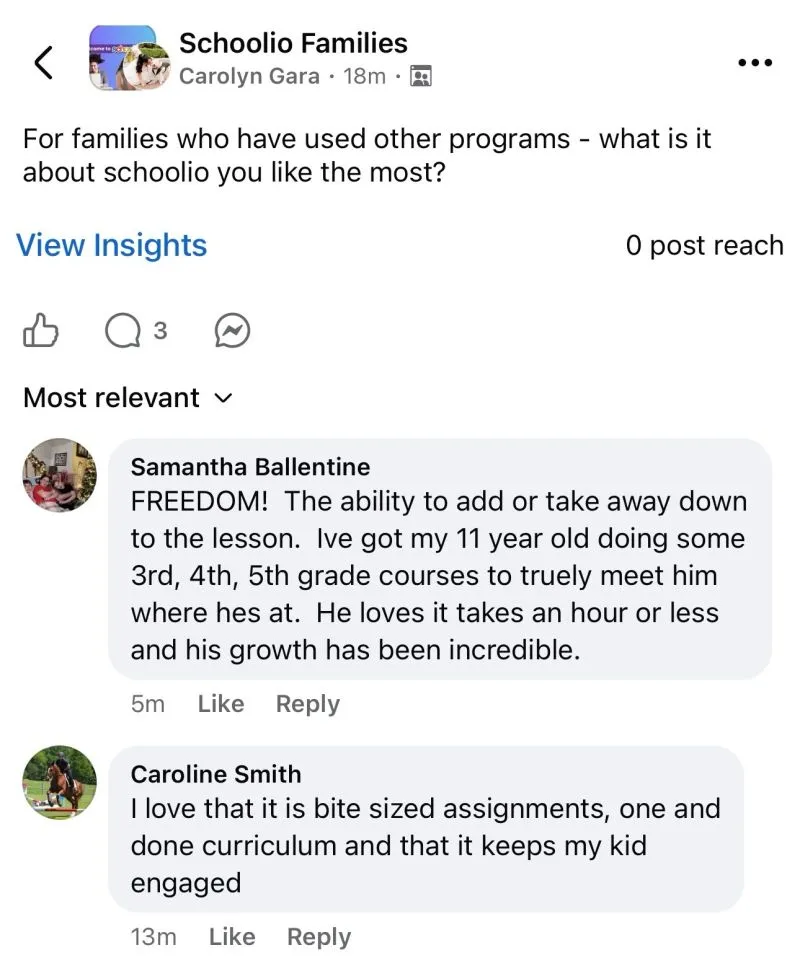
Freedom.

Not freedom from learning. Freedom inside learning.

One parent shared that her eleven year old moves between third, fourth, and fifth grade work depending on the subject. Not because he is behind. Not because he is ahead. Because that is where he is.

Another said she loves the bite sized, one and done lessons. Her child stays engaged. It takes less than an hour. Growth has been incredible.

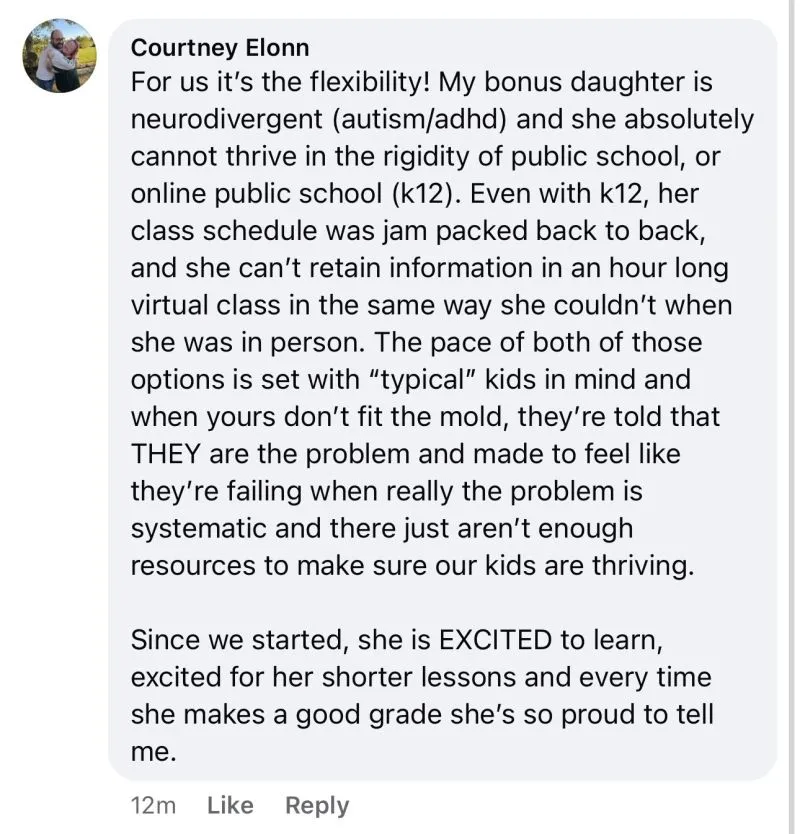
And then a mom of a neurodivergent daughter said something that hit hard. In public school and even online public school, the pace was built for typical kids. When her child could not keep up, she was made to feel like the problem.

Since switching, her daughter is excited to learn. Proud of her grades. Thriving.

This is why homeschooling is becoming more normal across the world.

It is not about escaping school. It is about building systems that adapt to kids instead of asking kids to adapt to systems.

When parents say freedom, what they mean is their child finally fits.


Sathish

still learning, still unlearning


The Magic in the Daily

The Magic in the Daily


This has been on my mind today…

“Why?” he would ask.

And I’d answer.

“Why?” he’d ask again.

And I’d stop whatever I was doing to explain another thing that caught his attention. He was five. Curious about everything. I loved answering his million questions a day.

As we get older, we forget that feeling. We take the everyday things for granted. But through the eyes of a five-year-old, everything is magical. The TV remote is magical. The spoon is magical. The window light feels magical.

I miss that. The magic in the daily.

There’s so much noise now. So much to focus on, worry about, manage. And for parents who have taken on the incredible task of homeschooling, I see you. You are some of the most courageous people I’ve met through Schoolio. You are re-learning curiosity alongside your kids, rebuilding connection in the middle of chaos.

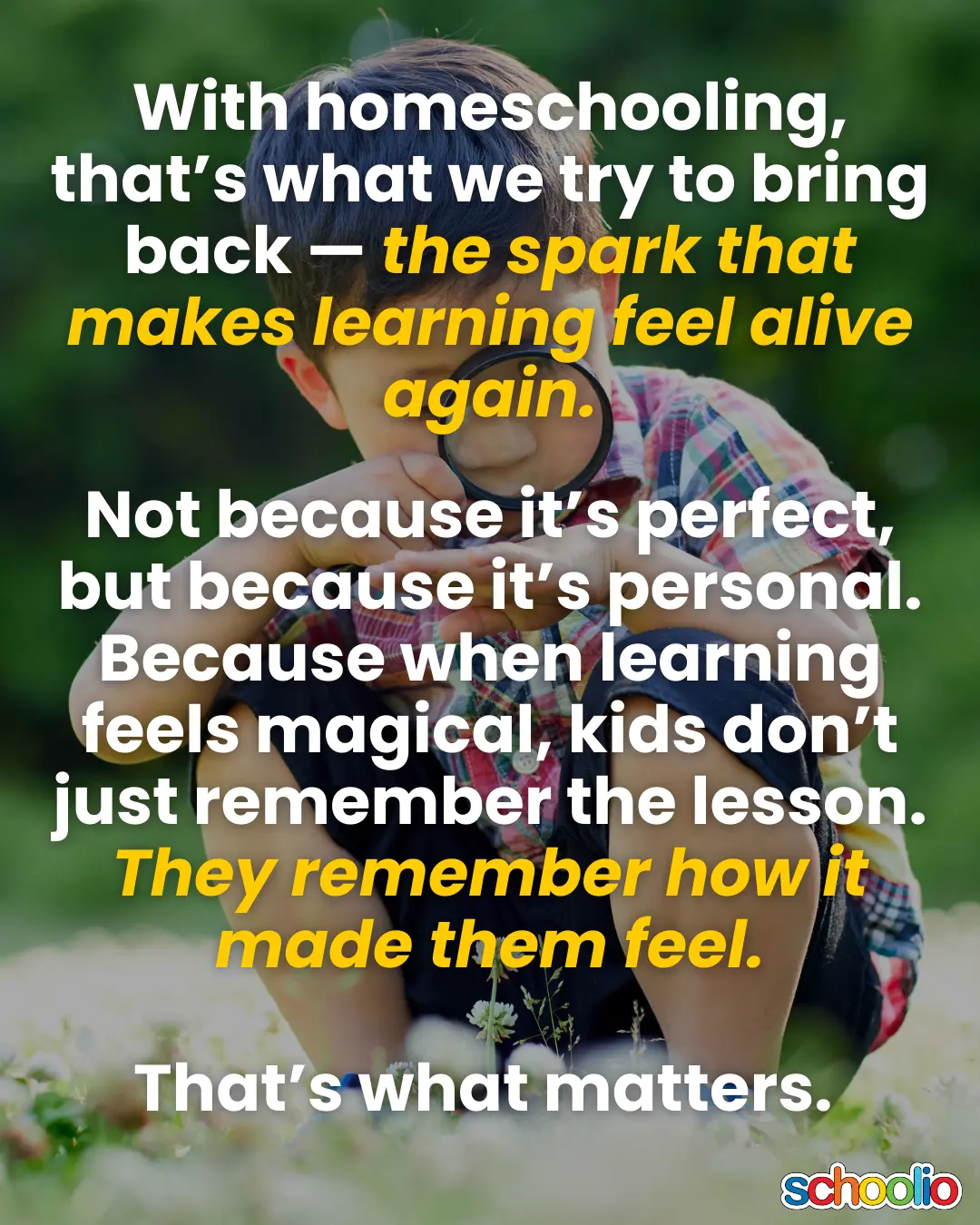
At Schoolio, that’s what we try to bring back — the why. The spark that makes learning feel alive again. Not because it’s perfect, but because it’s personal. Because when learning feels magical, kids don’t just remember the lesson. They remember how it made them feel.

That’s what matters. That’s what we’re building.


Sathish
still learning, still unlearning

The Night-Time Spiral

The Night-Time Spiral


It’s always at night, isn’t it? The house is quiet. Everyone’s asleep.

Except you.

The worrying… it creeps in so easily when you’re homeschooling. You start wondering…

Are we doing enough?

Are we behind?

Are they really learning?

What if they’d be better off in school?

Before you know it, you’re spiraling.

I know those nights too well.

So many nights, I’d lie awake, scrolling through Pinterest activities and curriculum reviews at 1 a.m., wondering if maybe this one will be the fix we need to make me feel confident we were “on track”. Replaying the day in my head- the math lesson that ended in tears, the half-finished writing assignment, the forgotten science experiment-  and convincing myself I was failing.

We’d never catch up.

I’d ruined their lives by homeschooling them.

Why had I ever thought that I could do this?

The self-talk… it gets bad in the still of the night, doesn’t it?

But here’s something I’ve learned after years of homeschooling and many of my own late-night spirals:

Bad parents don’t worry about whether or not they’re bad parents.

Good parents worry.

We worry because we care — deeply, fiercely, endlessly.

That worry you feel? It’s not a sign that you’re doing something wrong. It’s proof that you love your kids enough to question yourself. It means you’re invested. You’re thinking. You’re trying.

And that’s what good homeschooling is made of — not perfect routines or Pinterest-worthy plans, but care.

Every good parent I know worries about whether they’re doing it right.

Every good homeschooler I know questions if they’re doing “enough”.

It’s part of the process.

But try to reframe that worry the next time it sneaks up on you in the quiet hours. Instead of letting it spiral into fear, remind yourself what it really means:

You care enough to notice.

You care enough to show up.

You care enough to want the best for your kids.

And caring that much — that’s the heart of everything that matters.

So take a breath.

You’re not failing. You’re loving.

And that’s exactly what they need most.

Lindsey
Certified Special Ed Educator & Co-Founder, Schoolio

One of Homeschooling Quietest Strengths

One of Homeschooling Quietest Strengths


By Lindsey Casselman, special-ed teacher & homeschooling mom


When I first started homeschooling, I thought a “good homeschooler” had a tidy schedule. Wake up at 8, lessons by 9, neat little blocks of math, reading, and science lined up like ducks in a row.

But then reality stepped in: my kids aren’t ducks, and neither am I.

What I learned over time — and what research keeps confirming — is that one of the most powerful tools we have in homeschooling is also the simplest: sleep.

In traditional school, kids are often shaken awake by alarms, rushed through breakfast, dressed half-asleep, and hustled out the door before their brains have even had a chance to fully wake up. I remember my own school mornings feeling like chaos in fast-forward. But homeschooling gave us the freedom to slow down, and that’s when I noticed something life-changing.

Well-rested kids don’t just learn better. They feel better. They laugh more. They regulate their emotions more easily. They can focus longer, without the constant battle against exhaustion. Science tells us sleep is not laziness — it’s learning in disguise. It’s when the brain is literally growing, making connections, and preparing itself for curiosity.


Here’s what that looked like in our homeschool:

  • Starting the day when my kids naturally woke up, not when a bus schedule dictated.
  • Protecting rest days after big field trips, instead of pushing through.
  • Building gentle morning and bedtime rhythms so transitions felt calming, not chaotic.
  • Letting rest be part of the curriculum, because restoration fuels curiosity.

And here’s the best part: this isn’t “falling behind.” It’s moving forward in a way that honors kids as whole humans — body, mind, and spirit.

So maybe the question isn’t, “Am I doing enough school hours?”

Maybe it’s, “Am I giving my child enough rest to flourish?”

Because the truth is, flexible sleep schedules aren’t a weakness of homeschooling. They’re one of its greatest strengths.


? Lindsey

Certified Special-Ed Educator & Co-Founder, Schoolio