How Many Hours Should You Homeschool Each Day?

How Many Hours Should You Homeschool Each Day?

One of the first questions I hear from new homeschool families is this: “How many hours should we be doing every day?” It’s a question that often carries a lot of weight, as parents worry about whether they’re doing enough. And I always smile a little because the answer is often fewer hours than they’re expecting. Understanding how many hours are truly needed can bring a sense of relief and clarity to your homeschooling journey.


Why so much less than traditional school?

Think about what a six-hour school day actually looks like. There’s the morning routine — getting settled, taking attendance, announcements. Transitions between subjects, between classrooms, between activities. Lining up. Waiting. Bathroom breaks for the whole class. Behavior redirection when someone is off task — which in a class of thirty kids, is almost always someone. Lectures delivered to the whole group at a pace that works for the middle — too fast for some, too slow for others. Work periods where half the class is waiting for the other half to catch up. By the time you strip all of that away, the actual focused learning happening in a traditional school day is a fraction of the clock time.

At home, with one child — or even a few — you cut almost all of that out. No transitions. No waiting. No redirecting twenty-nine other kids. Just your child, you, and the lesson. That’s why two hours at home can cover what takes six hours at school. For example, a focused math lesson that might take an hour in a classroom can often be completed in 20 minutes at home.


What they taught me in teacher training

When I was getting my education degree, one of the most useful things my professors taught me was this: You can expect a child to give you their focused attention for as many minutes as they are years old. An eight-year-old? Eight minutes of genuine sustained attention. A six-year-old? Six minutes.

Now — that doesn’t mean a lesson is only that long. It means something needs to happen as a reset every few minutes. A change of location. A switch from listening to doing. A question asked and answered. A quick movement break. Anything that breaks the sustained attention and gives the brain a little refresh. Even traditional school isn’t six straight hours of focused learning. It’s dozens of tiny resets strung together across a day. Homeschool is no different — and once you understand that, the whole day starts to make a lot more sense.

For instance, a science experiment might involve a quick setup, a period of observation, and then a discussion. Each part offers a natural break and reset for the child’s attention.


So how long should homeschool actually take?

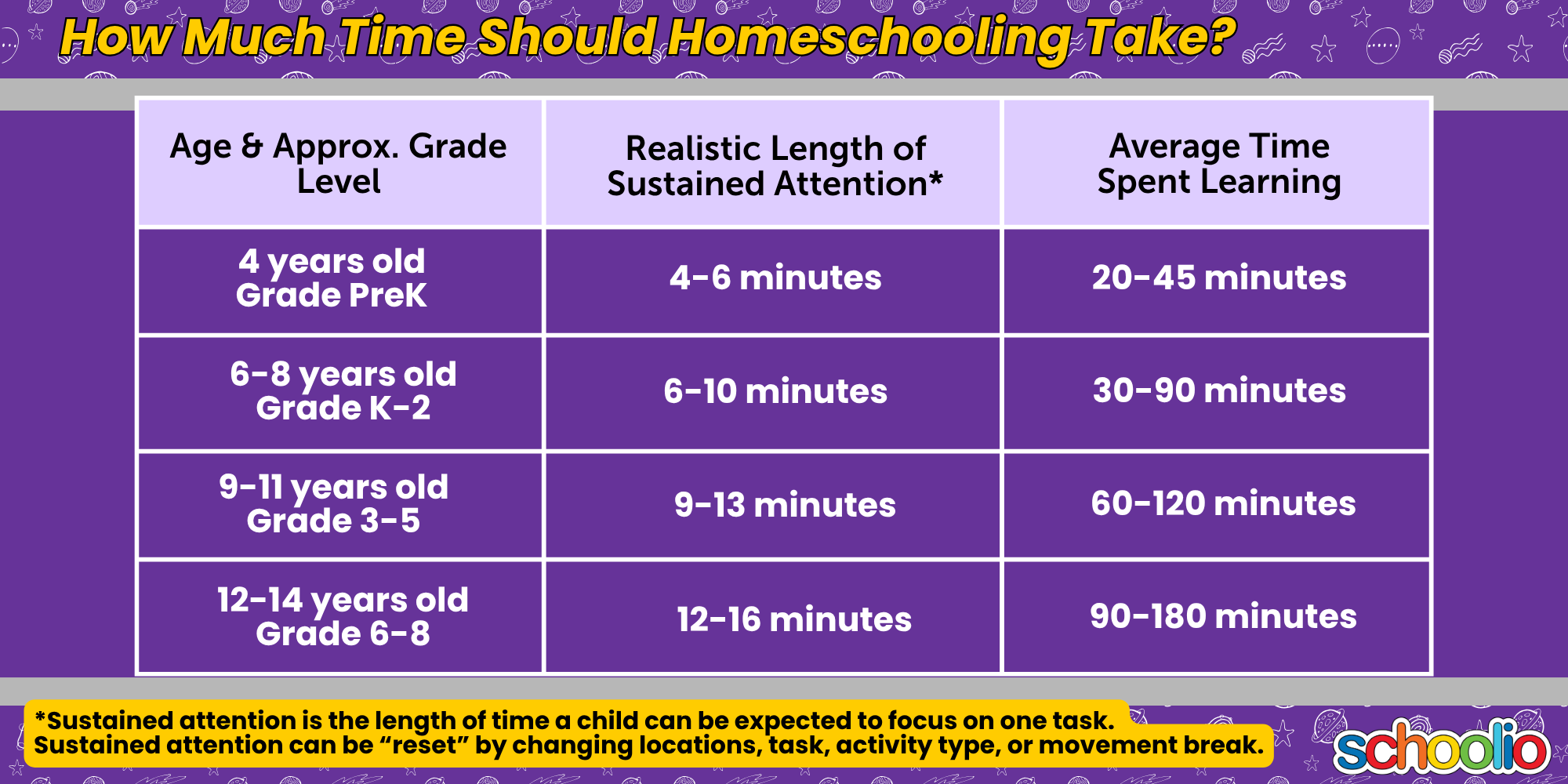
Here are some rough guidelines that the homeschool community has generally come to agree on. Think of these as a loose norm, not a rulebook. (See the chart below for a full breakdown by age and grade.)

PreK (Age 4) 20–45 minutes total. Sustained attention of just 4–6 minutes at a time. Play is the curriculum at this age. Keep it light, keep it moving. Activities might include storytelling, simple crafts, or a nature walk.

Kindergarten to Grade 2 (Ages 6–8) 30–90 minutes total. Sustained attention of 6–10 minutes. Short, varied activities work best. Reading, then building, then drawing — keep switching it up. A typical day might start with a reading session, followed by a hands-on math activity, and then a creative art project.

Grades 3–5 (Ages 9–11) 60–120 minutes total. Sustained attention of 9–13 minutes. Kids this age can handle a little more depth, longer projects, and starting to follow their own curiosity. You might introduce a research project on a topic of interest, encouraging independent learning.

Grades 6–8 (Ages 12–14) 90–180 minutes total. Sustained attention of 12–16 minutes. More independent work starts here — reading, research, writing — but it still shouldn’t feel like a grind. Consider incorporating a mix of structured lessons and self-directed study, like a science project or a book report.

TimeSpentLearning.png


A note for neurodivergent learners

If your child has ADHD, autism, or sensory processing differences, these numbers may look quite different — and that is completely okay. For many neurodivergent kids, sustained attention windows are shorter, and the need for resets is more frequent. That’s not a problem to fix. That’s information to work with. Twenty minutes of real engagement will always beat ninety minutes of struggle. Tailor your approach with flexible schedules and sensory-friendly activities.


The bottom line

Seat time is not the same as learning time. If your child is engaged, curious, and absorbing what you’re working on together — you’re doing it right. Even if it only took an hour. Even if it looked nothing like school. That’s kind of the whole point. Remember, the beauty of homeschooling is its flexibility and the ability to adapt to your child’s unique learning style and pace.

When Our Homeschool Turned to S**t

When Our Homeschool Turned to S**t


This has been on my mind today…

One winter morning, we set out on a nature walk. Nothing fancy, just some fresh air and a chance to stretch our legs. That’s when it happened. The kids stopped, pointed, and announced with total fascination:

“POOP!”

There it was on the path. Just sitting there, waiting to be discovered. And instead of me steering them back to the “lesson plan,” they had one question that became our curriculum for the whole week:

“What animal did this come from?”

We started guessing. Deer? Rabbit? Maybe raccoon? The curiosity snowballed. Back at home, we started researching. We found pictures of animal scat (yes, that’s the proper word) and compared them. We talked about the diets of different animals and how that shows up in their droppings. The kids wanted to make their own scavenger hunt checklist of “poops to find,” so we did. Suddenly every walk was a full-on investigation, magnifying glasses in hand, kids crouched down like little detectives.

And then nature gave us another gift — snow. Once they had learned about scat, the curiosity expanded:

“If we can tell an animal by its poop, can we tell it by its footprints too?”

That week turned into tracking lessons. We studied paw shapes, stride lengths, and patterns. We matched tracks to the animals in our region. Every walk became a treasure hunt. They weren’t just “getting exercise.” They were observing, comparing, classifying, and recording. In other words, science.

And here’s the thing: none of it was on my lesson plan. There was no worksheet waiting on the table that morning titled “Animal Scat and Tracks.” But it was real learning. Engaged, memorable, full of wonder.

The kids didn’t just learn about animals. They learned how to follow a question, how to investigate, how to let curiosity guide them. That’s the kind of learning you don’t forget — even if it started with poop.

So yes, sometimes school looks like math books at the table. Other times, it looks like poop on a trail. Both count. Both matter. And both are homeschooling.

? Lindsey

certified special-ed educator & co-founder, Schoolio

When Does Learning End? For Me, It Was When My Father Went to Sleep

When Does Learning End? For Me, It Was When My Father Went to Sleep


This has been on my mind today…

I saw a post that simply said, “My son’s done with homeschooling in two hours.”

And just like that, I was back in Singapore — racing home from school, not for fun, but out of fear.

See, school for me ended close to 4pm.


school


My parents knew exactly how long it should take for me to get from the gates of the school to the door of our apartment.

If I was late, it wasn’t a missed bus or a slow walk — it was disrespect.

And there were consequences.

But the real weight?

School didn’t end when the bell rang.

It ended when my father went to sleep.

Usually around 6pm, he’d be home — and by then, we had to be seated, heads down, already into our homework or the next stack of extra workbooks.

Every day.

For years.

Twelve to fifteen hours a day spent studying.

Almost no play.

Very little conversation that wasn’t about performance, progress, or punishment.

That was childhood.

And even though I sent my own kids to public school, I made a quiet promise to do things differently.

School ended the minute they walked out of the building.

Evenings were for play.

For laughter.

For sitting together at the dinner table without a pencil in hand.

For movie nights and bike rides and not having to earn joy.

And yet — I see so many of my friends, especially fellow South Indian parents, unknowingly continuing the cycle.

Evenings and weekends filled with more learning.

Catch-up. Push ahead. Get into the best school. Stay ahead of the curve.

But the curve keeps shifting.

The truth is, the world our kids are stepping into will not reward them for how fast they finished a textbook.

It will reward them for their ideas.

For their empathy.

For how well they adapt and connect and create.

Jobs we know today won’t be around by the time they graduate.

Learning styles have changed.

Grades don’t mean what they used to.

Trade skills and entrepreneurship are on the rise.

And I’ll say it — homeschooling is where I’m seeing the balance emerge.

Not because it’s easier.

But because it’s more human.

It’s where a child can complete their day in two focused hours and spend the rest of their time living.

It’s where parents no longer feel the need to steal youth from their kids in the name of preparation.

It’s where play becomes part of the plan, not an afterthought.

And it’s where I’m learning — still learning — how to unlearn the things I was taught to fear.

If your evenings feel like an extension of school instead of a return to family, maybe it’s time for a new way.

Maybe it’s time to put the joy back into childhood.


Sathish

still learning, still unlearning

Do You Need to Overthrow the Schedule for January?

New Year, New You?: Do You Need to Overthrow the Schedule for January?

Written by Chelsea McLeod

It’s a new year; is it going to be a new you? Are you anticipating a significant change this year or hoping to keep it relatively status quo? Some people find it necessary to make significant changes and completely revamp routines, family plans and schedules. Others are happy to settle into the familiar routines and schedules that worked before the holidays.

As we know, January is typically the time for reflecting on the past year with its successes, failures, wins and losses, drafting resolutions, setting goals and making plans to accomplish for the new year. It is also the time for getting back to routine after a hopefully relaxing holiday break. After a week or two of late nights, travel, sleep-ins and, in many cases, not knowing what day it is, you and your kiddos are likely feeling ready for the consistency that routinely brings. So this begs the question: Do you need to overthrow the schedule for January?

“Do what works for you and your family; you know best.” 

It comes down to personal preference and what you know will work for you and your kids. Some people thrive on change and the excitement that comes from a difference from the normal. Others need that structure, predictability and consistency in their lives. You know yourself and your kids best, so make sure to consider that before making a significant change when asking yourself, ‘do you need to overthrow the schedule for January?’ 

Finally, there is no harm in keeping things the same if that’s what works best for your family; maybe there is something in your previous routine that you need to change for you or your kids to be successful or learn better. If this is the case and you feel a change is needed after a break is the best time to make any changes since you and your family have already been out of routine. So, in essence, what you do in January is entirely up to you, so change things up…Or don’t; you are entirely and totally in charge of your homeschool schedule. Do what works for you and your family; you know best.


Change things up.

New homeschool year

Why not let the New Year work for you by changing things up? 

You could try some of the following suggestions to see if they work for your family during the New Year:

  • Add something new to your homeschool plans.

    • You could try a new tactic for Art, like a Schoolio Art Class or add an Audiobook for listening comprehension skills. Or you could add some hands-on activities to your math program instead of pencil/paperwork.
  • Do something different.

    • Maybe you have been following a book program for math or ELA. You could try a more computer-based program, like Schoolio Digital, to change it up in January.
  • Switch up the schedule. 

    • Maybe you have done Reading first thing up until this point? It could be time to change that up and do your Math when you first begin your homeschooling day.
    • Or maybe plan a daily time slot for fun reading. Books and things that are not part of the learning plan. It’s essential to read, and many of us would prefer to do so with a book we are interested in, not one that has been assigned; this goes for kids as well. Also, this gives you an excellent opportunity to read yourself and model reading behaviour. Sometimes the best way to learn is to watch others.
  • Join a homeschool co-op, a book club, or start your own. 

    • Depending on where you are, there are many options for a Homeschooling Co-op. You could join a local chapter; they often meet once a week for learning and sometimes plan field trips together.
  • Make tents or blanket forts and let your children do their school underneath. 

    • Kids love forts! There is something so fun about a homemade tent/fort with lots of pillows and twinkly lights.
  • Have a hot chocolate dreaming party next to the fireplace. 

    • This could be a break during the day or planned as an evening after supper. Just a great way to connect with your kids and spend time together. Talk about school or don’t, enjoy each other’s company.
  • Plan a living room slumber party and talk about family bucket lists.

    • This does not have to be specific to before I die; in recent years, people have begun making “bucket lists” for other time frames, such as before I graduate or before I turn 13, etc.
    • Enjoying your kids’ company and decompressing with them is also fun. You can create a bucket list for them and the family. Maybe you want to travel somewhere before your kids are a certain age. You can learn a lot about your kids when dreaming and talking about life plans, and your kids will appreciate being included in family planning.
  • Get outside!

    • In January, your kids would much rather be outside building a snowman than studying books, right? So why use that interest to plan your lesson and make them more engaging?
    • You could study snow, for example. You could measure snow in different states of matter, taste snow, and make snow cones, snow forts, and snowmen.
    • This could be the perfect opportunity to chart weather patterns. You and your kids could study your local weather patterns and compare them to others like Alaska, Iceland, or Sweden.
    • This might not work if you don’t live in a wintery location; however, you can constantly adjust to your environment. Maybe you need to study sand, the ocean, or the grass.

Or don’t.

Maybe you feel confident in the schedule and routines you planned at the beginning of your homeschooling year. Your kids were thriving with that schedule, and you are feeling good about your ability to juggle all the pieces. You Do Not have to change anything! No rule says January brings all kinds of changes, whether we like it or not.

Each family has a routine and schedule that works for them, and homeschooling is no different. You are in charge. Like Napoleon Hill once said, “You are the master of your destiny. You can influence, direct and control your environment. You can make your life what you want it to be.” So no, as asked in the title, You do not have to overthrow the schedule for January.

You can head right back into your pre-holiday routine, rest assured and with a smile. It is a New Year, but it doesn’t have to be a new schedule. So as we head into 2023, take some time to reflect and decide how to proceed with your homeschooling. Trust yourself, make whatever changes you need to make, or dust off that fall schedule and keep trucking. Enjoy. You Got This!


Does Your Student Hate Writing?

Does Your Student Hate Writing?: 

Tips and Tricks to Make It Easier

By: Chelsea McLeod

Hate writing?

Has your writing time become the bane of your existence, the most challenging part of your homeschooling routine? Is your kid miserable when It comes time to practice writing? Are they pushing back, getting easily frustrated, complaining, avoiding and completely shutting down and refusing to do it? 

At Schoolio, we get it; writing can be tricky even for adults. Many of us don’t practice it regularly.  Unless the writing is work-related, it’s not something we would sit down and do in our spare time. So while we all understand that it is an essential skill that we all need to learn and practice often, it is also crucial to keep it fun, light and engaging if we want our kids to practice it without a fight. 

Writing Doesn’t Have to Be Boring! Keep it Kid-Friendly.

Just like with anything else, kids need us to change things up. Do you like it when things are always the same at work? While routine is essential, and our days should be structured similarly in the homeschool environment, adding different activities and trying new things is essential. So here are some kid-friendly ideas to keep your student guessing and having fun while doing something they don’t particularly like: Writing. With any luck, doing some of these activities might make them forget about their dislike for a while!

Kid Friendly Writing

Have You Tried to Have Them…

1. Write what they want to write about

    • Practice makes perfect, right? So what better way to influence your student to want to practice than writing about whatever they want? What we are trying to encourage here is to get them writing. It doesn’t matter what it’s about or why they want to write it, just that they are writing and therefore practicing a critical skill. They can write a letter to a friend, a diary or a journal entry, a story, a description of a game they created, etc. You get the idea; the sky’s the limit, and they will want to practice more because they aren’t being told what to do and how to do it.  

2. Write a step-by-step instructions piece, and you do what they write about… This is hilarious and very informative on missing steps rather than you harping on it.

  • Speaking of being told what to do, your student could write a step-by-step instructional guide on a topic of their choice or one you give them but keep it fun. For example, “How To….” Make a Peanut Butter and Jam Sandwich, as seen in this video. The kids have written the instructions, and the Dad follows them to the letter.  (TW, you will have to gauge your learners here, this may not be an excellent option for students who are easily frustrated or discouraged because it will be wrong several times before it is done correctly.)
  • The key here is first to have your students write uninterrupted with no interference from you. Then you try to follow their instructions exactly as they wrote them. This is not only fun but also an “experiential learning opportunity” for them. Watching you complete their step-by-step, they can see in a funny way where they missed an instruction (or 3). In this way, they will learn that they need to be more detailed in their writing and have fun watching you perform a silly task. They might not even remember their writing because they will have a great time!

3. Write an alternative ending to their favourite book.

  • Again, writing doesn’t have to be boring.  It doesn’t have to be a miserable part of anyone’s day, which can be highlighted by using their favourite stories as inspiration.  Reading is a fun way to use imagination, support, and develop writing skills.
    Listening to books activates the same part of the brain as reading them. Therefore if they don’t have a favourite that they have read yet, they can choose something you have read to them. Often our kids and we have books we wish ended a certain way or want them to continue because we love the characters and story so much. So why not use that to your advantage during your homeschooling day? 

Creative writing

  • Having them choose a story they already enjoy and continue it the way their imagination leads them is an excellent way to promote longer writing. In this case, students will often write many more lines or pages than before because they aren’t worried about what you may think or what is correct. They are just following their imagination and writing for themselves. Maybe they will be so engrossed in this task that they will end it in such a way that they can write their very own sequel too!

Having fun is the easiest way to engage your student.

Sometimes planning and preparing for the homeschooling day can get overwhelming. You want to make sure you cover all required, touching on necessary topics and subjects, all while you fill the day with skill practice to ensure your student isn’t falling behind their peers. And while it is crucial your child learns the necessary skills and required curriculum to help them out in the world when they grow up, it is also important to remember that kids also learn while they play.

They often learn best by doing or playing through scenarios they live in, which is also something they could write about! Having fun is often the easiest and best way to engage their brains, and Writing is no different. We hope that this list has been informative and will help you move forward in planning your homeschooling time. School can be fun, and it doesn’t take complicated projects with many supplies to achieve—just some good, old-fashioned paper and a pencil, coupled with creativity and an open mind.

Book a Concierge Call.

If you aren’t sure how to get started or what programs would best suit your child’s learning needs, then you can chat with one of our experts on a one-on-one Concierge Call, completely free!
Click here to book a Concierge Call. 

How to Add a Student to the Schoolio Digital Platform.

How to Add a Student to the Schoolio Digital Platform.

Are you new to the Schoolio Digital Platform? Using the Schoolio digital platform might overwhelm you, and learning a new digital system can be confusing! That’s why we are here to help guide you through every step on the Schoolio Digital platform so that you and your student will be successful while bringing fun back into learning. This blog will teach how to add a student to the Schoolio Digital Platform.

Let’s Learn How to Add a Student to the Schoolio Digital Platform.

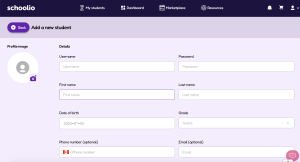
Adding a student to your account is much easier than you’d think. First, head to your account and sign in. Once you’ve signed in, you will be prompted to add your first student on the Schoolio Digital Platform.

Step 1: Add Your First Student 

How to Add a Student on the Schoolio Digital Platform

Add Student Details:

Once you have clicked the Add Your First Student Button, you will be taken to the student details page. You can go ahead and enter your student’s information here. Fill out the required fields: Student Username, Student’s Password, First Name, and Date of Birth. Then select your child’s school grade. (Don’t stress too much about this, as the courses are customizable. So, if your child is technically in grade 4 but needs a grade 3 level math, you can select that once you get to the courses.)

You can add the courses automatically or wait and add them later. Just to remind you, your student’s email and phone number are entirely optional. Now you can save your changes.

Step 2: Add Student Details

Student Details

Your Next Step is to Subscribe Your Student on the Schoolio Digital Platform.

You’re ready to go!

Now that you’ve completed all the steps for signing up, you can subscribe your student on the Schoolio Digital Platform to gain access to over 4,000+ videos and lessons.

Book a Concierge Call.

If you need help with how to get started or what programs would best suit your child’s learning needs, then you can chat with one of our experts on a one-on-one Concierge Call, completely free!
Click here to book a Concierge Call.

For more information on how to add a student on the Schoolio Digital Platform check out this video:

Now it’s time for your next step! Adding a course to your Digital Platform.

Click here for information to subscribe a student. 

Prepare Your Child for Grade Five

Have you been trying to figure out the best way to prepare your child for grade five without overwhelming them? And still, allowing them to have fun all summer long? Cramming curriculum into each day during the summer might prevent summer learning loss, but it also might overwhelm your child. So, what’s the solution? Should you fill up their days with learning and homeschool curriculum, or should you let them have fun all summer and ignore books and learning?

Prepare your child for grade five while avoiding summer learning loss.

The first step is to let go of all that stress and worry. As parents, we can get distracted by all these worries about trying to ensure our children are doing their best and getting all the opportunities in life that they deserve. There’s this constant worry that we aren’t doing enough, causing our children to struggle. This is especially true when we think of the impacts of pandemic learning on our children’s education.

Which makes our goal to avoid summer learning loss so much more important. Bouncing between our attempts at fixing pandemic learning loss and trying to prevent summer learning loss can be an exhausting endeavour. Especially when we see statistics about summer learning loss, like that 2.6 months of math skills, two months of reading skills and one month of overall learning are lost for most children each summer.

Click here to learn more about Summer Learning Loss. 

So what can you do to help your child catch up on all the learning they have lost? While also aiming to stay on track and not lose even more learning skills during the summer?

General learning skills like math, reading and writing are essential for your child to practice to develop correctly continually; this is especially true during the summer.

Simplify learning; that’s the best way to prepare your child for grade five.

You must avoid overthinking your child’s summer learning, as we know that overthinking adds more stress than good. The assumption that you must have some elaborate plan to be able to prepare your child for grade five is false. It will only lead to you and your child feeling exhausted and never feeling like you’ve done enough.

The easiest way to simplify summer learning when preparing your child for grade five is to use the Summer Schoolio: Get Ready for Grade 5 book! Summer Schoolio: Get Ready for Grade 5 book was created to help your child stay on track with essential learning. Which will also save you time and money searching for a homeschooling curriculum that fits your summer learning needs.

Take a look inside the Summer Schoolio: Ready for Grade 5 workbook!

Prepare your child for grade five

We want you to have an enjoyable summer without the stress of trying to complete extra tasks. The Summer Schoolio books have been designed in a simple format, without the mountain of overwhelming tasks. This helps your child stay on track with their learning.

The Summer Schoolio: Ready for Grade 5 book combines the best homeschooling curriculum concepts to bring you and your child a unique solution to help you prepare your child for grade five. We’ve combined the homeschooling writing curriculum, homeschooling language arts curriculum and homeschooling math curriculum to bring you and your child a workbook to help practice essential skills to stay on track.

Summer Schoolio: Ready for Grade 5 overview:

Prepare your child for grade five

The Summer Schoolio: Ready for Grade 5 workbook is filled with learning materials that aren’t just educational; they’re fun too! This combination is an excellent resource to help prepare your child for grade five. Created for six weeks of learning, your child will have the opportunity to learn and refresh different learning concepts each week.

Week one includes:

The Summer Schoolio week includes three days of simple learning that won’t be overwhelming or take too long to complete.

  • Day one, Weekly Writing – Friendly Letters – and Math – Number Sense.
  • Then day two has Weekly Writing and Math – Number Sense.
  • On day three, your child will work on Weekly Writing – Scrapbooking – and Math – Number Sense.

Week two includes:

The second week of Summer Schoolio: Ready for Grade 5 is similar to week one, just switching up learning concepts.

  • On day one of week two, your child will have Weekly Writing – Writing Fiction – and Math – Number Sense.
  • On Day Two, they will have Weekly Writing and Number Sense.
  • Then on day three, they will have Weekly Writing – Scrapbook and Math – Number Sense.

Week three includes:

During the third week of the Summer Schoolio: Ready for Grade 5 book, your child will be working on:

  • Weekly Writing – Reviewing a Book – and Math – Algebra on day one.
  • Then on day two, your child will work on Weekly Writing and Math – Algebra.
  • Followed by day three, which is Weekly Writing – Scrapbook and Math – Algebra.

Week four includes:

  • When your child is working on week four, day one, they will do Weekly Writing – Writing Non-Fiction – and Math – Geometry/Spatial Sense.
  • Then on day two, they will be working on Weekly Writing and Math – Geometry/Spatial Sense.
  • Finally, on day three, they will get to work on their scrapbook for Weekly Writing and the final day of Math – Geometry/Spatial Sense.

Week five includes:

  • Day one of week five is Weekly Writing – Poetry – and Math – Data Management.
  • Then on day two, they will work on Weekly Writing and Math – Data Management.
  • Followed by day three, which is Scrapbooking for Weekly Writing and Data Management for Math.

Week six includes:

  • The first day of week six focuses on Weekly Writing – Summarizing – and Math – Financial Literacy.
  • The second day is all about Weekly Writing and Financial Literacy for Math.
  • Then, your child can work on their scrapbook again for Weekly Writing day three, and enjoy their final Financial Literacy assignment.

A daily repetitive learning cycle with refreshing learning concepts helps your child stay interested with a structured plan for summer learning. This technique will help your child master essential math, writing and reading concepts for grade five.

Prepare Your Child for Grade Five

The Summer Schoolio: Ready for Grade 5 workbook includes a sample schedule/calendar that looks like this:

Monday: Read a Book or Chapter.

Tuesday: Weekly Writing Day 1, Math Day 1, Read a Book or Chapter.

Wednesday: Weekly Writing Day 2, Math Day 2, Read a Book or Chapter.

Thursday: Weekly Writing Day 3, Math Day 3, Read a Book or Chapter.

Friday: Read a Book or Chapter.

Trying to help your child stay on track and up-to-date with their learning while avoiding summer learning loss and preparing for the next grade doesn’t need to be an overwhelming and stressful task. It also doesn’t need to take a massive chunk of time every day to succeed. The Summer Schoolio: Ready for Grade 5 book helps your child keep up with their learning needs, refresh, and not become overwhelmed by too much information crammed into one day.

Prepare your child for grade five.


Get your copy of Summer schoolio

10 Of The Best YouTube Channels for Kids

An excellent source of education and entertainment is YouTube, which makes it a fantastic tool for boredom. It can feel like an overwhelming task to try to find the best content for your child to watch as you try to sift through thousands of channels. And unfortunately, if you’re not using the Youtube Kids app, your child could find something that isn’t suitable for them to watch. So we have made a list of 10 of the best YouTube channels for kids to subscribe to.

10 Of The Best Youtube Channels for Kids


https://www.youtube.com/watch?v=vQSECrMIygg
Homeschool Pop – The Sun for Kids

Homeschool Pop

When it comes to 10 of the best YouTube channels for kids, Homeschool Pop is one of the greatest. Homeschool Pop has many amazing educational clips for your child to choose from. They cover many topics from History to Geography to Math to Biology and even Social Studies. This channel has taken great care to explore many different areas of education. Homeschool Pop can provide an excellent boost of information for your child with videos like Oceans of the World, Antonyms, Helen Keller for Kids, Rosa Parks for Kids, The Sun, Rocks, Analog Clocks and more. HomeschoolPop is a fantastic channel created in 2015 with over 856,000 subscribers and 116 million views.

More Homeschool Pop

https://www.youtube.com/watch?v=TcUX6eNT2j4
Crash Course Kids – Succeed by Failing

Crash Course Kids

The excellent Crash Course Kids channel was created in 2014, with over 73 million views and 680,000+ subscribers. It’s easy to understand why it is a preferred choice of parents as it boasts of being one of the best kid-friendly YouTube Channels. They offer bi-weekly shows all about grade school science. These unique videos take a deeper look at Earth, Space, Engineering, Habitats, Chemical Reactions and more. With fun host, Sabrina Cruz. There are new uploads every Tuesday and Thursday. It’s no wonder Crash Course Kids describes itself as “Science with a side of awesome.” This channel is perfect for helping your child gain more interest in how the world works.

Find more Crash Course Kids Page

https://www.youtube.com/watch?v=C1aQVApevDM
Nat Geo Kids – Discover Dinomania

National Geographic Kids (Nat Geo Kids)

Nat Geo Kids is a child-friendly version of The National Geographic Network. Furthermore, each video is kept short and simple while being packed with information for your child. In addition, Nat Geo Kids aims to make exploring the world fun through weird, wild and wacky videos. These fun videos vary from cool science to funny pets to unique animals and more. Nat Geo Kids was created in 2014 and now has over 120 million views and 612,000 subscribers.

Find out for yourself why Nat Geo Kids is such a hit.

https://www.youtube.com/watch?v=O3mSkMFZ44c
WordWorld – Boppin’ with the Bug Band/Shuffleword

WordWorld

Designed to help your child learn words, this channel is specific to younger children. Obviously, this channel is a fantastic find for parents with young learners. Additionally, this channel offers weekly episodes that last 30 minutes each. Furthermore, each episode has a different star of the show, the star being the words. Therefore Word world is an excellent channel for encouraging reading, writing and spelling. Created in 2012, this channel has over 10 million views and 82,400 subscribers.

Find more WordWorld Videos.

https://www.youtube.com/watch?v=mz6o8b2bFd0
Storyline Online – The King of Kindergarten Read by Terry Crews

Storyline Online

This YouTube channel is a total gem! Storyline Online by the SAG-AFTRA Foundations award-winning and Daytime Emmy-nominated children’s literacy website. Storyline streams unique videos that encourage your child to use their imagination. Additionally, stories are read by actors like Allison Janney, Justin Theroux, Viola Davis, the late Betty White, and more. As a result, Storyline Online is one of the best kid-friendly YouTube channels; founded in 2011, Storyline Online has over 304 million views and 535,000 subscribers.

More Storyline Online Videos

https://www.youtube.com/watch?v=0wJoG7Uuw_s
TVOkids – My World Kitchen – Pippa’s Zimbabwean Nyama

TVOkids

Some of the best kid-friendly YouTube channels are the ones that feature other children. And TVOkids offers a variety of fantastic video series for your child to choose from that features other children. Like My World Kitchen, All-Round Champion, Family Fun Time, Dino Dan: Trek’s Adventures, Abby Hatcher, Odd Square Mobile Unit, The Brilliant World of Tom Gates, and more. Consequently, TVOkids aims to help children prepare for school, life and the world through the power of learning. Created in 2015, TVOkids has over 81 million views and 210,000 subscribers.

Check out TVOkids.

https://www.youtube.com/watch?v=PeNuj2GH8xg
FreeSchool – All About Stars for Kids: Astronomy and Space for Children

FreeSchool

Providing age-appropriate videos on subjects like Language Arts, Science and History FreeSchool is a preferred YouTube Channel by parents. Particularly, FreeSchool offers a safe and friendly learning space that teaches children about famous art, literature, natural science and classical music. As a result, many parents describe FreeSchool as educational, entertaining and enriching. FreeSchool was created in 2014 and had 513,000 subscribers and over 165 million views.

More FreeSchool Videos.

https://www.youtube.com/watch?v=jt2q1cHsH6E
Kids Academy – Community Helpers for Kids, Joys & Occupations

Kids Academy

This fantastic Youtube Channel, Kids Academy, was created in 2016 and now has 545,000+ subscribers and 160 million views. Additionally, kids Academy has a large selection of educational videos. Moreover, these videos help kids learn important lessons that can be very useful in school as well as, their videos are short, informative and interactive, keeping kids engaged and learning.

More Kids Academy Videos.

https://www.youtube.com/watch?v=hBvcMMuBsHQ
Simple History – The Great Escape Beneath the Berlin Wall (1964)

Simple History

This unique channel helps visualize the past by bringing history to life through neat animations. It should be noted that Simple History is geared towards older children. And will help your child learn about how people lived throughout history. While also including lessons on their culture, epic battles and events and developments in technology. Additionally, they’ll know what it would’ve been like to be in the trenches of the First World War? Or to be a pirate in the Caribbean or a factory worker in the Industrial Revolution? This channel was created in 2014 and now has more than 955 million views and 3.75million subscribers.

Simple History for older children videos.

https://www.youtube.com/watch?v=D9N7QaIOkG8
TedEd – Why is it so hard to escape poverty?

TedEd Lessons Worth Sharing

Why do parents love TedEd for their older children? Because it’s phenomenal and filled with incredible lessons. Without a doubt, one of the heated channels with videos like ‘Building the Impossible: Golden Gate Bridge,’ ‘The Dark History of the Overthrow of Hawaii,’ ‘Spaceship vs. Space Elevator.’ Furthermore, TedEd was created in 2011 and has 16.4 million subscribers and over 3 billion views. Apart from its popularity, this channel is committed to creating carefully curated educational videos for your older learners.

Find more TedEd videos.

Things to remember when searching for educational content for kids.

We hope you enjoyed learning about 10 of the best YouTube channels for kids. It should be noted that while the media listed here are loved by parents and children worldwide, it’s important to remember that all kids respond differently to content. Furthermore, your child might be more advanced for some younger learner videos. In comparison, for some of the older children’s videos, your child might be overwhelmed by some of the content.

Unquestionably, you should always watch videos before your child does and gauge whether or not the video would be something that your child should watch. Indeed these channels come highly recommended; however, only you can determine whether or not your child should watch a channel.

Schoolio After-School

Learn more about Schoolio After-School

When Your Kids Are Driving You Crazy

Homeschooling is all fun and games until you realize that your kids are with you 24/7 and you’re the teacher. There’s really no break for the default homeschooling parent. So, how do you cope? How do you function on those days when your kids are driving you crazy? Let’s find out. 

First, you need to remember that kids will sometimes be annoying. Especially when they’re trying to figure things out or if they’re just genuinely bored. Did you just start homeschooling this year? This can be a big change, and can sometimes play a big part in their behaviour. As you and your child are both experiencing a major adjustment when they go from traditional education to homeschooling. In this situation, you can start by learning the reason’s behind your child’s behaviour by reading the ‘Why Your Kids Are Driving You Nuts’ blog. 

Additionally, there are two major categories that you should take a look at when your kids are driving you crazy. 

  1. How to keep your child entertained. 

  2. Ways to get a break as a homeschooling parent. 

Let’s start with category number one. 

How to Keep Your Child Entertained.

1. You Don’t Have to Keep Your Child Entertained. 

  Are you scratching your head now in complete confusion? The first step is how to keep your child entertained? But then step one in that category says you don’t have to keep your child entertained. How does that work? I promise I’m not trying to confuse you, or lead you down a rabbit hole. See, it’s good for your child to learn how to entertain themselves. When you are constantly planning events and play for your child, they won’t learn how to embrace their imagination. Notice how I said constantly. Because planning opportunities for your children is great, just not when you do it all the time.

The reason is because your child needs to have the opportunity to use their amazing imagination. Being the constant source of entertainment for your child will only deter their ability to entertain themselves. 

2. Encourage Imagination Play When Your Kids Are Driving You Crazy.

The beautiful gift of having an imagination. I’m sure that you have fond memories of using your imagination as a child. Perhaps climbing a dirt pile while wearing a beautiful white dress and pretending you were the queen in her castle. Some of my most favourite childhood memories are the ones where I was using my imagination as my main source of entertainment. 

How can you encourage imagination play for your child? 

  • Put the iPads/tablets/phones/video games away. 
    • Basically just anything that is electronic, take it away. Wait, you didn’t know you can do that? Surprise! You can! Because you’re the parent. So, take away the electronics and place boundaries around when they’re allowed to use their electronic devices.
  • Include free play in your daily schedule/routine. 
  • Show them how to use their imagination.
    • You might have to actually remind your child how to use their imagination, if they haven’t been in touch with it for a while.
  • Get them outside.

3. Have Your Child Help Around the House. 

Do my kids enjoy chores? Not always! But I have watched them embrace chores using the gift of their imagination. It’s actually so exciting to see. For example, my son will pretend he’s a recycling truck, when he’s taking the recycling bin to the garage. Chores provide an excellent opportunity for your child to use their imagination while building independence. Additionally, you can use chores as amazing learning opportunities also!

Turning chores into learning opportunities: 

  • Sorting laundry is an excellent way to learn and refresh the concepts of matching and colours. While also helping your child learn proper organizational skills. 
  • When your child empties a dishwasher or dish strainer, they have the opportunity to learn about ratios when stacking plates of different sizes together. 
  • Grocery shopping with a parent can help your child read out words on different products. 
  • Making their bed can help your child feel pride for doing something to their own satisfaction.

4. Help Your Child Get Creative. 

Creativity is such an amazing outlet for both children and adults. Which is why helping your child get creative can guide them to find their unique outlet. So be sure to pick up some creative items at the local craft store. Here’s a fun crafty opportunity for your child to get started: How to Make Stickers – Good to Know. 

5. Get Active. 

Are your kids feeling super tired and bored? Get active! Run around outside, play ‘Simon Says’, go for a bike ride, play some hockey or basketball, take a walk in nature, go for a hike. Getting active helps freshen up your child’s imagination. Which then helps them with their creativity. As you can see, getting active has so many benefits. 

6. Add Interest Learning to Your Homeschool. 

When you’re always focusing on Math, Science, Social Studies and Language Arts, your homeschool life can become very boring. Adding in some fun child led learning opportunities will help curb that boredom. And giving your child the opportunity to dive into their interests may result in hours of research and creativity. 

Not sure where to start? Check out our Special Interest Units for unique learning opportunities for your child.

7. Teach Your Child How to Sew/Knit or Crochet. 

There’s a special satisfaction that comes with creating your own designs. So, obviously teaching your child how to sew, knit or crochet will for sure pay off. As teaching your child these skills may result in your child spending hours creating. 

8. Encourage Your Child to Write a Story. 

They may need a little help with ideas on what to write. So, encourage your child to write a unique story, that they can share with friends or family when they’re finished. Remind them that it’s not always a quick event, writing sometimes takes time. 

9. Help Your Child Find Books They Love. 

Does your child not like reading? Maybe they just haven’t found the right material that interests them yet. First, ask your child what they want to read about. Second, get a library card. Third, pick up different reading materials to help them determine which style they like most. Fourth, set a time of the day for independent reading time. 

10. Listen to stories. 

There’re so many amazing kids stories out there. But chances are you’re feeling burnt out and not really in the mood to read books to your kids? You can use a story reading app like Audible. Or look up neat podcast series for kids. They will be using their imagination as they listen to the stories play over the speaker. Additionally, while they’re listening, you can encourage them to draw pictures, or write. 

11. Teach Your Child Mindfulness. 

Mindfulness is such an amazing practice for you and your child to learn. If you’re unsure where to start when teaching your child mindfulness, research mindfulness teachers for kids. Like the Goldminds program. Goldminds believes in the power of teaching mindfulness strategies to children from a young age, to equip them with the tools they need to regulate big emotions, build resilience and improve self-confidence. Goldminds offers live online classes. You can learn more about Goldminds here.

12. Play Board Games. 

Break out the Monopoly! But not just Monopoly, there are some really amazing board games available for kids. So, do some research to find the best games for your family. 

Step one of what to do when your kids are driving you crazy is now complete. Now we are going to jump into category two.

Ways to Get a Break as a Homeschooling Parent. 

Getting a break as a homeschooling parent seems like a myth. Can homeschooling parents actually get a break? You’re with your child all the time. But you’re feeling burnt out, frustrated, over-worked, over-touched, and ready to hide in the dark of your bedroom until your kids are older. Obviously you aren’t going to be able to jump on an airplane and head to a tropical island anytime soon. So, how can you get a break? 

1. Ask For Help. 

  This is number one in this category for a reason. Asking for help can often feel like a foreign concept for homeschooling parents, because we are used to doing it all. If you break down and ask someone to watch the kids for a couple or hours, it could potentially fuel their thoughts about how you can’t accomplish it all. This is false thinking on your part. You’re human, and every human needs a little extra help sometimes. Asking a friend or family member to watch the kids for just a couple hours once a week, can give you that oh so important time to yourself. 

You might feel afraid to ask for help, but you really don’t need to. Asking for help is healthy, and a part of everyday normal life. And, it’s not just for you. Getting a break will benefit your children also. Because their parent will be refreshed, and they’ll learn that it’s ok to ask for help for themselves, too. 

2. Schedule a Homeschool Break. 

During this homeschool break you can take the time you need to reset and refocus. Your child can utilize their creative skills that we talked about above. And you can spend time doing the things that you have neglected during the rigorous daily schedule that you’ve been trying to maintain. 

3. Have Mandatory Quiet Time. 

Scheduling in 20 minutes of quiet time everyday will help you have time to reset during each day. The noise and chaos of the day can become overwhelming sometimes. So being sure to have 20 minutes of quiet time will help you get back in the right mindset before taking on the next task of the day. Your kids can read, write, play in their rooms, or play outside during this time. 

4. Play Some Music. 

I don’t know about you, but music fuels my soul. When I’m feeling burnt out, frustrated, and in desperate need of a soul refresh. I turn on my music. Music has the ability to lighten up our whole house. If we’re all having a rough day, music gives us the chance to dance and laugh and find joy again. 

5. Wake Up Early. 

It might be tough at first, but waking up early is essential as a homeschooling parent. Spending time first thing in the morning without your kids in your face is hugely important to the mental peace that you will need for the day. When you wake up, be intentional about having gratitude for all the amazing aspects of your life. Along with the tough aspects that challenge you. 

6. Exercise Away From The House. 

Going for runs is my lifeline. Typically a run will be my go-to at 5am when my household is still asleep. Knowing that my husband is home with the kids, I can safely and peacefully challenge my body and refresh my mind with exercise. Run, walk, go to the gym, whatever works for you. Just be intentional, because being intentional about your exercise and alone time will benefit you in many, many ways. Including preparing you for when your kids are driving you crazy. 

7. Head to a Coffee Shop With Your Friend. 

Obviously, you are going to need someone to be with the kids. For example, I do this when my husband is home, or if they’re in a co-op/gymnastics class. I take the one hour window to chat with a friend, and just be me, the person that can get lost in the process of homeschooling, parenting, and working. 

Homeschooling is a challenge especially when your kids are driving you crazy.

You will have days in which everything goes so smoothly and you feel like you are on the right track. Alternatively, you will have days when your kids are driving you crazy and you desperately want to hop on a plane and get out. 

When you figure out how to keep your child entertained by teaching them to entertain themselves, and find ways to get a break as a homeschooling parent, you will be on the road to success. Just remember to be patient. Good things don’t come over night. They often take lots of time, and practice. With time, your family will find it’s groove and it will be smooth sailing. Keep aiming for it, and you will reach it. 

20 Don’ts of Homeschooling

Is there some magical way to become a better homeschooling parent? Well, learning the right way to do something and the wrong way are both important. We’ve compiled a list of things you don’t want to do as a homeschooling parent.  So, let’s jump to the 20 Don’ts of homeschooling. Created and approved by veteran homeschool parents that know what they’re talking about. 

The 20 Don’ts of Homeschooling

1. Don’t Overwork and Overwhelm Your Kids. 

Keep your lessons short, sweet, and simple. Many homeschoolers think that they need to cram in an abundance of ‘work’ during school time. In order to keep up with traditional education. Don’t do this. When you overwork your kids with workbooks and lessons. It can actually overstimulate them and cause them to become overly frustrated with their education. When you choose to overwhelm and overwork your kids, you are undeniably choosing stress for them. And that stress is a quick step to a learning block. So, don’t do that. 

2. Don’t Over Schedule. 

Homeschooling in itself takes up a huge part of your day. Additionally, the default homeschool parent is often the one that is also responsible for housework, and for some, working from home too. Therefore you should always aim to keep your family’s schedule light. Society has this way of making us believe that if our kids aren’t in ballet, ice skating, gymnastics, basketball, hockey or some other extracurricular activity. That they won’t be on the same level as their peers. That’s false. While it can be nice to have those extra activities, it’s vital to protect the schedule.  Perhaps your child is extremely talented in one area and you want to cultivate that – that’s totally fine. I’m not saying you should give up on all extra activities. But, over scheduling with activities that they probably don’t even enjoy? What’s the point? Stop over scheduling. Aim for a simple schedule instead. 

3. Don’t Overwhelm Yourself. 

Number 3 of the 20 Are you the type of parent that is quick to cut up your 9 year olds waffle for him? Stop. Let your child learn how to be independent. Doing so by allowing them the opportunity to actually accomplish tasks on their own. When it comes to class work, are you sharpening the pencils? Are you sitting at the table for hours while your child finishes each question of their lessons? Don’t do that! There’s a reason this is number three on the 20 don’ts of homeschooling. Because it’s important.

If your child is old enough, implement checklists for homework. This can look like ‘Today you need to complete pages 90 – 93 of your Language Arts.” If you know that it’s just practice work, and you don’t necessarily need to teach them directly. Then allowing them to use a checklist to complete these tasks is an amazing habit to get them, and yourself into. Teaching your kids to be independent is one of your greatest goals as a parent, so aim to reach it!

20 dDon’ts of Homeschooling pro tip for teaching multiple grades: Click Here

4. Don’t Compare Yourself. 

Please, please, don’t compare yourself to other parents. Don’t compare yourself to other homeschool parents. Above all, don’t ever compare your child to another child. Doing so will just create a complex in their mind and put them on the comparison path for the rest of their life. Rather you should remind yourself that your kids are unique, you are unique, and your homeschool is a reflection of that. Everyone is going to be a little different. And, every homeschool is going to look a little different. 

5. Don’t Tear Other Homeschoolers Down. 

This is just as important as being sure not to compare yourself to other homeschooling parents. You should never, ever criticize someone else’s homeschooling style. Why? Because you really never know when their style will become your own. Homeschooling changes, constantly.

As your children grow, your homeschool changes. You’ll find different ways that work best for your children. Often (most) times one way of learning will be great for one of your kids and absolutely not for your other kid. It’s easy when you first start homeschooling to assume that you are going to continue to homeschool in that specific way forever. But, you won’t. Your homeschool will change and evolve. A homeschooling style that seemed to be totally foreign and off the rails for you, just might become the style that you end up gravitating towards one day. 

It’s also just really important that we should never criticize another individual whether behind their back or to their face. It’s not kind. This is especially true for homeschooling families. Rather than criticizing, we should be supporting them while also learning from them. Homeschool families need to stick together, whether your styles mesh or not. 

6. Don’t be Afraid to Experiment. 

This is why it’s also so important not to criticize other homeschooling styles. Because it’s paramount for you to find your own style, schedule and even curriculum that works best for your family. Changing things up is a great option when things are getting messy and no one seems to be enjoying the homeschooling journey. Please don’t be afraid to change things up! 

7. Don’t Imitate a Public School Classroom. 

It’s totally fine to have a schedule, we aren’t saying that everyone should just jump to unschooling. But listen, if that’s your jam than obviously – do it! The point is, you don’t want to get tied up by an unrealistic schedule. It can be hard to wrap your mind around what an alternative educational model can look like when you’re accustomed to the public school model alone. 

8. Don’t Feel That You Need to Cover It All. 

You don’t need to jump into every subject the first day, week, or even month. Homeschooling is often a really big adjustment for the whole family. So instead, you should give your family and yourself time to get familiar with your learning content and routine. Focus on one or two core subjects, and sprinkle in something that your child really loves! This could be art, music, physical education, or even a nature study. As time goes on, you can start to sprinkle in the other subjects. 

9. Don’t Cram It All Into One Day. 

I feel like I’ve said this before. But that’s fine. I’ll say it again, especially for the 20 don’ts of homeschooling. Because it’s an important point that needs to be recognized. You do not need to do Math, Science, Social Studies, Language Arts, French, Arts and Music all in one day. Schools don’t even do that! When you choose to homeschool in this way, your child can’t properly grasp all the concepts that they should be grasping.

It’s so much better if you choose one or maybe 2 subjects per day. Take time to really dive into them. Look up neat videos to go along with your lessons. Check out library books, do research together. Find different ways to teach a certain concept. And then reiterate the lesson using different styles (on different days). You can do this until you’ve figured out the unique way that your child learns at this time. Notice I said “at this time”, because their learning style will change. 

10. Don’t Belittle Your Children. 

This really is just a general tip for parenting. But we can cross it into homeschooling as well. If your child is trying to dig deeper into a topic, or is struggling with something and trying to tell you that they are. Don’t ignore that. Never assume that it’s just ‘them’. And belittle them into getting the work done. Never belittle your children, period. Adding onto that, just please never belittle your children in the name of getting them to accomplish their school work. It’s not worth it, and can and will have lasting negative effects on their lives. 

11. Don’t Be a Taskmaster. 

I get it. You want to get all the work done so you can enjoy an amazing winter break with no school work, just holiday music playing and cookies baking in the oven. Regardless of that goal, you should never turn yourself into a taskmaster on behalf of trying to have your children reach their goals on the timeline that you have created. You don’t want to get to the point where your children think of school as yet another chore they must accomplish. And, you don’t want your child to look at you and think ‘Now what does she want me to do?’. I know you want to aim to get it all done, and quickly. But that kind of crammed learning isn’t learning. It’s chaos. So don’t do it. 

12. Don’t Force a School Day. 

Did your kids wake up with runny noses and they’re complaining of sore throats? Are your children just really tired from a busy weekend? Maybe you’re feeling exhausted and needing a break? Then take one. You don’t need to force a school day just because you saw the school bus go by the window outside. Because your child will not fall behind because you took a breather. Forcing school on a day that you know no one will want to participate will really cause more frustration than good. 

13. Don’t Teach When You’re Frustrated. 

DON’T TEACH WHEN YOU’RE FRUSTRATED. This ‘don’t‘ of the 20 don’ts of homeschooling is really, really important so I had to write it twice. Never teach when you’re frustrated. As a homeschooling parent you will still have life to deal with on top of homeschool. Sometimes you can be teaching a simple lesson of math, the day seems to be going great. Then all of a sudden your youngest comes in with a suspicious grin.

You hear a weird sound and notice water running down the hallway. Suddenly, you come to the horrific realization that while you were happily teaching math to your older child. Your younger child tried to dump their crayons in the toilet. Now there’s a flood down the hallway and you probably need to call a plumber. Ok, Math is done for the day. The frustration you’re feeling in that moment will only come out in your teaching style.

Even if you think you can suffocate the feelings, you can’t. It’ll come out in your body language. If you know you are frustrated, avoid teaching until you’ve gotten yourself into a better headspace. That doesn’t mean you should give up on the lesson for the day. It means you refocus, regroup, and come back to it when you’re more relaxed and able. 

14. Don’t Add More Curriculum. 

It’s tempting, when you’re walking by the piles of curriculum books at Costco to think ‘Oh this would be great practice work!’. You don’t need to do that. As homeschoolers we are constantly feeling like we need to do ‘more’. Or like our kids aren’t learning or doing enough. So, this feeling of ‘adding more’ just continually pops up. Your child did their Science lesson quickly and didn’t fuss? Does that mean you should add more practice? Make it harder for them? Absolutely not! Learning doesn’t need to be crammed in there, and difficult. It should be simple, fun, relaxing and engaging. Finding that balance will make a world of difference. 

15. Don’t Fall For Homeschool Parental Guilt. 

You are doing enough. And your kids are learning enough. Also, your home is clean enough. And your kids are eating healthy enough. We love to torture ourselves with these ideas that we just aren’t enough. Or like someone else is doing it better, so why can’t I? Stop! Turn the switch off when it comes to homeschool parental guilt. It literally ally gets you nowhere. Your kids really are learning enough, and you are truly doing such a good job. There’s no room for parental guilt, because you are totally filled up with positive affirmations on how awesome you are. 

16. Don’t Assume That Your Kids Are Behind. 

They aren’t. Your kids are right where they’re supposed to be. Let go of this idea that your child needs to be in the standard for their age group. Your child is unique and their learning style reflects that. Maybe your child is 9 years old but is reading at a grade 2 level. That’s ok. Your child isn’t behind, they don’t need to catch up. Just move along at the pace that works for your child and yourself. Then all the pieces will fall into place when they’re supposed to. 

17. Don’t Be Afraid to Ask For Help. 

It’s so good to ask for help and support when you need it. This doesn’t mean that you aren’t strong enough to be a homeschooling parent. 

18. Don’t Worry About Messing Up as a Homeschool Parent.

Life is messy! Literally everyone messes up sometimes. Some people just clean it up faster or hide it better. If you’ve messed up as a homeschool parent, learn from that mistake and move forward. 

19. Don’t Get Stuck in the Oops! 

If you did mess up, or loose your temper, or taught your kid the wrong concept. Don’t get stuck in the mistake. Look at it as a learning opportunity for you too! When you’ve mad a mistake, own it. Take ownership of your mistake, apologize, and strategize how to move forward in a positive way. 

20. Don’t Underestimate Yourself. 

You are more than capable of teaching your children. Be proud of the choice that you’ve made. Embrace the unknowns, and work diligently towards the future. Because you are capable of accomplishing some really, really amazing things. I’m so proud of you, and I hope that you are too! The very fact that you are searching out ways to be an amazing homeschooling parent, like reading the 20 don’ts of homeschooling, speaks volumes. Don’t cut yourself short, ok?


Did you enjoy the 20 Don’ts of Homeschooling? Stay tuned for the 20 Do’s of Homeschooling, coming soon!

Do you have any ‘don’ts’ to add to the 20 Don’ts of Homeschooling? Let us know!


When Homeschooling is Hard.

When you were considering homeschooling you probably heard the experienced home school moms says “We finish school in a couple hours, then the rest of the day is play time.” So, when you shifted your mindset, to actually stay home with your kids, you thought: ‘This is going to be awesome!’ But now you find yourself sitting at the dining room table, listening to your child whine about how they hate math. They literally have 3 math problems left and you’ve been stuck there for an hour. You’re probably wondering what you’re doing wrong. Wondering if your kid needs the school setting. Or if homeschooling was a huge mistake?  

Now you sit here in your frustration, your anxiety, your feelings of inadequacy as a teacher. This right here was not what you signed up for. You signed up for something that made you feel connected to your child, something that helped them learn in a one on one setting. But you’re scratching your head thinking ‘WHY DID I DO THIS?’ Then there’s the whole virtual learning challenge. Maybe you didn’t take the full plunge into homeschool, but you decided to keep your child home and do the virtual learning option. Only to be overwhelmed by frustrations when the technology doesn’t work, or your kid can’t hear the teacher over all the other children’s noises. 

You still find yourself sitting at the table with your child, as they spend countless hours sitting in front of a screen. You notice that they are beyond frustrated, but there’s not much you can do to soothe them because you also are extremely overwhelmed by this whole situation as well. 

You find yourself longing for the days when you could just put your kid on a bus and let someone else educate them. Giving you some time to work, rest, clean, shop or visit friends. Let’s face it, life is completely different for so many of us. The overwhelm that we are facing today can be overtaking. It’s hard to manage your time and patience when so much is new, and more challenging. But you need to remember that you are an incredible human being, that has given up so much to help your child learn in a safe and healthy environment. 

How can you keep calm on those days that just never seem to end? How can be a pillar of peace for your child when everything has turned crazy in their lives and yours? 

First, remember that they are struggling too. For many kids this new virtual reality and/ or homeschool adventure can be really challenging to undertake. It’s not that they’re at you. They’re mad because their life has changed. They had no say in what happened, none of us did. No one had the chance to avoid a global pandemic. Remember, that your child is just trying to navigate this new reality. So, when he gets frustrated with you, or his virtual teacher, or his homeschool math problems – that’s not your fault. 

Second, take breaks. It’s OK to walk away from the schoolwork. It’s OK to say “Hey you know what? We need the day off.” A day off doesn’t mean that they won’t be learning. Give them some Lego, let them build. Give them some paint, let them create. Get them an apron, let them bake. There’re so many ways to learn that don’t involve workbooks and schedules. There’re so many opportunities for them to learn about the world, about creating things, about having fun, and about taking care of themselves. 

Third, model good behaviour. Obviously, you don’t want to throw a tantrum in front of your child about how much you despise homeschooling and or virtual learning. But if you’ve accidentally done so. Move forward. Show your child that it’s ok to become frustrated, but that we don’t sit in that frustration. We recognize the frustration and we move forward. Nothing is normal right now, and that is something that your child is feeling also. Connect with them, tell them that you’re also struggling. Model to them that it’s OK to share your feelings, that it’s OK to be frustrated. 

Fourth, talk to your child. Ask your child whether there are ways that she thinks you both can improve this new chapter in your lives. Sit down, PUT YOUR PHONE AWAY. Talk to your child like you are talking to your friend. Not a student, not your kid, a friend. Ask them how they are feeling, tell them what you’re thinking. Brain storm ideas to move forward. 

Change is hard for everyone. We here at Schoolio understand that. Some of us handle it so much better than others. So, teach your child that even though change can be challenging, it doesn’t have to mean that you will both be miserable. There’s no instruction manual for how to homeschool during a pandemic and an increasingly changing world. Just take it day by day. Don’t be hard on yourself, don’t be hard on your child. You’re both trying, and there’s a lot to be said for that.

Jaymee Davis is a stay-at-home/work-at-home/homeschool mama. She wants you to enjoy homeschooling, even when it can be challenging. And is dedicated to helping you succeed in this new chapter.