If You Want Your Child To Be Social, Do Not Homeschool.

If You Want Your Child To Be Social, Do Not Homeschool.

This has been on my mind today…

I still see this stereotype floating around.

If you want your child to be social, do not homeschool.

It is an old argument built on an outdated picture of what homeschooling looks like.

The idea assumes that socialization only happens in a classroom of same age peers, sitting in rows, moving together by bell schedule. That is not how real life works. Adults are not grouped by birth year. We collaborate across ages, backgrounds, and interests every day.

Modern homeschooling rarely looks like isolation.

Kids are in co ops, sports teams, music groups, church communities, neighborhood pods, volunteer programs, online collaborations, and microschools. Many interact with more diverse age groups than they would inside a single grade classroom.

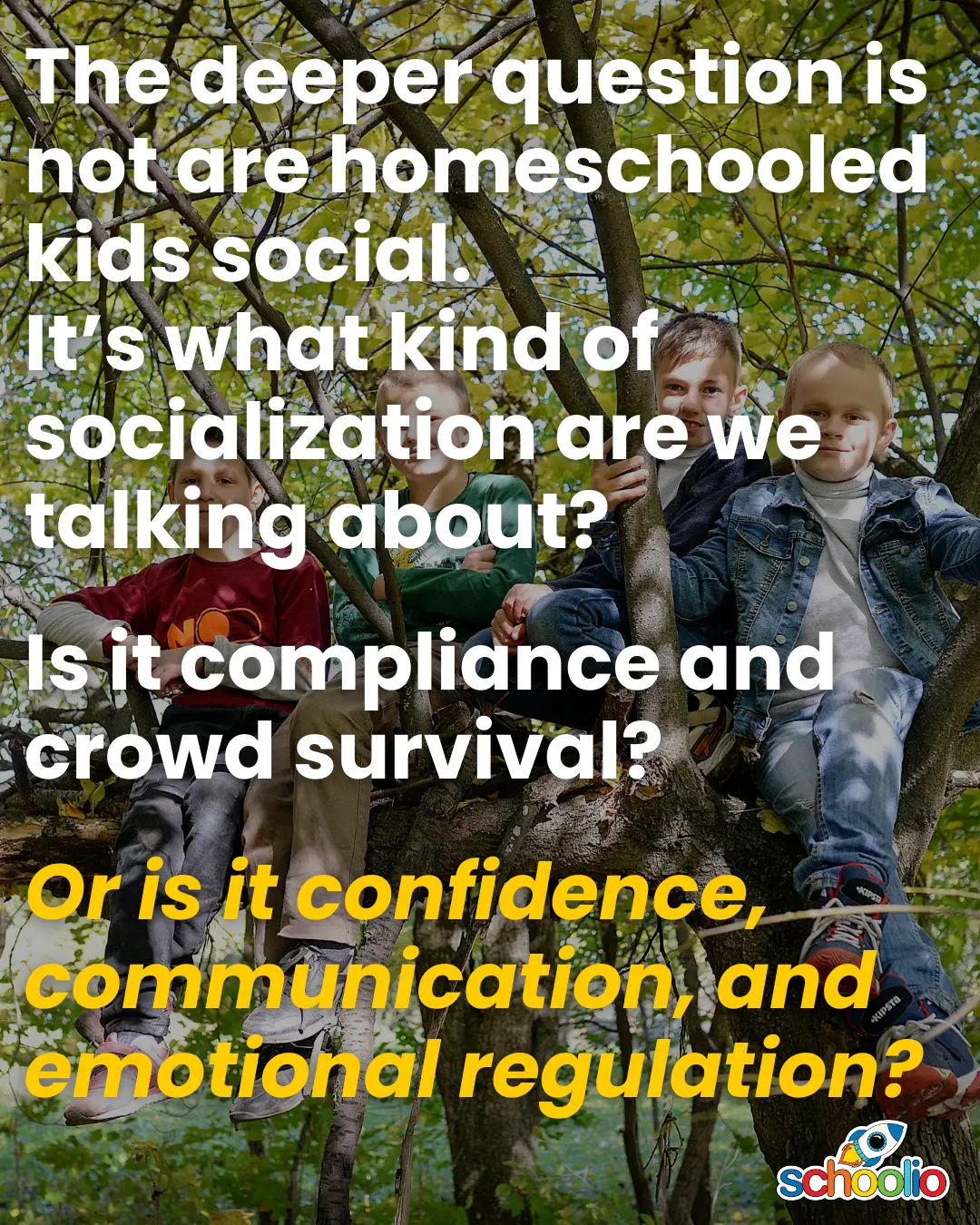
The deeper question is not are homeschooled kids social.

It is what kind of socialization are we talking about.

Is it compliance and crowd survival?

Or is it confidence, communication, and emotional regulation?

I have seen kids who struggled in traditional school labeled antisocial. In reality, they were overwhelmed. Remove the rigidity. Adjust the pace. Give them agency. They open up.

Homeschooling is not anti social. It is intentional social.

The stereotype lingers because it is easy. The reality is more nuanced.

Sathish

still learning, still unlearning

Source: **https://thegatewayonline.ca/2026/02/how-to-be-a-social-person-dont-homeschool/**


Interoception in Neurodivergent Kids: Why Your Child May Not Know What Their Body Is Telling Them

Interoception in Neurodivergent Kids: Why Your Child May Not Know What Their Body Is Telling Them


“Are you hungry?”

“I don’t know.”

“Do you need the bathroom?”

“No.” (…five minutes later: emergency.)

“Wow look at that bruise- didn’t that hurt?”

“No. I didn’t notice.”

If this sounds familiar, you’re not alone — and it’s not defiance, avoidance, or lack of self-awareness. For many neurodivergent kids, the issue lies in something called interoception.

Understanding interoception can completely change how you interpret your child’s behavior, emotional regulation, and even their resistance to basic self-care tasks.


What Is Interoception?

Interoception is the body’s ability to sense internal signals.

It includes things like:

  • Hunger and thirst
  • Heart rate and breathing
  • Body temperature
  • Pain or discomfort
  • Fatigue
  • Emotional signals (like anxiety, excitement, or overwhelm)

Interoception is how we know what’s happening inside our body — and what we need to do about it.

For most neurotypical people, this system works quietly and automatically. But for neurodivergent kids — especially ADHDers and autistic kids — interoception can work very differently.


Why Interoception Matters So Much

Interoception is foundational to:

  • Self-regulation (knowing when you’re calm vs. stressed)
  • Meeting basic needs (sleep, food, hydration, rest)
  • Emotional awareness (naming feelings based on body cues)
  • Self-advocacy (“I need a break,” “I’m overwhelmed”)

When interoception is unreliable or muted, kids aren’t ignoring their needs — they genuinely may not feel them clearly.


What Interoceptive Differences Look Like in Neurodivergent Kids

Many neurodivergent kids experience interoceptive differences, meaning the signals from their body are delayed, muted, overwhelming, or confusing.

This can look like:

  • Not realizing they’re hungry until they’re hangry
  • Missing early signs of needing the bathroom
  • Becoming exhausted without noticing fatigue building
  • Stimming or fidgeting until it causes injury that they don’t notice.

To parents, it can feel baffling. To the child, it can feel like body needs just happen to them instead of being something they can anticipate or manage.


Interoception and Emotional Regulation

We often expect kids to name their feelings:

“Use your words.”

“Tell me what you’re feeling.”

But emotional awareness depends on interoception.

If a child can’t recognize:

  • tightness in their chest
  • a racing heart
  • clenched muscles
  • stomach discomfort

then they may not realize they’re anxious, overwhelmed, or overstimulated until they’re already dysregulated.

This is why many neurodivergent kids struggle with emotional regulation — not because they don’t care, but because their body’s early warning system is unreliable.


Why This Isn’t a Failure — It’s a Difference

Interoceptive differences aren’t laziness, manipulation, or lack of responsibility.

They mean your child may need:

  • external reminders for basic needs
  • support identifying body cues
  • help connecting physical sensations to emotions

Expecting independent self-regulation without interoception is like expecting a child to read without learning letters first.


How Parents Can Support Interoception at Home

The goal isn’t to force independence — it’s to build awareness gently over time.

1. Externalize Body Needs

Instead of asking open-ended questions like “Are you hungry?”, try:

  • “It’s been two hours since you ate — let’s check in with your body.”
  • “Your body usually needs a snack around this time.”

This reduces pressure and builds pattern recognition.


2. Name Body Signals Out Loud

Help your child make connections:

  • “Your fists are tight — that can mean your body is feeling stressed.”
  • “Your voice got louder; sometimes that means you’re getting overwhelmed.”

This models interoceptive awareness without judgment.


3. Build Predictable Routines

Consistent meals, rest times, and movement reduce reliance on internal signals that may be unreliable.

Routine acts as an external interoceptive support.


4. Use Visual and Sensory Tools

  • Visual schedules for meals, breaks, and rest
  • Body check-in charts (“tired,” “hungry,” “wiggly,” “calm”)
  • Emotion charts tied to physical sensations

These tools make the invisible visible.


5. Teach Body-Based Emotional Language

Instead of focusing only on emotion words, try:

  • “Where do you feel that in your body?”
  • “Does your body feel fast or slow right now?”

This builds emotional literacy from the inside out.


Can Interoception Always Be Taught?

Here’s something that doesn’t get said often enough:

Not every child can “learn” interoception in the way we expect — and that’s okay.

Interoception isn’t a skill like reading or math. It’s a sensory system. And just like vision or hearing, some people will never have fully reliable internal signals — no matter how much practice or support they receive.

Some neurodivergent kids may learn to recognize patterns over time (“I usually get cranky when I forget to eat”), but they may never feel hunger, bathroom needs, fatigue, or emotional escalation early enough to act on it.

That doesn’t mean they’ve failed.

It means their brain works differently.


Awareness vs. Accuracy

It helps to separate interoception into two parts:

  • Interoceptive awareness – learning to understand body patterns after the fact
  • Interoceptive accuracy – the brain reliably sending early, usable signals

Some kids can build awareness with support.

Some kids will always struggle with accuracy.

And for those kids, the goal isn’t “listen to your body” — it’s manage your needs externally.


Management Is Not a Step Back — It’s an Accommodation

For children with consistently weak interoceptive signals, independence often looks like this:

  • Using timers to remember bathroom breaks
  • Eating on a schedule, not when hunger appears
  • Drinking water because the alarm says so
  • Taking breaks because it’s part of the routine
  • Checking charts or schedules instead of body cues

They don’t wait to feel the need.

They meet the need because the system supports them.

This is not dependence.

This is adaptive intelligence.

Just like glasses replace poor eyesight, external supports replace unreliable internal signals.


What Matters Most

The goal of interoception support is not to make a child “typical.”

The goal is:

  • needs being met
  • reduced distress
  • fewer meltdowns and emergencies
  • dignity and autonomy

If a child uses timers and checklists into adulthood, that’s not a failure — that’s success.

Many kids feel enormous relief when they learn:

“My body doesn’t always give me clear signals — so I use tools.”

That understanding replaces shame with self-trust.

Interoception isn’t about perfectly feeling your body.

For many neurodivergent kids, it’s about learning how to care for their body in different ways — and that is just as valid.


The Homeschooling Advantage

Homeschooling allows you to support interoception in ways traditional school often can’t.

You can:

  • Pause learning to meet body needs
  • Normalize movement, rest, and snacks
  • Teach emotional awareness without rushing
  • Respond to dysregulation with curiosity instead of consequences

When a child feels supported in understanding their body, self-regulation becomes possible — not forced.


The Big Takeaway

Interoception is the bridge between body, emotion, and behavior.

When neurodivergent kids struggle with self-care, emotional regulation, or recognizing their needs, it’s often not because they won’t — it’s because they can’t yet.

With patience, modeling, and external supports, interoceptive awareness can grow.

And when kids learn to understand what their body is telling them, they gain something powerful:

self-trust.
High School – Is My Teen Prepared?

Is your teen prepared for High School?

The last two years have shown us all a very different way of life and education. For many students, virtual learning became the norm. While the world tried to figure out how to live through a pandemic. Due to that, many students have unfortunately lost precious education time. And now parents and students alike are feeling very underprepared for the road ahead. Especially students heading into high school for the first time.


Transitioning from middle school to high school is already a very big change for students. Now throw in the fact that kids going into high school this September haven’t had a normal education experience since March 2020. That likely will make them feel pretty overwhelmed. But don’t worry, that overwhelm is completely normal, and to be expected. Pandemic or not, it’s a big change. Different school, different teachers, different peers, and for some students that are homeschooled and going into high school, it’s a whole new ball park.

You want your teen to be successful.

I have no doubt that you want your child to be super successful with whatever they choose to do with their life. So, it’s normal for parents to feel a twinge of anxiety about how well they do in high school. After-all, it’s the final step before University. So, you might find yourself feeling like there’s a lot of pressure to make sure your teen does the best job possible.

Listen, you don’t have to suddenly become the chill parent, or the super crazy, pushy parent. Finding a balance somewhere in the middle is your best option.  You can accomplish that by simply being there for your teen. By offering them the right tools to help them have a successful high school experience despite these beginning hurdles they are facing.

There are two categories that we will focus on to help your teen have a successful  experience with their secondary school experience.


Category 1: Emotional Well-Being.

Kids are struggling with all the trauma that they’ve experienced in the last two years. We often like to assume that they’re doing fine. For some, they are. Even so, there has been a lot of damage done to their social and emotional skills. This being due to the ups and downs, and isolation of the pandemic.

That’s why it’s incredibly important to:


  1. Reassure your teen that we are all trying to figure it out. Life is different now, and unfortunately that means that your teen won’t have the same high school experience as generations before. It will be different. Let them know they aren’t alone in this. Other students, teachers, principals, and even you yourself, are all learning this new chapter of our lives together.
  2. Make sure that they know it’s OK to be a little freaked out. It’s totally natural to feel this way, and they are safe to talk to you about it.
  3. Don’t force toxic positivity on your kids. Is your child struggling with the fact that they didn’t get a real ‘Grade 8 graduation’? Could they be upset that they didn’t get to play that final season with the homeschool soccer team? Are they hurting inside because they never got to go to the science fair to show off their amazing experiment? Don’t ignore that. Let them be upset. Let them tell you that it made them sad. Don’t just jump to a silver lining. Teach them that sometimes it’s ok to notice the bad, sit in it and then when they’re ready, get up and move forward.
  4. Never compare how your teen does to the other teens around them. Every kid is different. If your child is struggling with the big change that is high school. Don’t be like “Well, my friends teen is doing just fine.” That will only cause frustration and a spike right down the middle of your relationship. If you notice that your teen is having a much more difficult time adjusting,  continually reassure them that they are going to be OK. That you are always there for them. And that with time, things will work out.


Category 2: Academic success.

As stated above, you obviously want your teen to be super successful on their secondary school journey. However, that doesn’t mean you should put unrealistic goals on their shoulders. Let them go on this journey, encourage them, be there for them. And give them the right tools to be successful.

What does that look like?


  1. Understand that he/she has their own learning pace. You should know your teen more than anyone else. So, you are the one that knows their learning pace (especially if you’ve homeschooled them). Therefore, you should be able to help them choose the right classes, to be successful on their high school journey.
  2. Help them build good study habits. Every day you can help your student learn good study habits, organization, and time management.
    1. Create a space that is just for study, or reading.
    2. Encourage them to keep a planner, to write down important dates and events.
    3. Show them how to take notes that are effective.
    4. Demonstrate to your child that it’s healthy and safe to ask for help. And reassure them of that when they get worried.
    5. You and your student both need to tone down the distractions. Are you someone that is easily distracted by your phone/T.V.? Limit those distractions when you’re working to help your child also learn to limit distractions when they need to be studying.
  3. Take an in-person or virtual tour of their new school. Depending on what is available to you, based on COVID guidelines. Letting them see where they are going to school can be really beneficial in that it helps them visualize their new digs.
  4. Brush up on pre-high school materials. Does that mean summer school? Nope! Instead, encourage them to spend about 15 minutes every day looking through their old material. This will help them remember so that they aren’t totally side-lined when they get to Secondary School.


Still worried about your teen starting high school?

If you are worried that your teen may have lost a lot of precious academic learning throughout the pandemic, there are steps that you can take in order to help them gain knowledge and get back to where they need to be academically.


You can sign up for the Schoolio High School Readiness Assessment. It’s free and simple to use. Your student will go through each question and section. After the assessment is finished, it will identify areas that your student may need a little extra support. And areas where they’re doing extremely well.


Sign up for The High School Readiness Assessment and we will notify you once it’s ready!


CLICK FOR HIGH SCHOOL READINESS SIGN UP


Check out these additional resources for helping your teen be prepared: