Curiosity Cannot Be Forced. It Has To Be Sparked.

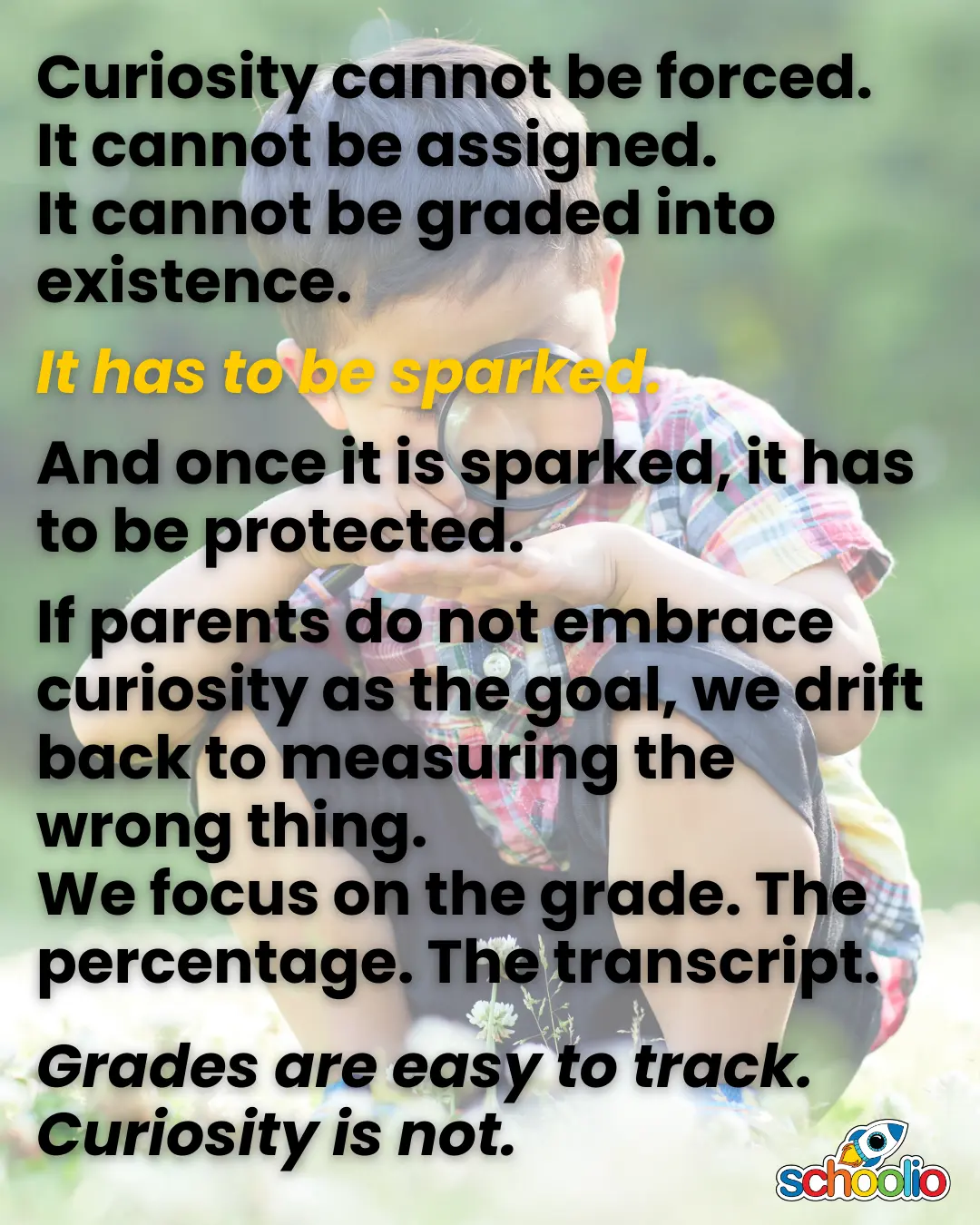
Curiosity Cannot Be Forced. It Has To Be Sparked.


This has been on my mind today…

I think about curiosity all the time.

As a dad. As a CEO at Schoolio.

Academics can be taught. With enough repetition, most kids can memorize what they need to pass a test. The system is built for that.

But curiosity is different.

Curiosity cannot be forced. It cannot be assigned. It cannot be graded into existence.

It has to be sparked. And once it is sparked, it has to be protected.

Growing up South Asian, curiosity was not exactly encouraged. The path was clear. Study hard. Choose the right career. Do not wander. Wandering looked risky. Distracting. Like falling behind.

Curiosity pulls you sideways. The system pulls you forward.

That tension shapes a lot of childhoods.

We designed Schoolio to spark curiosity. Short lessons. Flexible pacing. Space to explore. Room to ask why.

But here is the real tension.

If parents do not embrace curiosity as the goal, we drift back to measuring the wrong thing. We focus on the grade. The percentage. The transcript.

Grades are easy to track. Curiosity is not.

And yet, as adults, it is curiosity that drives innovation. It builds companies. It fuels reinvention. It is what pushes someone to keep learning long after school is over.

No one asks what your grade was in middle school science.

But the ability to ask better questions. That follows you for life.

At Schoolio, academics matter. Mastery matters.

But curiosity is the engine.

Our job is not just to help kids pass.

It is to help them stay curious long enough to build something meaningful with what they learn.


Sathish

still learning, still unlearning

When “Grade-Level” Tests Make Homeschool Parents Feel Like Failures

When “Grade-Level” Tests Make Homeschool Parents Feel Like Failures


This has been on my mind today…

I talk to so many homeschooling parents who have had this moment:

They run a school-based diagnostic test to see if their child is “on grade level”.

They see a score they weren’t expecting.

And suddenly, their confidence collapses.

“I think my kids have fallen behind.”

“I feel like I’ve failed them.”

“Did homeschooling make them lose skills?”

Let me say this clearly, as both a former teacher and a homeschooling mom:

School-based testing does not measure your child’s intelligence.

And it absolutely does not measure the value of your homeschool.

Most of these assessments — especially the popular ones families use to “check grade level” — were designed for traditional classrooms. They measure a very specific thing: a child’s ability to memorize and recall the exact skills schools have decided are important, in the exact format they expect.

That’s it.

They usually test math and language.

They don’t test problem-solving.

They don’t test creativity.

They don’t test if your child is happier, more confident, or less anxious than they were in school.

They don’t test emotional regulation skills.

They don’t test adaptability, curiosity, persistence, or resilience.

And yet those are the very skills that matter most once school is over.

Here’s something else most parents don’t realize:

The human brain only retains information for two reasons.

  1. Intrinsic interest — the learner genuinely cares about the topic.
  2. Perceived usefulness — the learner understands why this information matters in their real life.

Everything else? The brain offloads.

This is why retention in public school is so low. It’s why every fall, teachers spend weeks “reviewing” material kids supposedly learned the year before — and most students swear they were never taught it. They were. Their brains just didn’t keep it.

We adults are no different.

If most of us took a grade 7 math test today, we’d struggle — unless we’re naturally “math people” (intrinsic interest) or use it regularly in our work (perceived usefulness). That doesn’t make us less intelligent than a seventh grader. It just means we’ve let go of information we don’t need.

Kids do the same thing.

So when a homeschool parent sees a test score and panics, what they’re often seeing isn’t “lost intelligence.”

They’re seeing a mismatch between how the brain actually learns and how schools measure learning.

Homeschooling offers something radically different — and far more valuable. It teaches kids how to learn. How to ask questions. How to find information when they need it. How to notice what interests them and pursue it deeply. How to persist through challenges without shame.

Those skills don’t show up on standardized diagnostics.

But they show up everywhere else in life.

Now, if it’s important to you that your child aligns closely with public school benchmarks, that’s okay. Homeschooling isn’t one thing — it’s yours to shape. You can absolutely use test results as information, identify gaps, and choose to work on specific skills.

What I don’t want you to do is let those numbers define your child — or yourself.

Your kids are not checkboxes.

Your homeschool is not a failure because it doesn’t mirror school.

And you are not doing this wrong because your child’s brain didn’t perform on demand for a system you intentionally stepped away from.

Please take school-based tests for what they are: limited tools, not verdicts.

You are building something bigger than scores.

Something more human.

And that matters far more than any diagnostic ever will.


? Lindsey

Certified Special-Ed Educator & Co-Founder, Schoolio

Why Different Isn’t Wrong

Why Different Isn’t Wrong

I’ve been called a lot of things growing up. Dumb. Stupid. Social butterfly. But the one that stuck with me the most was weird. That word followed me through school hallways, into classrooms, and even outside of school. Most of the time, people didn’t say it to hurt me. They just didn’t understand me. I saw the world differently, noticed things others didn’t, and asked questions that didn’t have simple answers. And I wasn’t trying to fit in. I just didn’t feel like I needed to.

For a long time, I thought being different meant something was wrong with me. I believed the labels. I thought maybe I really was all those things. But over time, I began to realize that the problem wasn’t me. People often label what they can’t understand. It helps them feel like they’ve figured something out. Like sorting clothes into piles when you don’t know where something belongs. It doesn’t mean the clothes are bad. It just means you’re not sure where they fit.

As I got closer to the families who use Schoolio, I started to see pieces of myself in the children they were teaching. I saw it in the kids who struggled to sit still. In the ones who asked more questions than most teachers had time to answer. In the learners who didn’t follow the same path as everyone else. These kids weren’t broken or difficult. They were just full of a different kind of energy. The kind that doesn’t always show up the way school expects it to.

And the parents who choose to homeschool these children are some of the bravest people I’ve met. They don’t take the easy path and don’t choose homeschooling because it’s convenient. Parents do it because they want their child to feel seen and because they believe there’s more than one way to learn. They do it because their child needs something different, and they’re willing to build it themselves.

I think about how far I’ve come. From the kid who didn’t fit in, to someone who gets to support other kids who feel the same way. It’s not about fixing them—it’s about walking alongside them. Being different isn’t something to hide; it’s a part of who they are. And most of all, it’s something to be proud of.

At Schoolio, we get to be a small part of that journey. We get to help children feel understood. And we get to remind parents that their choice to take the road less travelled matters. Because sometimes, that road leads to the most incredible places.


Sathish

still learning, still unlearning

Why Schoolio Is a Better Choice Than MiAcademy for Most Homeschool Families

Why Schoolio Is a Better Choice Than MiAcademy for Most Homeschool Families

MiAcademy is a popular homeschool program that’s been around for more than 20 years. It’s familiar. It’s easy. And if you’re looking to replicate traditional school at home with a little fun and games mixed in, it has a straightforward setup, a full list of core subjects, and a digital interface that feels familiar to kids coming out of the classroom.

But most families don’t start homeschooling because they want to recreate the classroom. They do it because the classroom wasn’t working.

You want something better for your kids.

Something more flexible, more purposeful, more in tune with your child’s unique needs, and something that gives you, the parent, more control to design the perfect program for your unique child and your unique family, especially those raising neurodivergent, curious, or outside-the-box learners.

That’s where Schoolio stands apart.

Both Schoolio and MiAcademy are digital homeschool programs, but they have some important differences. MiAcademy is a solid choice for families who want to follow a school-at-home model and aren’t bothered by having to supplement with other programs where digital learning falls short.

Schoolio is different.

It’s a whole new way to homeschool, built from the ground up by real homeschoolers, with modern families and neurodivergent learners in mind.

If you’re looking for a truly complete program with real customization, neurodivergent-friendly content, offline learning options, and the kind of future-ready education that will help your child thrive in the future, Schoolio is the clear winner.

Here are the top 5 reasons why Schoolio is a better choice than MiAcademy:


1. MiAcademy Courses Mirror School. Schoolio Builds Future-Ready Kids.

MiAcademy keeps things fairly simple when it comes to course offerings. Their non-core options are limited to Music & Art, World Languages, Life Skills, and Biblical Studies. And that’s pretty much it.

Schoolio goes far beyond that and offers hundreds of courses across a much broader range of subjects. We also offer an entire library of Future Readiness content, our one-of-a-kind collection you won’t find anywhere else.

Our Future Readiness courses include:

  • Financial Literacy (because balancing a budget is more useful than memorizing Pythagorean theorem)
  • Emotional Intelligence (because kids who understand themselves and others do better in life)
  • Emerging Technologies (because our kids are growing up in an digital-first world, and they need to understand how it works)

These courses are built with real-world relevance in mind, helping your child develop both academic skills and practical, future-ready thinking. This isn’t filler content. It’s the future. And it’s only at Schoolio.


2. Schoolio Is Designed for Neurodivergent Learners

This one’s huge, and it’s where many online programs miss the mark entirely.

If you have an ADHD or Autistic child, you already know that most educational platforms weren’t built with them in mind. MiAcademy, while decent in terms of simplicity and structure, doesn’t offer any specialized support for neurodivergent learners.

Schoolio does.

In fact, we’re the only homeschool curriculum platform intentionally designed to support and accommodate neurodivergent students.

We built our content and platform to maximize short attention spans, reduce redundancy, limit cognitive overwhelm, and allow for the flexibility neurodivergent learners often need. We have multiple ways to engage, and allow parents to switch between Scheduling Mode (for routine and structure) and Exploration Mode (for flexibility and curiosity-driven learning).

Our goal? To help families find what works, without power struggles or meltdowns. When your child feels successful and supported, everything changes.


3. Schoolio Costs Less and Delivers Way More

Let’s talk money.

Homeschooling families are often working with tight budgets, we understand, we’ve been there. At the end of the day, cost matters. MiAcademy’s pricing at $42/month per child is higher than our complete digital package (including every Schoolio course and every grade level) at just $39.99/month. And we offer 30% off for siblings, and a military discount too. Want to save even more? We also have discounted annual plans.

More flexibility. More content. Less money. It’s a no-brainer.


4. Schoolio’s ELA Program Crushes MiAcademy’s Lightweight Approach

ELA (English Language Arts) is often where fully online programs fall short, and MiAcademy is no exception.

Yes, they cover the basics: vocabulary, some reading comprehension, and grammar. But let’s be honest, a few vocab games and short reading passages won’t help your child become a thoughtful, articulate writer.

At Schoolio, we believe a strong ELA program must include:

  • Real novel studies
  • Essay and research writing
  • Creative writing and structured reflection
  • Oral communication and presentation skills

Our ELA curriculum goes far beyond multiple choice and true or false questions. We help your child build the writing, reading, and critical thinking skills they need to express themselves clearly and powerfully while building a love of reading and writing.

Our ELA program has been praised by homeschool parents as being simultaneously robust in its coverage and easy to implement for resistant writers and neurodivergent kiddos.


5. The Adaptive Learning Model: Offline + Online = Smarter Homeschooling

MiAcademy offers optional printable PDFs, but they’re not designed to be part of the main program flow, more as an optional add-on, and they’re not annotatable or savable, you have to print or save them and use a different program to annotate, then keep those for your records somewhere else. In other words, they’re a nice-to-have, not a core feature.

At Schoolio, we do things differently.

Our [Adaptive Learning Model](https://schoolio.com/programdesign/?) blends the best of both worlds: online tools and offline learning. You and your child get all the benefits of digital education: interactive lessons, flexible scheduling, auto-grading, and a dashboard to track progress. But that’s just the beginning.

We believe screen time should support learning, not dominate it.

That’s why every Schoolio course includes offline activities that often include hands-on activities such as:

  • Science experiments
  • Art projects
  • Outdoor exploration
  • Critical thinking and reflection
  • Opinion writing and research
  • Speeches and oral presentations

These aren’t just extras, they’re built into the curriculum intentionally, because we know kids learn best when they can connect ideas to the real world.

MiAcademy gives you a browser tab and calls it a day.

Parents love the balance. Kids love the variety. And everyone gets a break from staring at screens all day.


The Bottom Line: MiAcademy Imitates. Schoolio Innovates.

If you want to recreate the classroom on a screen, MiAcademy will check the boxes.

But if you’re homeschooling because your child deserves something better — something more human, more flexible, more real — Schoolio is your answer.

  • More future-focused content
  • Built-in neurodivergent support
  • Comprehensive ELA
  • True hybrid learning
  • All for less money

And if that weren’t enough, Schoolio is now WASC accredited, supports microschools around the world, and continues to launch new courses and innovative features to serve today’s learners, not yesterday’s model.


Experience the difference for yourself.

? Learn About Schoolio’s Mission and Founders

? Start your 7-day free trial