Homeschool Curriculum in Canada: A Comprehensive Guide

Choosing the right homeschool curriculum can feel overwhelming, especially when you’re trying to align it with the educational standards of Canada. Many parents find themselves stuck between wanting a comprehensive program and needing something flexible enough to fit their unique family dynamics. If you’re in this boat, you’re not alone, and there’s a way to navigate this with confidence.

Understanding Homeschool Curriculum in Canada

When it comes to selecting a homeschool curriculum in Canada, the first thing to understand is the provincial guidelines. Each province has its own educational standards, and while homeschooling allows for customization, it’s essential to ensure your curriculum aligns with these standards. This not only helps keep your children on track with their peers but also eases transitions should they ever enter or re-enter the public school system.

For instance, in Ontario, the curriculum guidelines emphasize language arts, mathematics, science, and social studies, while British Columbia includes a focus on indigenous education and environmental stewardship. Understanding these nuances can help tailor your homeschool curriculum to meet provincial expectations.

Several resources, like Schoolio’s Canadian curriculum, offer detailed guides to help you match your homeschooling efforts with provincial expectations. This is a great starting point for parents who want to feel confident in their educational approach.

Benefits of a Canadian-Focused Homeschool Curriculum

Opting for a Canadian-focused homeschool curriculum brings numerous benefits. Firstly, it ensures that your child learns about Canada’s history, geography, and cultural heritage in a way that’s relevant and meaningful. This is particularly important for social studies and history lessons, which can vary significantly from American curricula.

For example, a Canadian curriculum might include detailed studies of the Canadian Confederation, the role of the fur trade in Canadian history, and the significance of the Charter of Rights and Freedoms. These topics not only educate but also instill a sense of national identity and pride.

A Canadian curriculum also incorporates local currency, measurement systems, and environmental studies, making practical applications much easier for children to grasp. These relatable examples help children understand their world better and apply their learning to everyday situations. Imagine your child calculating change using Canadian coins or measuring ingredients for a recipe using metric units—these are practical skills that a Canadian curriculum can enhance.

Customizing Your Curriculum for Family Needs

One of the greatest advantages of homeschooling is the ability to tailor the curriculum to fit your family’s needs. Whether your child is a visual learner or thrives with hands-on activities, you can customize lessons to suit their learning style. This flexibility is particularly beneficial for families with children at different educational levels, allowing each child to progress at their own pace.

To start customizing your homeschool curriculum, consider these steps:

  • Identify your child’s learning style (visual, auditory, kinesthetic). For example, if your child is a visual learner, incorporate more diagrams, videos, and visual aids into their lessons.

  • Choose subjects that interest your child to boost engagement. If your child loves animals, consider including a unit on Canadian wildlife in your science curriculum.

  • Incorporate real-world learning experiences, like field trips and experiments. A trip to a local museum or a nature walk can bring lessons to life.

  • Adjust the pace according to your child’s comprehension and interest. If your child excels in math, allow them to advance quickly, while providing more time for subjects they find challenging.

Resources like Schoolio’s blog offer additional tips and ideas for customizing your curriculum.

Overcoming Common Homeschooling Challenges

Homeschooling presents its own set of challenges, but with the right mindset and resources, they are manageable. One common struggle is maintaining a structured schedule. It’s important to establish a routine that balances academic learning with breaks and extracurricular activities. This helps prevent burnout and keeps learning fresh and engaging.

Another challenge is finding a community. Connecting with other homeschooling families can provide support, ideas, and social interaction for your children. Many cities in Canada have homeschool groups that meet regularly, and online communities are also available. These groups can offer advice, organize group activities, and provide a sense of belonging.

Evaluating Your Child’s Progress

Assessing your child’s progress is fundamental in ensuring the effectiveness of your homeschool curriculum. Unlike traditional schools, where testing is often standardized, homeschooling allows for more personalized assessment methods. Consider using a mix of evaluations such as quizzes, projects, and oral presentations to gauge understanding.

It’s also important to have regular check-ins with your child about their learning experiences. This not only helps you understand their progress but also builds their self-assessment skills, which are valuable for lifelong learning. Encourage your child to reflect on what they’ve learned and discuss any challenges they face.

Choosing a solid homeschool curriculum in Canada doesn’t have to be overwhelming. With resources like Schoolio, you can craft an educational plan that’s both comprehensive and adaptable to your family’s needs. Check out Schoolio’s offerings to see how they can support your homeschooling journey with confidence.

Suggested internal links:

Don’t Let School Convince You You’re Not Smart

Don’t Let School Convince You You’re Not Smart


My daughter and I spent several hours tonight studying for her math test tomorrow.

She’s neurodivergent. She struggles in math and English because of dyslexia and dyscalculia. There were a lot of tears. And at one point she said something that broke my heart:

“I wish I could just be as smart as everyone else.”

?

So I told her the truth.

Sweetie, everyone has hard things and easy things. Everyone.

This is your hard thing. Reading and numbers are harder for you. They just are. But that doesn’t mean you aren’t smart.

Here’s what no one tells you about school:

School is centered around reading and numbers.

Independent reading is how one adult manages thirty kids in a classroom. Tests are how large groups are measured quickly. The whole structure depends on literacy and numerical processing.

So if reading and numbers are your hard things, school will feel hard.

That doesn’t mean you’re not smart.

It means the system is built around your area of challenge.

And here’s another truth about school:

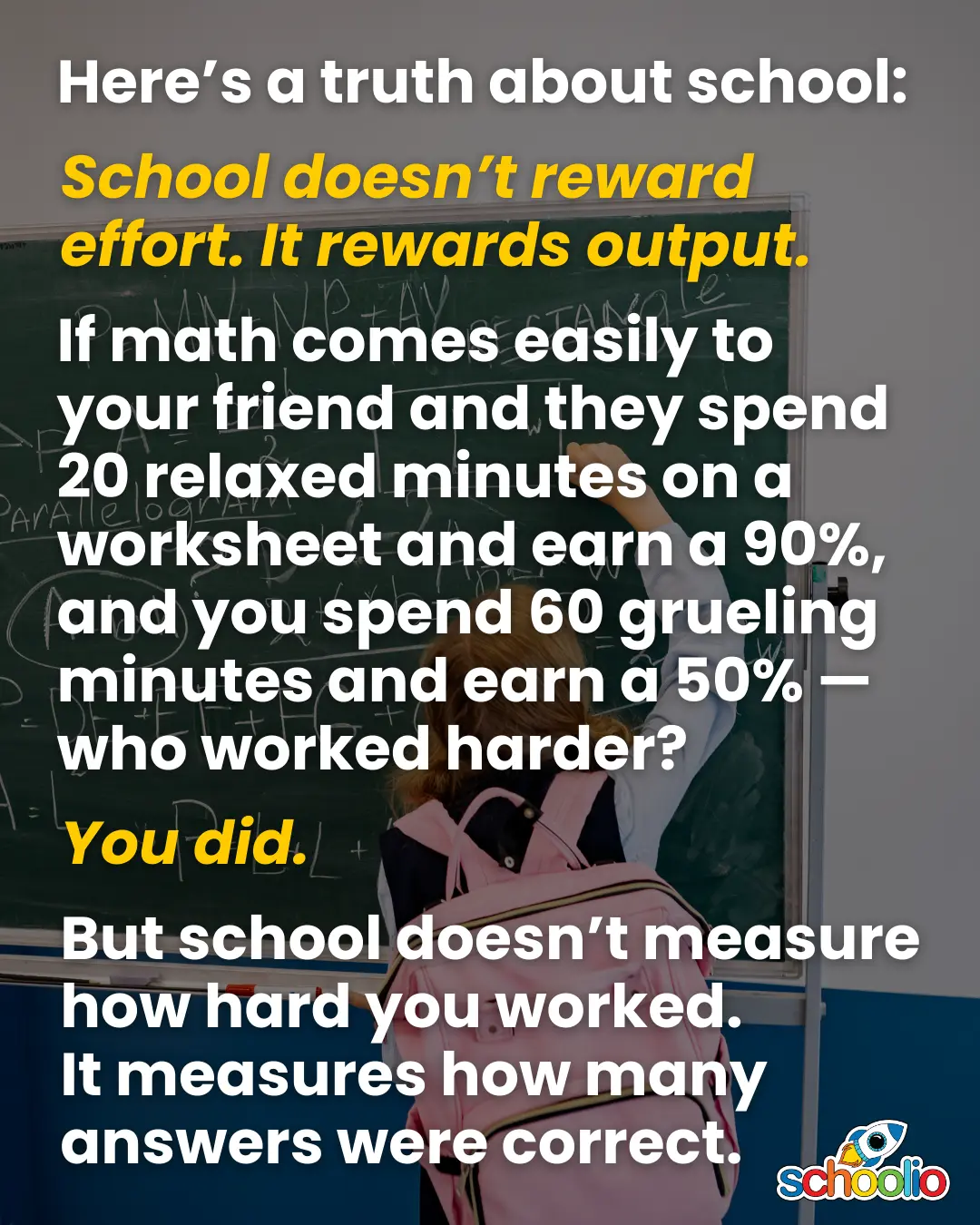
School doesn’t reward effort. It rewards output.

If math comes easily to your friend and she spends 20 relaxed minutes on a worksheet and earns a 90%, and you spend 60 grueling minutes and earn a 50% — who worked harder?

You did.

But school doesn’t measure how hard you worked.

It measures how many answers were correct.

Now imagine something different.

If school were centered around creativity…

or engineering-thinking…

or musical instinct…

or empathy and thoughtfulness…

or responsibility and trustworthiness…

You would be at the top of the class.

You would be absolutely crushing it.

But school doesn’t prioritize those traits.

But guess what? The real world does.

The real world cares that you show up on time.

That you think outside the box.

That you treat people with kindness.

That you keep going when things are hard.

The real world doesn’t care if you use a calculator to figure out a tip.

It doesn’t care if you prefer audiobooks over printed pages.

It doesn’t care how quickly you finish a worksheet.

The most powerful skill you’ll carry into adulthood isn’t mental math.

It’s perseverance.

It’s knowing how to work hard at something that doesn’t come easily.

So please — don’t let school convince you that you’re not smart just because it has a narrow definition of what counts.

Don’t let it shrink how you see yourself.

Don’t let it break your spirit.


? Lindsey

certified special-ed educator, homeschool mom, & co-founder of Schoolio

When a Mom in Our Community Answered a Simple Question with One Word.

When a Mom in Our Community Answered a Simple Question with One Word.


This has been on my mind today…

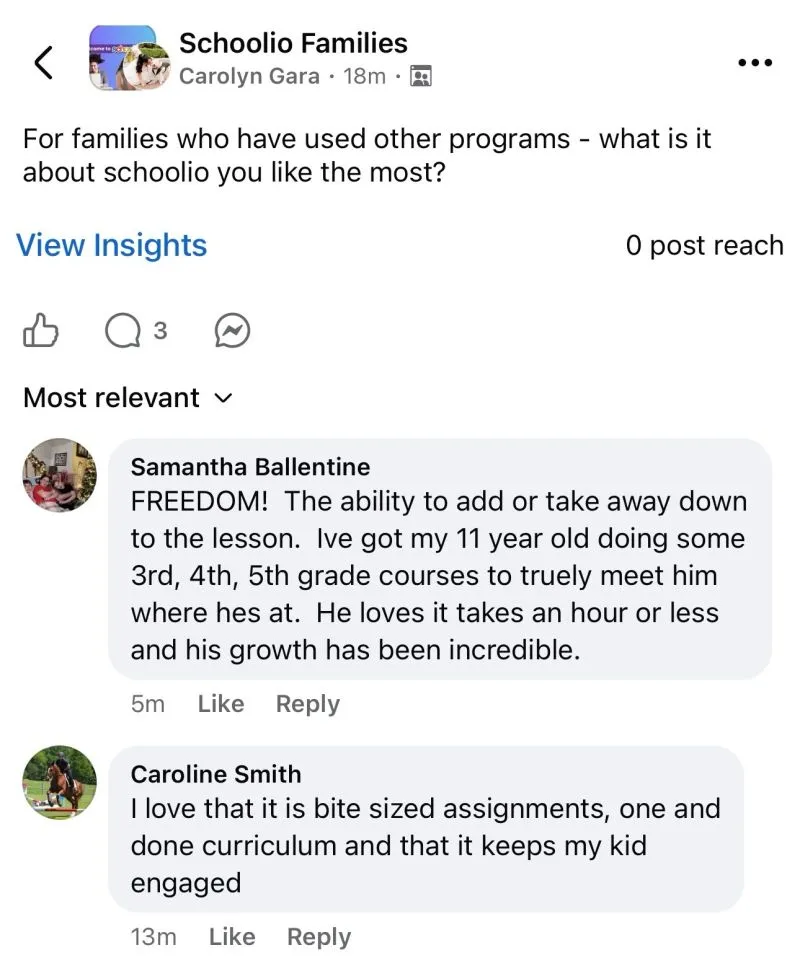
A mom in our community answered a simple question with one word.

Freedom.

Not freedom from learning. Freedom inside learning.

One parent shared that her eleven year old moves between third, fourth, and fifth grade work depending on the subject. Not because he is behind. Not because he is ahead. Because that is where he is.

Another said she loves the bite sized, one and done lessons. Her child stays engaged. It takes less than an hour. Growth has been incredible.

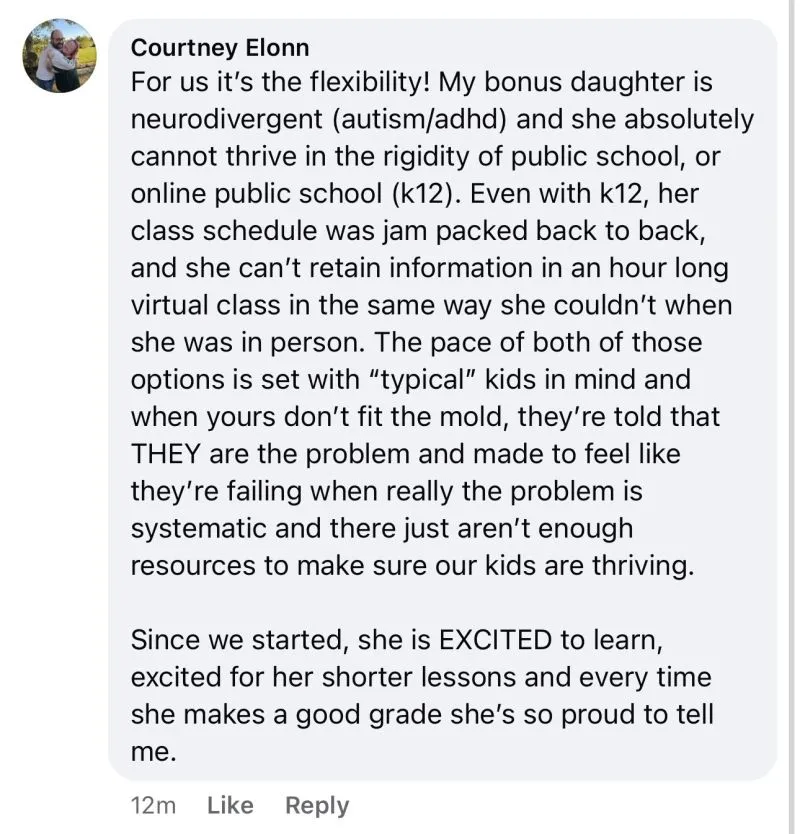
And then a mom of a neurodivergent daughter said something that hit hard. In public school and even online public school, the pace was built for typical kids. When her child could not keep up, she was made to feel like the problem.

Since switching, her daughter is excited to learn. Proud of her grades. Thriving.

This is why homeschooling is becoming more normal across the world.

It is not about escaping school. It is about building systems that adapt to kids instead of asking kids to adapt to systems.

When parents say freedom, what they mean is their child finally fits.


Sathish

still learning, still unlearning


The Harder Path Forward

The Harder Path Forward


customer feedback

I didn’t understand the courage it took until years later.

When my family immigrated to Canada, I was angry. I didn’t have the words for it at the time, but every part of me resisted this new life. I missed my friends, my neighbourhood, my routines. I was a teenager lost between two worlds—resentful of the change, and confused by the silence I had to carry with me in every classroom, every hallway, every awkward introduction.

People looked at me differently. Sometimes with curiosity, sometimes with judgment, but always with the weight of assumptions I hadn’t earned. The stereotypes followed me. So did the loneliness.

Back then, I thought my parents were wrong. I thought they didn’t understand what I had lost. But as I grew older—became a parent, built a life, listened to others—I began to see the truth I’d missed entirely.


It wasn’t an escape. It was a sacrifice.


They had uprooted everything they knew for a sliver of possibility—a better education, a safer life, a shot at something bigger than what we’d left behind. And they did it quietly. Without recognition. Without thanks. Without certainty. Just faith.

That story echoes again and again in the lives of homeschooling families we meet at Schoolio. While the world rushes to label them—too radical, too soft, too unqualified—what we see is something different. We see courage. We see parents choosing a harder path, not because it’s easier, but because it’s right for their child.

It’s not a summer experiment. It’s not a last resort. It’s a quiet, determined rebellion against a system that no longer fits.

And here’s the question we rarely stop to ask: if the traditional school system—funded, structured, and normalized—is so perfect, why are so many parents choosing to leave it behind?

Why are they willing to rebuild an entire learning experience from scratch?


Because sometimes love means walking uphill.


At Schoolio, we don’t see homeschoolers as fringe or fearful. We see them as architects of something new. Builders of bridges their children can walk across safely. Parents who are saying, “I will not wait for the world to catch up. I’ll start right here.”

And for those of us who have walked a harder path before, we know exactly how much strength that takes.

Sathish
still learning, still unlearning

Why I Stopped Worrying About Learning Gaps

Why I Stopped Worrying About Learning Gaps

By Lindsey, certified special-ed educator & co-founder, Schoolio

This has been on my mind today…

The weight of comparison. It sneaks in quietly. A friend tells you what their child is learning in school. A neighbor asks about your homeschool “schedule.” You catch a glimpse of someone’s color-coded curriculum plan on Instagram. Suddenly your confidence starts to unravel.

I remember this feeling most clearly when my oldest was around eight or nine. We were deep into homeschooling, but I was constantly looking over my shoulder at what public school kids were doing. Were we covering the same content? Were we behind? Was I doing enough?

It became exhausting. I was trying to replicate school at home—not because it worked for us, but because I thought that’s what “real” education looked like.

Here’s the truth I had to learn the hard way: homeschool doesn’t need to imitate public school to be valid. In fact, the whole point is that it doesn’t.

I kept coming back to a simple question. If I can’t remember what I learned in third grade, why was I putting so much pressure on myself to make sure my child retained every single concept in the third grade curriculum? I realized I was clinging to a system I didn’t even believe in—one I had left behind for a reason.

When kids are in school, they’re taught for a set number of days, then tested. If they get a 60%, that means they missed 40%—and the class moves on. No one loops back. No one stops the train. That’s a gap. A big one. But it’s accepted.

In our homeschool, if my child gets sick or we need to pause for emotional rest, schoolwork pauses. School doesn’t go on without them on sick days, it waits for them. We don’t pretend 60% is good enough. The beauty of this lifestyle is that learning pauses with the child and picks up again when they’re ready.

That alone makes a massive difference.

And the truth is, we all have learning gaps. Adults included. Because humans only retain what they find meaningful. You can make a child memorize facts for a test, but they’ll likely forget most of it after. If something isn’t relevant to their lives, it doesn’t stick. So whether you never cover it, or they forget it, the result is the same.

That realization gave me freedom.

I stopped obsessing over whether we had checked every box. I started asking better questions: Was my child curious today? Did we connect? Did they ask questions that mattered to them? Those were my new benchmarks.

And wouldn’t you know—it made everything easier. They were learning more, not less. And I was enjoying it more, too.

So if you’re caught in that loop of comparison, wondering if your homeschool is “real” enough, let me gently offer this: your homeschool is enough because it’s yours. Because it fits your child. Because it’s rooted in love, flexibility, and intention.

That’s not falling behind. That’s choosing to lead.

certified special-ed educator & co-founder, Schoolio


? Need help trusting your homeschool rhythm?

Start with our free homeschool planner, explore flexible curriculum bundles, or try our 7-day trial to see how it can work in your home.

Why We Need to Redefine What ‘Progress’ Looks Like in Homeschooling

Why We Need to Redefine What ‘Progress’ Looks Like in Homeschooling

Voice: Sathish

This has been on my mind today…

The word “progress” shows up a lot when we talk about education. Are they on grade level? Are they reading at the right age? Are they behind? Ahead? Caught up? We use these markers like a ruler held up against our kids — even when we know, deep down, that learning doesn’t work that way.

I’ve spoken to so many families who felt pressure to make their homeschool look like school. If their child wasn’t hitting the same pace or benchmarks, something must be wrong. But more and more I’m hearing stories from parents that flip that narrative completely.

Like Suzanne. Her son is autistic and in grade 6. They were searching for something — anything — that would actually work for him. She called finding Schoolio a “game changer.” For the first time, her son is doing really well. Not just keeping up — thriving. Not because someone pushed him through a one-size-fits-all curriculum, but because they finally found a platform that met him where he was.

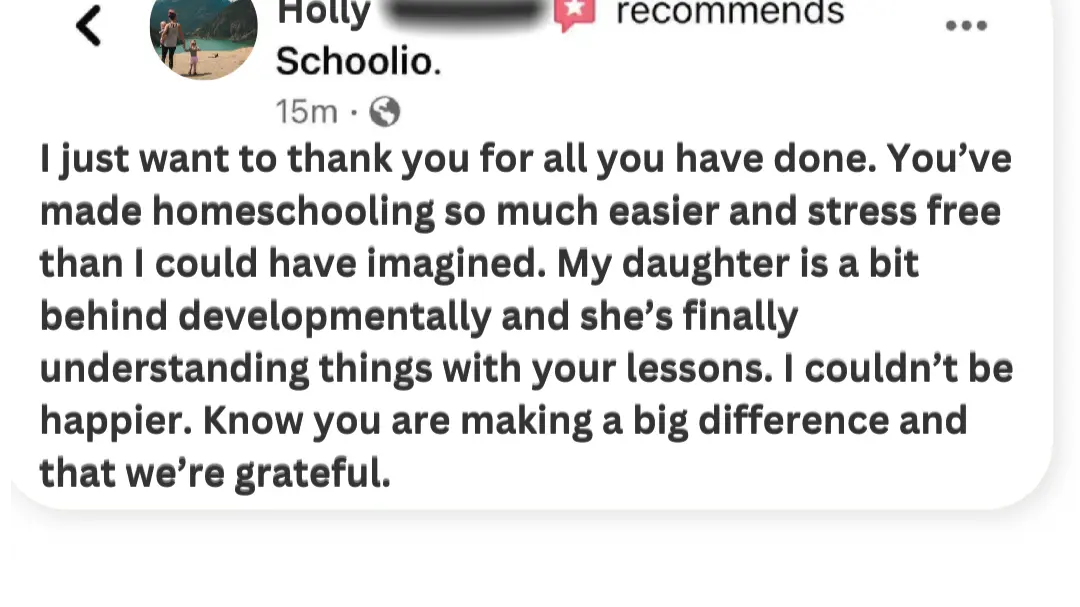
Or Holly, who told us her daughter was developmentally behind and struggling to understand things. Public school left her confused and overwhelmed. But now? With Schoolio lessons, she’s finally understanding. She’s gaining confidence. She’s calm and learning. And Holly said, “I couldn’t be happier.”

These stories remind me that real progress isn’t always loud. It doesn’t always show up on a test score. Sometimes progress is your child smiling during a lesson instead of crying. Sometimes it’s the first time they ask to keep going. Or the first time they feel safe enough to say, “I don’t get it,” and actually get the support they need.

We have to unlearn the idea that speed equals success. Learning isn’t a race. If your child needs more time to grasp a concept, that’s not failure — that’s human. Especially for neurodivergent learners or kids recovering from years of being overwhelmed by noise, rules, and fast-paced instruction.

Progress can be your child doing less… but doing it with joy. It can be fewer meltdowns. More calm. Asking questions again. Finding confidence. Progress might not be a straight line. But when we build learning around the child — not the system — it shows up in ways that actually matter.

So if you’re homeschooling and worried that your child is “behind,” take a breath. Ask yourself — are they more curious? More relaxed? Starting to enjoy learning again?

That might be the most important kind of progress there is.

Sathish

still learning, still unlearning


Schoolio vs. IXL: Why Relentless Quizzing Isn’t Enough for a Real Homeschool Education

Schoolio vs. IXL: Why Relentless Quizzing Isn’t Enough for a Real Homeschool Education

IXL is a familiar name in education. It’s used in thousands of schools across North America as a diagnostic tool, helping teachers assess students, assign drills, and place them based on grade-level standards.

And it does that job well.

But , you’re not a school.

IXL was built for schools, not homeschoolers.

If you’re homeschooling, your needs, and your child’s needs, are completely different than a classroom. You’re not trying to sort your child into a percentile or optimize for standardized test scores. You’re trying to create a meaningful, personalized education that actually helps your child learn, grow, and be ready for their future.

Schoolio was built for that.

Schoolio a full curriculum made by real homeschoolers who know what works, especially for neurodivergent and outside-the-box learners.

If you’re using IXL right now and it’s working as a supplemental tool, that’s great. But if you’re trying to use it as your primary curriculum- or if you’re wondering what else is out there- here are the top five reasons why Schoolio is a better fit for most homeschool families:


1. Complete Curriculum vs. Just Practice

Let’s get this out in the open: IXL doesn’t actually teach. It drills.

What is curriculum? Curriculum is a program of learning. It’s different than a workbook of pages of practice or, in the case of IXL, endless quizzing on concepts. Real curriculum includes lessons that teach those concepts, along with activities to help solidify the knowledge. All of this happens before we can quiz a child on what they’ve learned (if we even want to quiz them, which lots of homeschoolers do not.)

IXL has no lessons, no step-by-step teaching content, no built-in scaffolding. It’s designed for review, not instruction, and that means you’re left to fill in the gaps yourself.

“It’s straight drill practice… no teaching.”

Parent on the Well-Trained Mind Forum

“We use IXL for practice and reinforcement, but it wouldn’t work as our only curriculum. It would be frustrating and boring.”

Reddit homeschooling parent

Schoolio gives you everything in one place. Each course includes online lessons, hands-on learning activities, and digital quizzing- the complete package. You’re not piecing things together with Schoolio, you’re following a creating a learning path that adapts to your family’s needs.


2. Deep Learning: Online + Offline, Not All Screen

IXL is entirely online. That might seem convenient at first, until your child is zoning out after an hour of endless question banks, losing motivation, or worse- feeling frustrated because they’re being drilled on concepts they weren’t taught.

Schoolio takes a blended model approach that blends interactive digital lessons with hands-on offline activities, so your child isn’t missing out on the joyful learning moments that come from science experiments, art projects, outdoor exploration, and critical thinking tasks.

It’s called the Adaptive Learning Model, and it was created to help kids:

  • Build digital literacy
  • Learn through experience
  • Avoid screen fatigue

Because when we talk to parents, most of them don’t actually want their entire homeschool day to happen on a screen.


3. An Actual ELA Program

English Language Arts is where the cracks in most online platforms really start to show, and IXL is no different.

Yes, IXL covers grammar and vocabulary. But that’s about it. There’s no deep literature studies, no writing instruction, and certainly no space for creativity or self-expression.

Schoolio’s ELA program is a different story. Your child won’t just memorize grammar rules and vocab words, they’ll learn to use and love reading and writing. We cover:

  • Novel studies that take them deeper into literature, forming opinions and connections and drawing ideas and conclusions,
  • Essays, narrative writing, persuasive writing, research projects, and more
  • Creative and reflective writing
  • Oral communication and presentation skills

We’re here to raise confident communicators, not just kids who know where the comma goes.


4. Future-Ready Education, Because the Future Is Coming Fast, and Our Kids Need to Be Ready

IXL sticks to traditional core subjects: math, language arts, science, and social studies.

That’s fine, but it’s not enough.

Our kids are growing up in a world that’s evolving fast. They need life skills, emotional awareness, and tech fluency to succeed.

Schoolio offers Future Readiness courses you won’t find anywhere else, including:

  • Financial Literacy
  • Social Skills & Emotional Intelligence
  • Emerging Technologies

This is real-world learning for real-world kids. No drill platform can do that.


5. Designed with Neurodivergent Learners in Mind

This might be the biggest one of all.

IXL is known to be frustrating for neurodivergent learners. The “smart score” system penalizes mistakes and can create intense anxiety for kids who don’t test well or who struggle with working memory or processing speed. There’s no option to adjust pacing, remove streaks, or present content differently.

“My kid was crying after getting one wrong and losing points. This is not how learning should feel.”

Reddit parent

Schoolio was intentionally designed to support ADHD and Autistic learners.

From our uncluttered layout and short lesson formats to our flexible learning modes (Scheduling Mode for routine, Exploration Mode for curiosity), everything is created to reduce overwhelm and increase success.

We also recognize that neurodivergent kids often have uneven skill profiles and can be advanced in one area and behind in another. Our platform makes it easy to mix and match grade levels across subjects, include subjects that are of interest to your child, and set your own schedule, pacing, and intensity.


Bonus: What About IXL as a Diagnostic Tool?

If you’re curious how your child compares to public school grade levels, IXL can be a helpful diagnostic tool. Some homeschool families use it for that reason.

But please be careful not to use public school as your gold standard, especially for neurodivergent learners, who often underperform on traditional tests despite having deep knowledge and insight in specific areas.

A better approach? Use IXL occasionally if it helps you feel anchored, but don’t let it replace a real curriculum, and please don’t let it make you feel inadequate in your homeschooling. If you’re worried about your child’s progress, book a one-on-one call with a Schoolio Teacher who has also homeschooled and get real advice and support on your journey.

Your child deserves more from their education, homeschool experience, and childhood than just a drill-and-score routine.


The Bottom Line: Drill vs. Depth

Feature IXL Schoolio
Full Curriculum
Teaching + Instruction
Offline Learning
Future-Readiness Courses
ND-Friendly Design

IXL was made for the classroom. Schoolio was made for you.

If you’re homeschooling because school wasn’t working, if you want something built for your child’s strengths, struggles, and future, then Schoolio is your better option.


Ready to experience the difference?

Start your free trial or explore our full library today:

? Explore the Program Design

? Start Free Trial

? See How We Support Neurodivergent Learners

Staying in the Moment as a Homeschool Mom

Staying in the Moment as a Homeschool Mom – Guest blog by Tawny Stowe

The idea of being in the moment has been on my mind a lot lately as I contemplate and experience the concepts of time. As a young adult I thought I had all the time in the world. I was certain I could reinvent myself a million times and I never felt committed to one aspect of who I was becoming because I viewed that there would always be more time. Now I find myself seeking out ways for staying in the moment as a homeschool mom.

My younger days.

I travelled the world as a backpacker carrying only what I could on my back. I lived in each moment knowing almost always it was my very first and last in any given spot.  Sometimes the thoughts of what tomorrow would bring and where I would be next would creep into my mind. Especially in the beginning of my travelling adventures, the beautiful gift of being somewhere new often found me thinking about where I would be tomorrow. Then what was coming next, This then led me to missing the gift of being present in the moment and appreciating that part of the journey.

And then something happened.

I stopped travelling and I grew up.  Soon I became serious and I started to fear never having enough time to become myself. Here I find myself still figuring out what I have become and what I am becoming. However there was a definite sense of urgency at that time in my life. As I hit 30 years old, I started to panic. Thoughts about getting married, owning things like a house or a car, and raising a family became my priority. I found myself panicking about my education, my career and becoming of value in our society. Soon these thoughts took me over. Suddenly each day was only about getting further ahead in the future, not about being in the moment.

I didn’t realize how much this affected me.

Truly I hadn’t thought much about how this was affecting me. That is not until I became a parent and switched to homeschooling. First, I was so consumed by what I was preparing my child for in the future. Second, I was obsessed with Making sure I understood the expectations of a child’s growth and learning development. Third, I was in a state of worrying. Additionally, making my child the most prepared for each new developmental stage took centre stage. I wanted him to be the best he could be for tomorrow.

Through all of this, I noticed something; he was starting to play less in each moment and rather ask about what was coming next.

He was hiking the trail asking what we were doing after and the reality check of what I was projecting on him suddenly hit me. Was I teaching my child to focus ahead instead of just being ok right where we are? Being highly empathic his words got my attention. However it was what I could feel that really hit me. In my son I could feel emotional anxiousness about the day, the objectives, the expectations. This truth hurt my heart. See, as a parent of a child with diagnosed separation anxiety, I chose to homeschool to help him build confidence not to take it away. This is when the deep reflection began within in.

If when I traveled I became free by living in the moment what was it that enabled me to do so? It was owning less, needing less, and trusting that where I was was exactly where I was meant to be.

I felt free, calm, alive, and in flow.

I really want those things for my son too. So, how can I help him discover these things that brought me so much joy? The answer is: I need to return myself to joy, and then I need to model it!

As the world seems to have gained speed and appear to be moving faster than I can keep up. Now more than ever I am coming back to the acceptance that nothing in life is permanent. Each day as I work towards healing my Metis roots I strive to connect deeper to the seasons. While walking gently upon the Earth as one of Her kin. If I am willing to accept impermanence in society and I surrender to the constant that is change in nature. Then surely I can open my heart to model being present in both of these aspects for my son.

This is my work.

As a parent I am always growing, as you are too. My son reflects back to me where I am out of alignment and where I can grow. He gifts me the constant opportunity to be better and rise to be the best version of myself possible. As the fall leaves come crashing down around me, I too have much to shed and I will. I will shed the illusion of becoming. Then I will work at simply being right here, right now. For my son I will let go of who he must become and be with him as he is right now. Together, we will live this season and grow as beings walking hand in hand on a journey designed for us.


Schoolio Guest Blog


Have you read ‘Stay Curious With Your Homeschool’? Another guest blog by Tawny Stowe.

“Every child is different! Isn’t this exactly why I wanted to homeschool? To give time and space to my child so he can learn in his own way? Well, intellectually yes. But then I found myself setting up my home exactly like a school. Trying to do all the ‘school like’ things. My heart was hearing Rudolph Steiner loud and clear. Saying “Why did you bother to read my philosophies if you are going to be so mechanical?” Even so, I just couldn’t let go of this idea of how I thought education should be. Because that is all I have ever known. I wasn’t sure how to stay curious with our homeschool.

What changed…

Luckily for my son and I, I am a Saggitarius who gets bored with routine with ease. So, we were released from the ‘educational’ prison I had created. Just as soon as the weather turned nice enough to spend the majority of our time outside.

Over the spring and summer months I turned my trust to homestead moms. I leaned into Wildschooling ideas, placing a great importance on learning in our natural environment. At first it was sheer necessity, as a single mom I couldn’t manage our spring gardens with a full day of sit down learning. Very quickly this way of learning opened my eyes to a beautiful truth for my son and I.

Learning about Charlotte Mason and Rudolph Steiner spoke to my soul.

Truly the ideologies of Charlotte Mason and Rudolph Steiner speak to my soul. I find that the more I learn about them the better able I am to embody them and to model them. This has resulted in an epic growth for me and a much deeper connection to my environment. A true healing of my Metis roots, and a stronger richer bond with my son.

When exploring homeschooling for the first time, or really at any time. It can be so overwhelming to know what to study, and how to study. To be honest, some days it can be overwhelming to know where to even start. Some people have a natural teacher flow to their life and it comes like second nature. While others, like me, have to nurture their teacher flow a bit more until we can really find it. The true key to success in homeschool, is to stay curious and stay in alignment with your values.

What are the best questions to ask yourself to stay curious?

Some of the best questions to ask yourself usually start with why you want to homeschool? The answers to these questions will guide you towards what philosophies or even curriculums support your desired outcomes. As I deepen my relationship with my son, I find I have to evaluate my reasons constantly against his growth. Constantly checking in with whether I am doing things for him, or for me. Because the answer to that can drastically shift our educational direction. I am continually learning that I must stay as curious as him. Curious about what excites him, what lights him up, what fuels him, what challenges him, what improves his confidence, nourishes his mind, his body and his soul. I use the seasons to prompt my reflection time. This way I can check in where we are both at, four times a year.

Continue Reading…


Schoolio Guest Blog

Read: “Everything has a Season — Even Education” Guest Blog by Tawny Stowe

“Everything has a season” … It’s a cliche, but for me it’s also a permission slip! As a homestead mom and an entrepreneur, certain seasons find me a little over my head! This was my first-year homeschooling. And when I began, I had these grand ideals of how to make school happen in my home the way it does in a classroom.

I failed. Miserably.

First I started off with alarms set, I had specific curriculum planned out every day and books set up on the table. I even had specific days for different topics.  At first, my four-year-old was excited and just as quickly he wasn’t. As soon as it turned into a power struggle for our family, I knew something had to change. But being so new to the homeschooling way of life, I didn’t know what!

And then… It happened.

As they say when the student is ready the teacher appears. So as I sat in on a webinar for my business that happened to be led by a homeschooling and homestead mamma of three. In her teaching she fully admitted that as gardening season approaches, her and the kids are done with formal learning for the remainder of the school year. When the demands of the garden increased, all learning revolved around growing food!


This was inspiring!

Suddenly, I felt as if the Spring Season was an open permission slip to let the rigidity and routine of learning go. We could slide into a more “unschooled approach” to education.

Then what took place blew my mind!

The power struggles that my family was facing, vanished. It seems getting a five-year-old to put on rain boots and splash in puddles requires zero effort! We went hunting for bugs, exploring wetlands for migrating birds, and spent time talking about the fertility of the Earth as it unravelled before our very eyes. Then we talked about seeds, and land stewardship (okay he’s five we called it tending to our food and forests). We collected garbage, we kayaked and we explored medicines and wild foods as they presented themselves. As I was walking around from morning to night working in the gardens, wheelbarrowing dirt, starting seeds and transplanting seedlings, and raising baby chicks, my son was with me every step of the way

Another change in our Homeschooling Journey.

So here we are, now watching this season that started as Spring. Moved into summer and is quickly bringing us to fall.  I am pausing to reflect on what I am harvesting from the seeds I planted and tended all summer. Both in my garden and in my son’s learning environment.

My son has outgrown his shyness. He thrived in the natural world talking to plants, trees, rocks, and animals. We spent a summer taking our winter learning of Anishinaabemowin (Ojibwe Language) and applying it to our outdoor classroom. We read books, we studied field guides. We had countless campfires helping us heal our Metis roots. Doing so by keeping us feeling connected to the Natural Landscape and all of her beings.

A new cycle is here.

Continue reading this guest blog by Tawny Stowe.

Click here 


Back to Homeschool

There’s an office-supply company locally that uses a parody of the Christmas song “It’s the Most Wonderful Time of the Year” to advertise their back-to-school sales every year.  And getting ready for starting your homeschool year can be the most wonderful time of the year! To make sure it’s a great year for you and your kids, here are a few things you can do to start off right.

1.   Before you start your homeschool:

Plan ahead

Before you start your homeschool year, take a moment to grab a calendar. Things will go a lot smoother this year if you do a little bit of planning, especially if you’re a family that thrives with predictability.  So, on your calendar, plan out your school year dates. What day will be the “official first day” of your homeschool year? When is the “last day of school”? And when is your fall vacation break, Christmas break, spring break and any other days off?  Mark them all off on your calendar.

Create space

Next, gather up all the resources — books, curriculum, paper, pencils, etc — and put them where you can find them. You don’t necessarily need a dedicated homeschool room, but a dresser, shelf or cupboard where all the supplies and resources live, will help immensely.  Give your homeschool a home base, so that you can find stuff when you need it.

Get supplies

Finally, it’s time to go shopping. Just because we homeschool doesn’t mean that we can’t take advantage of all those back-to-school sales!  There’s just something about freshly sharpened pencils, brand-new glue sticks and crisp, blank notebooks that excites my kids about getting started. So, take the kids and go back-to-school shopping.


2.   Get ready:

Clean out

Now that you have a plan and supplies, it’s time to get ready for school. Start with cleaning out the shelves from last year, if you haven’t already. Get rid of the old worn-out pencil sharpeners, the crinkled and torn papers, and the tiny bits-and-pieces of eraser lying around. Straighten up the books, sweep out the pencil shavings, and tidy up the paints and math manipulatives. Then you can put all those fresh new supplies away, ready for that first day.

Plan ahead

Next, do yourself a favour and plan out your first month of meals, at least. Starting a new school year can be busy, because it’s not just our studies that begin again, but all the extra activities do too! So, if you’ve got kids who will be doing swimming lessons, soccer, and Spanish classes this fall, you’ll probably be busy driving on top of everything else. Who has time to figure out what’s for dinner?  Plan ahead.

Stock up

And stock up on snacks for the new school year, as well. If your kids are anything like mine, they’ve been used to raiding the fridge anytime they like over the summer, while fresh fruit and veggies are in ample supply. Keep up the good habits by stocking up on healthy snacks now, so that they (and you) aren’t tempted by more convenience foods later.

Make a note

Speaking of all those extracurricular activities, pull out your calendar again, and note down when those start dates are. Do you need to get new shoes for soccer? Are fees due for Scouting or piano lessons? Make a note to yourself of the extra costs and supplies you need to get. And you’ll also want to check for potential field trips or special events you want to attend with your homeschool community.

Adjust your routines.

And finally, it’s time to start adjusting your routines to accommodate a less casual day. If you’ve slipped into later bedtimes, less frequent baths (because they’ve been out at the splash pad or pool anyway!) and meals have been more “grazing” and less “sit-down”, you may want to start those habits again with your family. If you have a “school year” routine and a “summer” routine, take the time to adjust yourself and the kids from one to the other.


3.   “Not Back to School”


In many homeschool support groups and communities, homeschooling families will celebrate with a “Not Back to School” party, potluck or picnic. These are awesome ways to connect with your community and celebrate homeschooling! And because we aren’t sending our kids to school, we have the flexibility to enjoy the last days of summer at parks, playgrounds, splash pads and trails without the same crowds.


Check with your local support group for dates and locations!


4.   It’s the First Day of homeschool!


Homeschooling doesn’t mean you can’t do those cute “first day” traditions that public school parents do.  Make your first day just as memorable and fun!  Maybe you spend the day in pajamas? Or maybe there’s a special “first day” breakfast you make? Grab a fun sign and take pictures with the kids! Create your own special traditions to mark that first day.


5.   Keep going.


Maybe your first day isn’t as fun as you hoped. Or maybe those first few weeks are a little rough. Homeschooling is all about the flexibility. So, keep going with your homeschooling, even if your first few days and weeks don’t go according to plan.

Don’t rush

There’s no need to rush on getting things done. So, it’s ok to take your time, and let the kids adjust to a new routine. Whether it’s your first year, third year or 18th year of homeschooling, not everything goes well the first time you do something. That’s normal. Take a deep breath, remind yourself why you chose to homeschool, and keep going.

Stay consistent

Follow the kids’ lead here. Sometimes it’s not going well because something isn’t working. But sometimes, it’s just a transition issue! It helps if you can stick to a routine as much as possible, and keep the house rules and expectations as clear as you can. When things change, sometimes kids start testing our patience again, just to see where the boundaries are. Stay consistent, and keep going.

Play with them

Take time out for play too! Public schooled kids get recess, and our kids can have much more. Homeschooling doesn’t have to be an all-day thing. So, go outside, break out the board games, or grab the craft supplies and have fun with your kids too. If the day has been hard, maybe a snuggle and a movie will lighten the mood.

Throw it out and start again

If your first days have a few bumps along the way, that’s ok. It should smooth out soon. But what if it doesn’t?


Well… homeschooling is about flexibility! Don’t be afraid to throw it all out, regroup and try again. Reach out to your support group, or favourite blogger, and get encouraged. Keep going!


Guest Blog - Sarah Wall

Sarah Wall is a pro at teaching her older kids and homeschooling teens. She also helps homeschool mamas do the same. After leaving an abusive marriage with 5 young children, launching a successful business, and creating a support community with several hundred members, Sarah believes there’s always a way to achieve your goals. It’s just about finding the right support. So, if you’re contemplating homeschooling teens, or middle schoolers, she believes that you can accomplish it.

Click here to learn more about Sarah Wall 


Curious about how to start homeschooling in Canada? 

Click here to read ‘How do I start Homeschooling in Canada?’


Ways to Make Your Back to Homeschool Fun

10 Ways to Make Your Back-to-Homeschool Fun – Guest Blog by Rebecca Miller

As Fall approaches, many parents are gearing up for their kids to go back to school. I often breathe a sigh of relief that, as a homeschool mom, I dodge the frantic crowds doing their back-to-school shopping. However, as September rolls around and I begin to see all those cute “back-to-school” photos on Instagram. And start to hear about first-day-of-school traditions, I find myself wondering are my kids missing out? Here are 10 ways to make your back-to-homeschool fun.

From my experience:

As a child, I remember my parents always took us out for breakfast to celebrate the first day of school. It was a tradition we followed for most of my public school years. I remember the smell of my new crayons and writing for the first time in a brand new notebook. They are fond memories.

Naturally, I began to lament that my children don’t necessarily have those memories of the first days of a new school year. That ugly mom-guilt started to seep in. But then I started thinking, there’s absolutely no reason they can’t make special start-of-the-year activities! We can make our own traditions as a home learning family!

Even if you homeschool year-round like we do, there is something about Fall that just seems like a fresh beginning. So, whether it’s your first year homeschooling, or your tenth. Here are some ideas for fun ways to celebrate the new school year with your family.

10 Ways to Make your back-to-homeschool fun:


1. Make a fun breakfast

As I mentioned, one of my favourite memories was getting dressed up in my new school clothes and going for breakfast with my family on the first day of school. This is something we, as homeschoolers, can also do. Another take on that is to make breakfast together. Does your family love chocolate chip pancakes? What about strawberry waffles? Whatever your favourite breakfast foods are, coming together in the kitchen to create a special breakfast together is a great way to connect, and create memories for the first day of “school.”

2. New school supplies

One of the nice things about homeschooling is that you don’t necessarily have to go to the expense of buying new pens, pencils and crayons each September. We usually use things we have from last year. However, it can also be fun to buy some special extras – maybe some glitter pens, a new colourful notebook or sketchbook, or some new paints. You can set all the new school supplies in a pretty basket on the table for the kids to discover in the morning.

3. New books

I don’t know about you, but I get super excited to get a new book. Do you have a favourite read-aloud or a book your family has been wanting to read? It can be a novel, a book of poetry, a picture book (no matter the age of your kids) or even an audio book. Wrap the book up like a gift and have your learners open it in the morning. Then you can all grab a cup of hot chocolate and sit around and read your new book together.

4. Hit the park

One of the best parts of Fall for homeschoolers is having our parks and playgrounds to ourselves again. During the summer they can be crowded and some kids can become overwhelmed (and adults, too). Its always fun to call up a few homeschool buddies and meet up at the park on the first day of school. Maybe bring a picnic and make a day of it.

5. Hit the road

For some families, the first week of school means a road trip! Remember, homeschool doesn’t have to look like school. The flexibility of educating at home, means homeschooling families have the opportunity to take advantage of trips when other families can’t. Pack up the kids, the dog and the bikes and head to the mountains. You can go camping, hiking, fishing, whatever your heart desires. Remember, it’s about making connections and memories.

6. Visit your favourite museum, science centre or planetarium

Just as the parks empty as kids go back to public school, so do museums and libraries. Which is your favourite “field trip”? Is there a place you haven’t check out yet? Maybe you have a local zoo that you didn’t get a chance to check out, or a botanical garden. Sometimes the cooler weather of the Fall can make the experience even better.

7.  Spirit Week

Do you remember having spirit week at public school? The first week of homeschool can be a great time to have your own Homeschool Spirit Week. Brainstorm with your learners what they think might be fun, or surpise them with a list of what to expect for the week. For example: Monday is wacky hair day, Tuesday is backward day etc.

8. Have a board game day

In our homeschool, we love game-schooling. Gameschooling is where you use board games to teach different skills. Sometimes we learn things without even noticing, because we are having fun. How fun would it be for your kids to come into the family room in the morning and see a variety of games set up to explore? Pick some of your family favourites and maybe grab a new one to try!

9. Go to a matinee

A fun tradition to start (and one that might make your kids feel like their public school friends are missing out!) is to go to a weekday afternoon movie. Look through the movie listings at your local theatre and pick one that your family wants to see. Going to a movie on the first day of school sounds like an awesome tradition to me.

10. Make a vision board

Each year, I set out poster board, glue sticks, magazines, pencil crayons and scissors. I have the kids envision what they want to learn about and get better at this year. What experiences do they want to have this year? What goals do they have? The kids then go through magazines and cut out pictures of things that symbolize their goals for the year and draw pictures and words that describe those things as well. You can hang the posters up or take pictures of them to refer to later in the year.


This Blog was written by Rebecca Miller from Heart Based Learning. 

Check her out on Instagram: @heartbasedhomeschoolers

Click here for more information on Heart Based Homeschoolers.

More information from Schoolio before you start homeschool.