Don’t Let School Convince You You’re Not Smart

Don’t Let School Convince You You’re Not Smart


My daughter and I spent several hours tonight studying for her math test tomorrow.

She’s neurodivergent. She struggles in math and English because of dyslexia and dyscalculia. There were a lot of tears. And at one point she said something that broke my heart:

“I wish I could just be as smart as everyone else.”

?

So I told her the truth.

Sweetie, everyone has hard things and easy things. Everyone.

This is your hard thing. Reading and numbers are harder for you. They just are. But that doesn’t mean you aren’t smart.

Here’s what no one tells you about school:

School is centered around reading and numbers.

Independent reading is how one adult manages thirty kids in a classroom. Tests are how large groups are measured quickly. The whole structure depends on literacy and numerical processing.

So if reading and numbers are your hard things, school will feel hard.

That doesn’t mean you’re not smart.

It means the system is built around your area of challenge.

And here’s another truth about school:

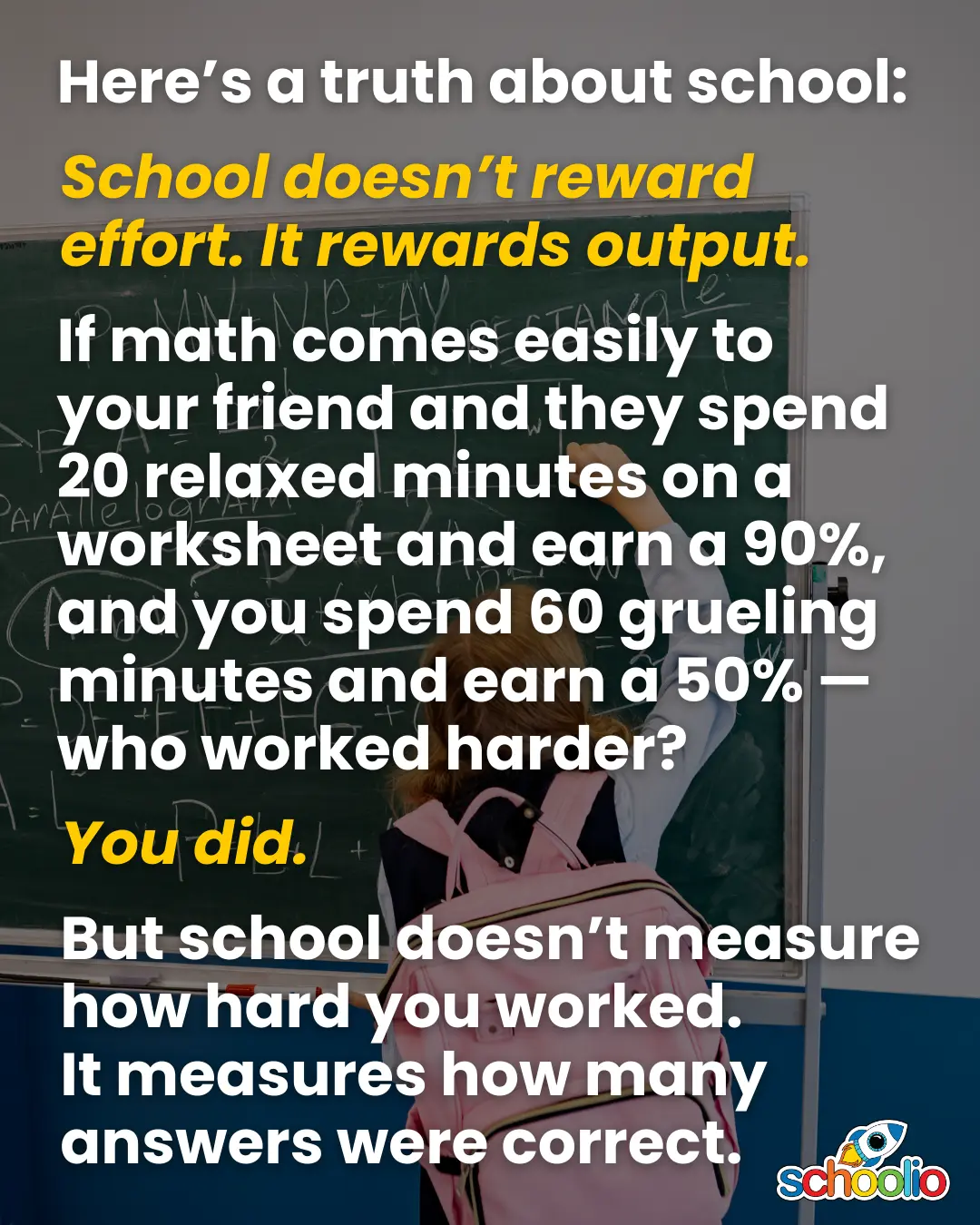
School doesn’t reward effort. It rewards output.

If math comes easily to your friend and she spends 20 relaxed minutes on a worksheet and earns a 90%, and you spend 60 grueling minutes and earn a 50% — who worked harder?

You did.

But school doesn’t measure how hard you worked.

It measures how many answers were correct.

Now imagine something different.

If school were centered around creativity…

or engineering-thinking…

or musical instinct…

or empathy and thoughtfulness…

or responsibility and trustworthiness…

You would be at the top of the class.

You would be absolutely crushing it.

But school doesn’t prioritize those traits.

But guess what? The real world does.

The real world cares that you show up on time.

That you think outside the box.

That you treat people with kindness.

That you keep going when things are hard.

The real world doesn’t care if you use a calculator to figure out a tip.

It doesn’t care if you prefer audiobooks over printed pages.

It doesn’t care how quickly you finish a worksheet.

The most powerful skill you’ll carry into adulthood isn’t mental math.

It’s perseverance.

It’s knowing how to work hard at something that doesn’t come easily.

So please — don’t let school convince you that you’re not smart just because it has a narrow definition of what counts.

Don’t let it shrink how you see yourself.

Don’t let it break your spirit.


? Lindsey

certified special-ed educator, homeschool mom, & co-founder of Schoolio
Why We Need to Redefine What ‘Progress’ Looks Like in Homeschooling

Why We Need to Redefine What ‘Progress’ Looks Like in Homeschooling

Voice: Sathish

This has been on my mind today…

The word “progress” shows up a lot when we talk about education. Are they on grade level? Are they reading at the right age? Are they behind? Ahead? Caught up? We use these markers like a ruler held up against our kids — even when we know, deep down, that learning doesn’t work that way.

I’ve spoken to so many families who felt pressure to make their homeschool look like school. If their child wasn’t hitting the same pace or benchmarks, something must be wrong. But more and more I’m hearing stories from parents that flip that narrative completely.

Like Suzanne. Her son is autistic and in grade 6. They were searching for something — anything — that would actually work for him. She called finding Schoolio a “game changer.” For the first time, her son is doing really well. Not just keeping up — thriving. Not because someone pushed him through a one-size-fits-all curriculum, but because they finally found a platform that met him where he was.

Or Holly, who told us her daughter was developmentally behind and struggling to understand things. Public school left her confused and overwhelmed. But now? With Schoolio lessons, she’s finally understanding. She’s gaining confidence. She’s calm and learning. And Holly said, “I couldn’t be happier.”

These stories remind me that real progress isn’t always loud. It doesn’t always show up on a test score. Sometimes progress is your child smiling during a lesson instead of crying. Sometimes it’s the first time they ask to keep going. Or the first time they feel safe enough to say, “I don’t get it,” and actually get the support they need.

We have to unlearn the idea that speed equals success. Learning isn’t a race. If your child needs more time to grasp a concept, that’s not failure — that’s human. Especially for neurodivergent learners or kids recovering from years of being overwhelmed by noise, rules, and fast-paced instruction.

Progress can be your child doing less… but doing it with joy. It can be fewer meltdowns. More calm. Asking questions again. Finding confidence. Progress might not be a straight line. But when we build learning around the child — not the system — it shows up in ways that actually matter.

So if you’re homeschooling and worried that your child is “behind,” take a breath. Ask yourself — are they more curious? More relaxed? Starting to enjoy learning again?

That might be the most important kind of progress there is.

Sathish

still learning, still unlearning


Fear Doesn’t Always Announce Itself with a Loud Bang

Fear doesn’t always announce itself with a loud bang. Sometimes, it whispers. Sometimes, it hides behind uncertainty, camouflaged in the endless tabs we open at midnight searching for answers. For many parents, the decision to homeschool isn’t driven by rebellion against the school system, but by love—a deep, unwavering desire to do what’s best for their child. And yet, that love often collides headfirst with fear. Not fear of teaching, but fear of not knowing how to start.

There’s a quiet vulnerability that comes with stepping away from something familiar, even if that familiarity no longer fits. Traditional schooling, with its bells and classrooms, offers predictability. Homeschooling, on the other hand, feels like stepping into the unknown. What if I mess it up? What if my child falls behind? What if I’m not enough?

This is the inner monologue we hear from families all the time. It’s not doubt in their children—it’s doubt in themselves. The moment you remove the scaffolding of a school system that’s dictated your child’s learning path for years, you’re left with a blank canvas. And while that can feel freeing, it also feels heavy. That fear is real. It’s the same feeling I had the first time I tried to build IKEA furniture without the manual—confused, overwhelmed, surrounded by pieces that didn’t yet make sense.

At Schoolio , we don’t dismiss that fear. We honor it. Because hidden within that uncertainty is the beginning of something powerful. Our platform wasn’t built just to deliver curriculum—it was built to guide. To hold your hand through those first awkward steps. To whisper back at your fears, “It’s okay not to know yet. You’re not alone.” That’s why onboarding is such a core part of what we do. It’s not just about logging in and choosing a subject—it’s about gently easing parents and students into a rhythm, giving them the courage to find their own way.

We believe homeschooling isn’t just an educational choice—it’s a decision to reclaim trust in yourself as a parent and in your child as a learner. And trust doesn’t come from flashy promises or academic jargon. It comes from experience, support, and one small win at a time. From watching your child grasp a concept you taught them. From discovering that learning can happen at the kitchen table, in the backyard, or curled up with a book in bed.

So no, it’s not the fear of homeschooling that holds people back—it’s the fear of starting. And the only way to quiet that fear is to take that first small step. At Schoolio, we’ve designed every part of our platform to make that step feel less daunting. Because we know that once you begin, once you feel that shift from fear to confidence, everything changes. Not just for your child, but for you.

And that’s when homeschooling stops being scary—and starts becoming home.

You've been crafting a homeschooling lifestyle that goes beyond the ordinary.

Assessing Homeschool Success: How to Determine if Your Homeschool Year Went Well

Assessing Homeschool Success: How to Determine if Your Homeschool Year Went Well

How to determine if your homeschool year went well

Homeschooling offers unique opportunities for personalized education, allowing parents and students to tailor their learning experiences to individual needs and interests. As a homeschooling parent, it’s natural to wonder whether your academic year has been successful. Evaluating the effectiveness of your homeschooling journey can be valuable for identifying strengths, areas for improvement, and ensuring your child’s educational progress. In this blog, we will discuss assessing homeschool success: how to determine if your homeschool year went well.

Is assessing homeschool success important?

Many homeschoolers employ various methods to assess the academic year. Some parents keep detailed portfolios of their child’s work. This includes samples, assignments, and tests. Which they review to gauge academic progress. Others may use standardized tests or benchmark assessments to measure their child’s proficiency in core subjects.

Additionally, some homeschooling families engage in regular discussions and reflection sessions with their children to evaluate their learning experiences and set goals for the upcoming year. By examining these examples, we can gain insights into effective assessment strategies and adapt them to our own homeschooling journeys.

was my homeschool successful

What do the experts say about assessing homeschool success?

Lindsey Casselman, co-founder and Chief Curriculum Officer (CCO) of Schoolio Learning, shares her thoughts on how to determine if your homeschool year went well. “How do the kids feel? Forget marks. Or how many worksheets you completed or how many books you read. Forget how many experiments you did. Are they happy? Has your relationship grown closer? Have they grown as humans? Are they kind? Are they curious?”

She continued: “These are the benchmarks for successful education. Education isn’t about stuffing as much content as you can into their learning time. It’s about building a whole little human, that includes their emotions, their mental health, their eagerness to learn, they’re fulfillment and their understanding of their place in the world and who they might want to become in the future.”

What are some key indicators that your homeschool year went well?

1. Academic Progress:

One of the primary goals of homeschooling is to facilitate academic growth. Assess your child’s progress by reviewing their work samples, assignments, and tests throughout the year. Have they made noticeable improvements in subjects like math, science, language arts, or social studies? Are they achieving the learning objectives you set at the beginning of the year? Assessing academic progress will help you gauge the effectiveness of your teaching methods and curriculum choices.

2. Learning Engagement:

Successful homeschooling fosters a love for learning. Consider your child’s level of engagement throughout the year. Do they actively participate in discussions and activities? Are they curious and enthusiastic about exploring new topics? Genuine interest and enthusiasm are indicators of a successful homeschool year. If your child is actively involved in their education, it suggests that you have created a nurturing and stimulating learning environment.

Learning engagement

3. Personal Development:

Education encompasses more than just academics. Homeschooling provides an ideal environment to nurture personal growth and character development. Reflect on your child’s personal development over the course of the year. Have they demonstrated improvements in self-discipline, time management, and organizational skills? Do they show greater resilience, independence, or a positive attitude towards challenges? Evaluating these aspects helps determine the overall success of your homeschooling efforts.

4. Individualized Learning:

One of the significant advantages of homeschooling is the ability to tailor education to your child’s unique needs and learning style. Assess if your homeschool year was successful by considering how well you have personalized the learning experience. Have you provided resources and activities that cater to their individual strengths and weaknesses? Are you adapting teaching methods to suit their preferred learning style? Individualized learning contributes to academic success and ensures your child feels supported and valued.

Individualized learning

5. Social and Emotional Well-being:

Socialization is often a concern for homeschooling families. While it’s essential to provide opportunities for social interaction, consider your child’s overall social and emotional well-being. Do they have healthy relationships with peers, siblings, or other community members? Are they able to communicate effectively and express their emotions? A successful homeschool year should focus on fostering emotional intelligence, empathy, and the development of social skills.
Pick up Schoolio’s Social Emotional Learning materials to help your child with these important skills.

6. Life Skills and Practical Application:

Education extends beyond textbooks and assignments. Reflect on whether your homeschool year has successfully incorporated practical life skills into the curriculum. Have you provided opportunities for your child to develop skills such as critical thinking, problem-solving, communication, and financial literacy? The ability to apply knowledge in real-life situations is a valuable indicator of homeschooling success.

Life skills and homeschooling

The ultimate success.

Evaluating the success of your homeschool year involves assessing multiple factors. These include academic progress, learning engagement, personal development, individualized learning, social and emotional well-being, and life skills acquisition. Remember that homeschooling is a dynamic and evolving process. If you identify areas that need improvement, view them as opportunities for growth and adaptation. Ultimately, the success of your homeschool year lies in creating an environment that supports your child’s holistic development and instills a lifelong love for learning.