But What About Socialization? (Let’s Talk About It.)

But What About Socialization? (Let’s Talk About It.)


Ah yes… the classic question that every homeschooler has heard (probably a few dozen times):

“But… what about socialization?”

It’s asked by grandparents. Aunts and uncles. Curious friends. Grocery store strangers.

And yes, we’ve seen the memes. We’ve done the eyerolls. We’ve even — on occasion — offered a snarky reply.

But truthfully? I don’t mind the question. I like giving people a better picture of what homeschooling really looks like.

And when it comes to socialization, I answer it in two parts — because most people are actually asking the wrong thing.


?️ Part 1: Yes, My Kids Socialize

Let’s start with the easy answer.

Do my kids spend time with other kids?

Do they have friends? Go to activities? Go on field trips?

YES. Yes. And yes.

My kids were always part of our local homeschool group.

Here’s what my kids do with their homeschool group:

  • Soccer
  • Gymnastics
  • Swimming
  • Skating
  • Art lessons
  • Track and field
  • Academic co-op (monthly)
  • PE co-op (twice a month in winter)
  • Holiday parties & themed events
  • Weekly summer park meetups
  • 3 field trips per month (far more than they ever got in public school!)

And best of all — these are the same kids they see over and over again. The friendships are deep and real. The connections are consistent. The community is strong.

We even text each other to coordinate sign-ups for events, just like any other friend group would.

So yes. My kids socialize. A lot.


? Bonus Perk: Our Evenings and Weekends Are Peaceful

Because our extracurriculars happen during the day (with our homeschool group), we’re not cramming activities into busy evenings or rushing around on weekends.

We eat dinner together.

We go to bed at reasonable times.

We rest.

Homeschooling has given us the gift of balance — and that’s good for everyone’s mental health.


? Part 2: Let’s Talk About Socialization (The Real Kind)

Now for the word people use… without really understanding it.

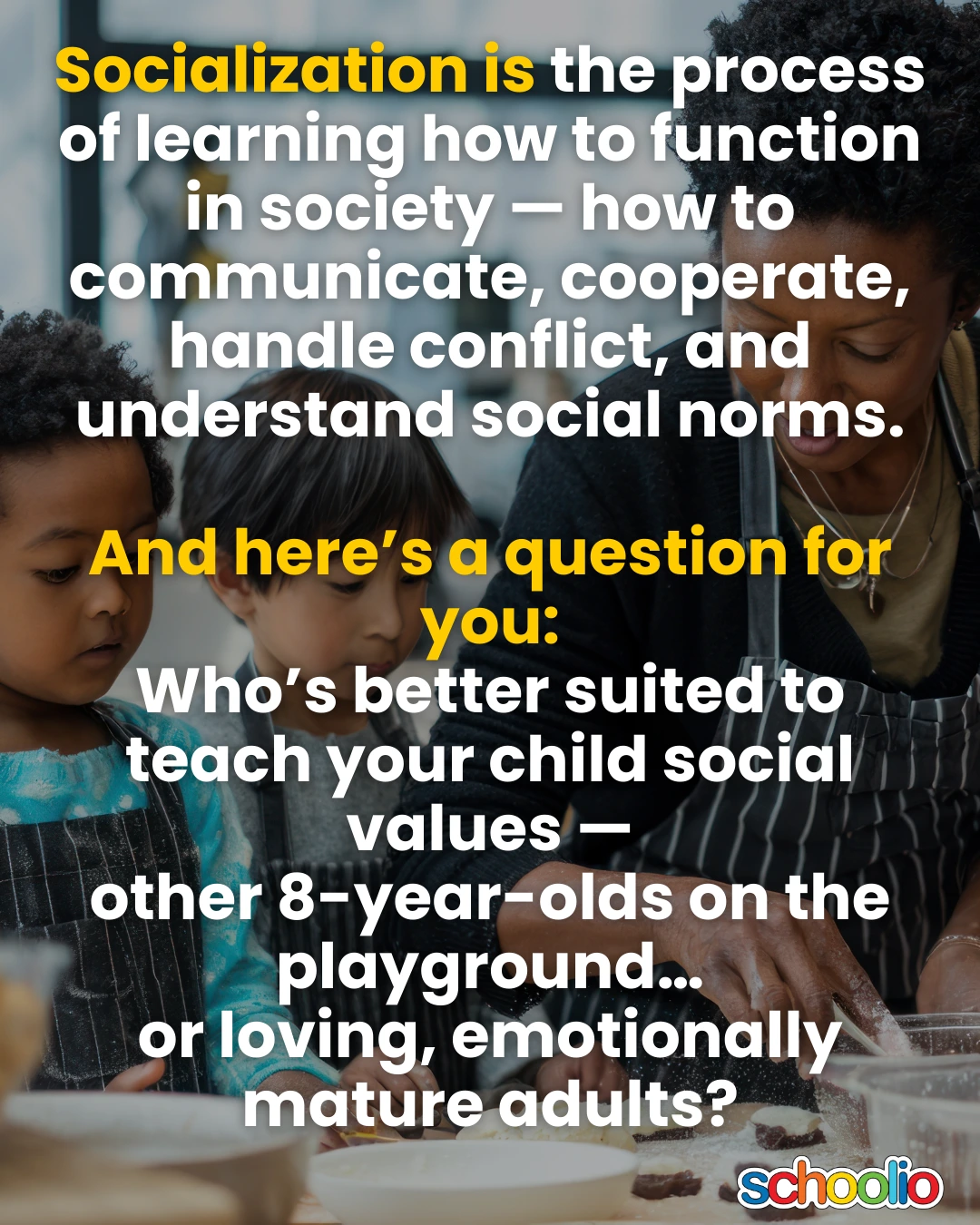
Socialization is the process of learning how to function in society — how to communicate, cooperate, handle conflict, and understand social norms.

And here’s a question for you:

Who’s better suited to teach your child social values —

other 8-year-olds on the playground…

or loving, emotionally mature adults?

When my child is at a homeschool event and has a conflict with a friend, they can come to me right away for support and coaching.

I help them understand the situation, plan a response, and reflect on how it went.

That means they’re learning social skills in real time, with guidance.

It’s not “helicopter parenting.” It’s real mentorship.

The result? Even very young homeschooled kids learn to resolve conflict with kindness and maturity.


? Homeschooled Teens Are (Surprise!) Really Cool

If you’ve ever had a full conversation with a homeschooled teen, you know what I mean.

They’re articulate.

Confident.

Curious.

Engaging.

Not sullen or withdrawn. Not afraid to talk to adults. Not obsessed with fitting in. Just… lovely humans.

No weird stereotypes. No Stepford vibes. Just kids who’ve had space to grow up at their own pace, in their own way.


? Public School Culture Is Not the Social Utopia People Think It Is

Yes, some kids enjoy the social side of school.

But many don’t — and for good reason.

Here’s what socialization looks like in most public schools:

  • Friend groups sorted by birth year only (not interest or personality)
  • Pressure to conform or risk bullying and isolation
  • Toxic norms that teach kids not to trust or confide in adults
  • A culture where “fitting in” > being yourself

Even kids who succeed socially often do so by constantly managing their behavior to meet those unwritten rules — and it’s exhausting.

We wonder why so many kids are anxious. But is it any surprise when the stakes of every interaction feel this high?


?‍♀️ “But School Prepares Them for the Real World…”

Here’s the thing:

Being trapped in a toxic environment with no way out is not “real world prep.”

Yes, adults deal with difficult coworkers. But as adults, we have:

  • Control over our environment
  • Emotional regulation
  • Resources
  • Options

Children don’t.

When a kid is being bullied at school, school is their entire world.

They often feel trapped, unsupported, and completely alone.

That’s not “character building.” That’s trauma.


✅ So Let’s Wrap It Up

Do my kids socialize? Yes. Joyfully, regularly, and with a diverse group of friends.

Are they socialized? Yes. In ways that are healthy, supported, and guided by loving adults.

And honestly?

They’re thriving — not despite homeschooling, but because of it.


Lindsey

Certified Special Ed Educator & Co-Founder, Schoolio
Why Our “First Day of School” Looks Nothing Like Theirs — and Why I Wouldn’t Trade It

Why Our “First Day of School” Looks Nothing Like Theirs — and Why I Wouldn’t Trade It


This has been on my mind today…

The hardest part of the homeschool year for me wasn’t math lessons, or planning, or juggling the day-to-day chaos. It was the first day of public school.

Every September, my social media feeds would flood with photos of smiling kids at the end of the driveway — shiny shoes, new backpacks, parents buzzing with excitement. I would feel it in my chest, that little ache of missing out. Was I depriving my kids of this milestone? Was our homeschool missing something?

But then, something shifted. I realized those photos were it. The moment. The kids posed for a quick picture, then disappeared into a classroom to sit under fluorescent lights, being taught by a stranger for the rest of the day.

So one year, I decided to do something different. I started our own tradition.

That morning, I snapped a “first day of school” photo of my kids… still asleep. Because that’s the beauty of homeschooling: they wake when their bodies are rested, not when a bus pulls up.


Then, just for myself, I kept taking pictures throughout the day. Hour by hour.

? Pancakes in pajamas.

? Jumping on the trampoline after math.

? Reading aloud together on the couch.

? Baking cookies in the kitchen.

? Building sandcastles at a beach we had all to ourselves.

? A social studies lesson with a cat curled up in their lap.

? Walking the dog in the late summer sun.


And when I scrolled through those photos at the end of the day, I finally saw it: this was more.

It wasn’t just about lessons and curriculum (though those happened too). It was about time. About laughter. About siblings who actually enjoy each other. About kids who get to learn at their own pace and still have energy left to play, imagine, and connect. About a childhood that isn’t rushed out the door.

That was the day I stopped feeling wistful about the back-to-school buzz on my feed. Because the truth is, I wasn’t depriving my kids of anything. I was giving them something different. Something richer.

So now, every September, we take our first-day photos too. They just don’t look like everyone else’s. And I’m okay with that.

With love,

? Lindsey

Certified Special Ed Educator & Co-Founder, Schoolio
Why Public School Pressures Kids to Grow Up Too Fast—and Why I’m Grateful My Homeschooler Still Plays

Why Public School Pressures Kids to Grow Up Too Fast—and Why I’m Grateful My Homeschooler Still Plays

This has been on my mind today…

My daughter’s friend, who has always been in public school, told her recently that she wished she could still play with toys. My daughter, without hesitation, said, “So play with toys then! Who cares? Do what you want!” But her friend shook her head. She said no—she was too old for toys, and if other kids found out, they’d make fun of her.

They’re 13 years old. And here’s the thing: 13 is still a child. If a child that age still wants to play, that isn’t immaturity—it’s development happening at the pace it’s meant to. Play and imagination are not only normal, they’re scientifically proven to be deeply beneficial for kids’ brains. Yet her friend felt she couldn’t do it, because the social culture around her said she was “too old.”

And it wasn’t just about toys. She also shared that at her school, there’s pressure to start thinking about crushes, even dating. Imagine that—kids who still long to play with toys being told that what’s “normal” is pairing off romantically. That’s not freedom. That’s conformity.

People often ask homeschool families about socialization. “Aren’t you worried your kids won’t know how to socialize?” But what’s rarely asked is the harder question: what exactly are kids being socialized into at school? Too often, it’s a kind of toxic conformity that shames kids for being developmentally right where they are.

Our homeschoolers aren’t “immature.” They’re maturing at their natural pace. They’re free to linger in play, imagination, and curiosity without shame. And when the time comes, they’ll step naturally into new stages of life—without being rushed there before they’re ready.

One of the greatest gifts of homeschooling is that we get to protect childhood. We get to give our kids the time and space to grow up without unnecessary pressure. And sometimes, that looks like a 13-year-old proudly playing with toys, because she’s still a kid—and that’s exactly what she should be.

Want to give your child the freedom to grow at their own pace? Explore Schoolio’s homeschooling curriculum and see how it can support your family’s journey.

Lindsey
Certified Special Ed Educator & Co-Founder, Schoolio

Are You Feeling Isolated As a Homeschooling Parent?

Homeschooling Parents are Feeling Isolated. Here’s How We Fix It: 10 Benefits of a Virtual Homeschooling Community

Homeschooling parents are feeling isolated.

Homeschooling parents are no strangers to sacrifice. They willingly give up jobs, time, and the social connections that come with them to provide their children with a tailored education. It’s a path filled with love and dedication, but it can also be an isolating one. The lack of support and camaraderie can leave parents feeling like they’re navigating this journey alone. Are you feeling isolated as a homeschooling parent? That’s where virtual homeschooling communities step in to bridge the gap.

In this blog, we’ll explore how these communities offer a lifeline to parents who have made the choice to homeschool. We’ll delve into the invaluable benefits of joining a virtual homeschooling community where parents can connect with others, access expert advice, and participate in enriching events. Plus, we’ll introduce you to the latest and safest addition to this community, Schoolio, a place where parents can find the support they need to thrive in their homeschooling journey. Join us as we discover the top 10 ways virtual homeschooling communities can make the homeschooling experience not only easier but more fulfilling.

Not All Homeschooling Community Are the Same.

Not all homeschooling communities are created equal. While the internet, particularly Facebook, is teeming with homeschooling groups. It’s essential to acknowledge that each community has its unique vibe and culture. Many parents who have ventured into online homeschooling groups have experienced the downside of judgment, misunderstanding, and misinformation. Some groups can be less supportive and more critical, leaving parents feeling isolated and disheartened.

Not all homeschooling communities are the same

However, it’s crucial to recognize that there are alternatives – virtual homeschooling communities like Schoolio, for instance, which prioritize a positive and inclusive atmosphere. These communities strive to offer a haven where parents can connect, learn from one another, and grow together, all while feeling respected, understood, and supported in their homeschooling journey.

Are You Feeling Isolated as a Homeschooling Parent? Here are 10 Ways Virtual Homeschooling Communities Can Change the Game:

1. A Sense of Community:

Virtual homeschooling communities like Schoolio bring parents together, creating a sense of belonging. You’re no longer alone on this journey. Sharing experiences, challenges, and triumphs with fellow homeschooling parents can be incredibly reassuring.

2. Expert Advice at Your Fingertips:

Homeschooling may come with unique challenges, and you might occasionally feel out of your depth. Virtual communities provide a platform to seek expert advice and guidance. Whether it’s curriculum recommendations or teaching strategies, you’ll find invaluable insights from experienced homeschoolers.

3. Events and Activities:

Homeschooling doesn’t have to be isolated learning. Virtual communities often organize events, field trips, and workshops. These activities not only enrich your child’s education but also offer opportunities to bond with other parents.

4. Flexible Scheduled Hangout Times:

Flexible Scheduling

Homeschooling through a virtual community allows for flexibility in your schedule. You can adapt your routine to suit your family’s needs, ensuring that both education and family life thrive.

5. Access to Diverse Resources:

Virtual homeschooling communities provide access to a wide range of online resources, from educational websites to virtual libraries. You’ll find an abundance of materials to help with your home learning.

6. Customized Learning:

Tailoring your child’s education is one of the primary advantages of homeschooling. In virtual communities, you can talk to veteran homeschoolers to help create a customized curriculum that caters to your child’s learning style, interests, and pace.

7. Peer Interaction for Children:

Virtual homeschooling communities often organize virtual meet-ups and classes, allowing your child to interact with peers. These interactions foster social skills and provide opportunities for group learning.

8. Support for Special Needs:

If your child has special needs, virtual homeschooling communities can connect you with resources and support specific to their requirements. You’re not alone in navigating this challenging path.

Homeschooling and socialization? Click here.

9. Global Awareness:

Interacting with families from diverse backgrounds within a virtual homeschooling community can instill a strong sense of cultural and global awareness in your child. This exposure can lead to greater tolerance, empathy, and a broader perspective on the world.

10. Empowering Parents:

Virtual homeschooling communities empower parents to take an active role in their child’s education. They provide resources, encouragement, and a strong support system, fostering a sense of purpose and confidence in your ability to navigate the homeschooling journey successfully.

Join the Newest, Safest, Homeschooling Community.

Join the homeschool community

Homeschooling parents don’t have to face the journey in isolation. Virtual homeschooling communities like Schoolio offer a lifeline, providing support, resources, and a sense of belonging. These communities can transform your homeschooling experience, making it not only easier but more fulfilling. If you’re considering homeschooling or currently on the journey, don’t hesitate to join a virtual homeschooling community and reap the countless benefits it has to offer.