When Our Homeschool Turned to S**t

When Our Homeschool Turned to S**t


This has been on my mind today…

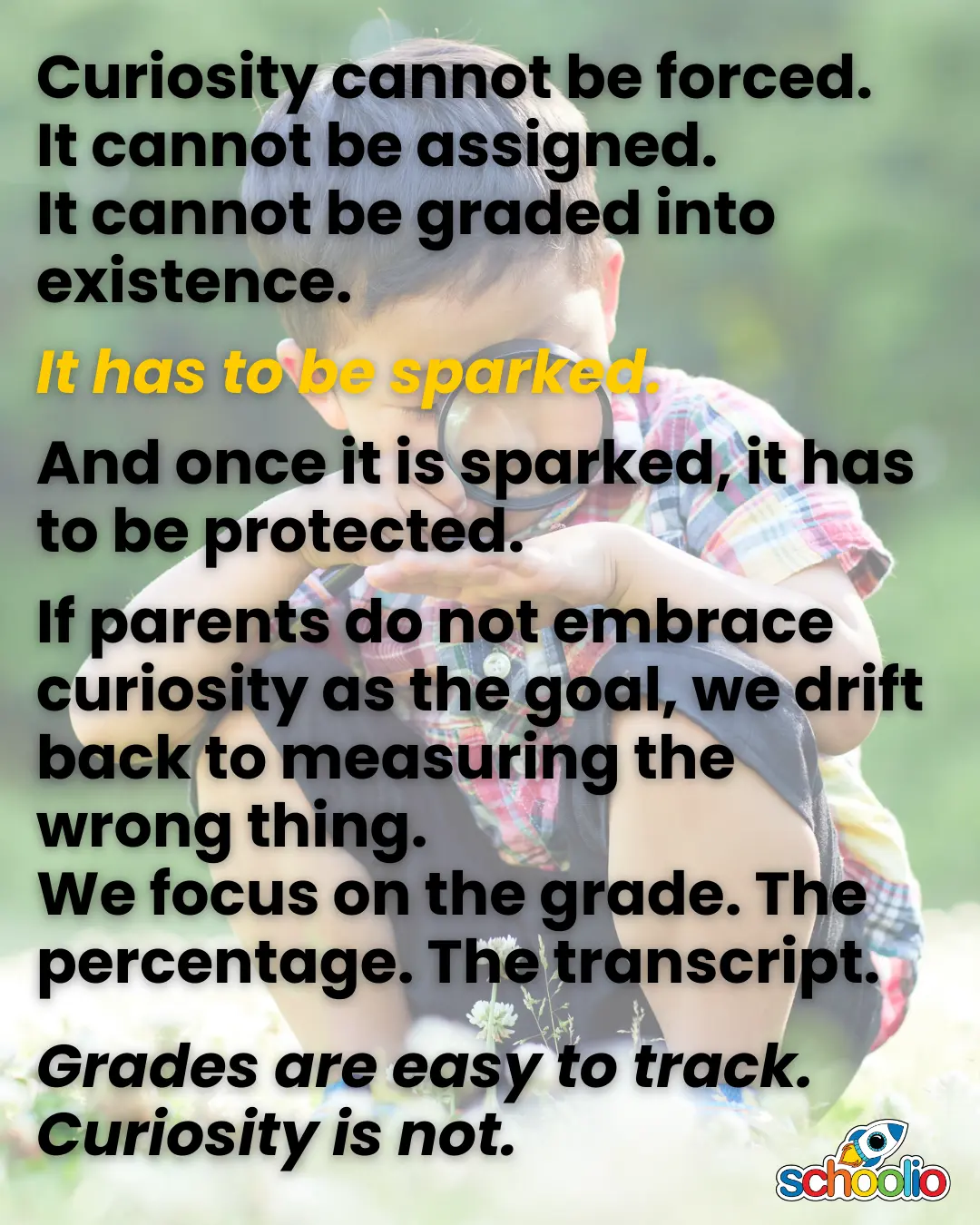
One winter morning, we set out on a nature walk. Nothing fancy, just some fresh air and a chance to stretch our legs. That’s when it happened. The kids stopped, pointed, and announced with total fascination:

“POOP!”

There it was on the path. Just sitting there, waiting to be discovered. And instead of me steering them back to the “lesson plan,” they had one question that became our curriculum for the whole week:

“What animal did this come from?”

We started guessing. Deer? Rabbit? Maybe raccoon? The curiosity snowballed. Back at home, we started researching. We found pictures of animal scat (yes, that’s the proper word) and compared them. We talked about the diets of different animals and how that shows up in their droppings. The kids wanted to make their own scavenger hunt checklist of “poops to find,” so we did. Suddenly every walk was a full-on investigation, magnifying glasses in hand, kids crouched down like little detectives.

And then nature gave us another gift — snow. Once they had learned about scat, the curiosity expanded:

“If we can tell an animal by its poop, can we tell it by its footprints too?”

That week turned into tracking lessons. We studied paw shapes, stride lengths, and patterns. We matched tracks to the animals in our region. Every walk became a treasure hunt. They weren’t just “getting exercise.” They were observing, comparing, classifying, and recording. In other words, science.

And here’s the thing: none of it was on my lesson plan. There was no worksheet waiting on the table that morning titled “Animal Scat and Tracks.” But it was real learning. Engaged, memorable, full of wonder.

The kids didn’t just learn about animals. They learned how to follow a question, how to investigate, how to let curiosity guide them. That’s the kind of learning you don’t forget — even if it started with poop.

So yes, sometimes school looks like math books at the table. Other times, it looks like poop on a trail. Both count. Both matter. And both are homeschooling.

? Lindsey

certified special-ed educator & co-founder, Schoolio

The Harder Path Forward

The Harder Path Forward


customer feedback

I didn’t understand the courage it took until years later.

When my family immigrated to Canada, I was angry. I didn’t have the words for it at the time, but every part of me resisted this new life. I missed my friends, my neighbourhood, my routines. I was a teenager lost between two worlds—resentful of the change, and confused by the silence I had to carry with me in every classroom, every hallway, every awkward introduction.

People looked at me differently. Sometimes with curiosity, sometimes with judgment, but always with the weight of assumptions I hadn’t earned. The stereotypes followed me. So did the loneliness.

Back then, I thought my parents were wrong. I thought they didn’t understand what I had lost. But as I grew older—became a parent, built a life, listened to others—I began to see the truth I’d missed entirely.


It wasn’t an escape. It was a sacrifice.


They had uprooted everything they knew for a sliver of possibility—a better education, a safer life, a shot at something bigger than what we’d left behind. And they did it quietly. Without recognition. Without thanks. Without certainty. Just faith.

That story echoes again and again in the lives of homeschooling families we meet at Schoolio. While the world rushes to label them—too radical, too soft, too unqualified—what we see is something different. We see courage. We see parents choosing a harder path, not because it’s easier, but because it’s right for their child.

It’s not a summer experiment. It’s not a last resort. It’s a quiet, determined rebellion against a system that no longer fits.

And here’s the question we rarely stop to ask: if the traditional school system—funded, structured, and normalized—is so perfect, why are so many parents choosing to leave it behind?

Why are they willing to rebuild an entire learning experience from scratch?


Because sometimes love means walking uphill.


At Schoolio, we don’t see homeschoolers as fringe or fearful. We see them as architects of something new. Builders of bridges their children can walk across safely. Parents who are saying, “I will not wait for the world to catch up. I’ll start right here.”

And for those of us who have walked a harder path before, we know exactly how much strength that takes.

Sathish
still learning, still unlearning

Something is breaking—and the cracks are no longer subtle.

Something is breaking—and the cracks are no longer subtle.

Something is breaking—and the cracks are no longer subtle. This week, Ontario’s Education Minister Paul Calandra said the quiet part out loud: “We have to change the way school boards behave.” In his remarks to the legislature, he called out dysfunction, political distractions, and a lack of unified leadership across the province. The full article is worth reading here.

When politicians start publicly questioning the structure of an entire education system, it’s not a small thing. It signals something deeper—a disconnection between families and the institutions meant to serve them. Between what students need, and what schools are able—or willing—to provide.

At Schoolio, we’ve heard this unraveling for years. Quietly at first. A parent unsure if their neurodivergent child will ever be supported. A teacher burned out from fighting for basic classroom resources. A school board spending more on internal legal battles than on inclusive programming. And now, those whispers have grown into something louder. More urgent.

The traditional school model is struggling under the weight of complexity it can no longer carry. Bureaucracy, politics, budget cuts, and reactive policies are not a foundation for innovation or well-being. When boards debate flags and book bans while special education runs deficits, it’s not just the system that’s broken—it’s the trust.

This isn’t about abandoning schools—it’s about acknowledging that they no longer serve every child equally. It’s about making space for alternatives that are working right now, for real families, in real time.

Homeschooling, once dismissed as fringe, is now a lifeline. Microschools are quietly multiplying. Parents are reclaiming agency not out of rebellion, but out of necessity. And at Schoolio, we’ve built a platform to meet them there. A hybrid curriculum that blends structure with flexibility. A place where emotional safety, real-world skills, and learning readiness are just as important as test scores.

The question isn’t whether the old model can be fixed. The question is: will we keep asking families to wait?

Because they’re not waiting anymore.

They’re moving forward—with or without the system.

And Schoolio is walking beside them.

Sathish
still learning, still unlearning

There Are No Bad Kids.

There are no bad kids.

This has been on my mind today…

“Is that your firstborn?” someone would ask. And reluctantly, I would be acknowledged. I was 12 years old. A little boy whose greatest crime was a set of grades that didn’t meet someone else’s expectations.

In school, I wasn’t a troublemaker. But I was already being written off. I didn’t measure up. I didn’t fit in. And no one was coming to help.

What many adults forget is this: There are no bad kids.

there are no bad kids

Some kids feel confused. Others believe they are dumb before they even get a chance to feel capable. A system labels these kids with scores that start their story and end it before they can begin.

For so many children, the moment a poor grade lands in front of them, everything shifts. The label sticks. The expectations drop. The pressure increases. And the love? That part often fades into the background.

From that point forward, learning is no longer something you do to grow. It becomes something you have to prove.

I think back to my own childhood and wonder what would’ve been different if someone — anyone — had paused and asked not, “What’s wrong with you?” but instead, “What makes you come alive?”

That’s why this company, Schoolio, isn’t just a platform for me — it’s personal. I’m not building a business. I’m trying to build what I needed at 12. A place where kids don’t feel invisible. Where parents and students light up together. Where learning — or the lack of it — isn’t used as a weapon or a judgment, but seen as what it truly is: a work in progress. A human journey. A shared path.

That’s what homeschooling offers so many families — not just a curriculum, but a chance to reset the story. To raise children who know their worth, not by test scores, but by the fire in their eyes when something finally clicks. Or the calm that comes when they feel safe enough to try again.

I didn’t get that growing up.

But I’m doing my part to make sure someone else’s child does.

Making a child invisible is the harshest punishment.

Please — don’t do that to your kids.


Sathish

still learning, still unlearning

When I Finally Let Go of the Curriculum That Just Didn’t Work

When I Finally Let Go of the Curriculum That Just Didn’t Work

By Lindsey, certified special-ed educator & co-founder, Schoolio


This has been on my mind today…

A few years ago, I made what I thought was going to be a game-changing purchase for our homeschool. I joined a group buy of Gather Round and was thrilled to finally have something that looked like it would make my life easier.

I loved everything about it—at least, on the surface.

The artwork? Gorgeous. Those soft watercolors made my teacher-heart swoon. Honestly, it felt like it was designed more for parents than kids, which, in hindsight, should’ve been a clue. The format? Brilliant in theory. Everyone learning the same thing at the same time? No more juggling three different subjects, three different levels, three different kids? Yes, please.

I wanted so badly for it to work.

But here’s the reality: my kids hated it.

The lessons felt like fact after fact with little room for curiosity or critical thinking. The images I found beautiful didn’t grab them at all. The activities didn’t spark anything except resistance. And instead of making life easier, it made it harder. Because when your kids aren’t engaged, you spend twice the energy convincing, redirecting, negotiating. It became a daily tug-of-war instead of a tool.

And it was expensive. Not just financially, though that stung too—but emotionally. I had invested hope. I had invested energy. And it felt like I had failed when it didn’t work.

Eventually, I had to admit what was obvious: it wasn’t the right fit. And like many other programs, books, and “perfect solutions” before it, I shelved it. This one, though, felt like the last straw.

Because here’s the thing: I don’t have standard-issue kids. I have neurodivergent learners. Their brains are curious, vibrant, and beautifully unique. They don’t learn by filling in the same worksheet, at the same time, in the same way. And when I tried to force it, all of us ended up frustrated.

That moment—closing the book on a curriculum I wanted so badly to work—was also the moment I realized I couldn’t keep outsourcing the decisions about what would fit my family. I had to build something that actually worked for them. Something that made sense not in theory, but in practice.

That’s when I started creating my own programming. Not because I wanted to, but because I had to. And honestly? It was the best “failure” that ever happened to our homeschool.

So if you’ve been there—spending money, time, and hope on a curriculum that ends up collecting dust—I want you to know it’s not you. It doesn’t mean you failed. It doesn’t mean your kids are “too difficult.” It just means that program wasn’t built for your unique learners. And that’s okay.

Sometimes letting go is exactly what opens the door to the kind of learning that works.

Why I Learned to Plan Our Homeschool in Pencil

Why I Learned to Plan Our Homeschool in Pencil

By Lindsey, certified special-ed educator & co-founder, Schoolio


This has been on my mind today…

When I first started homeschooling, I thought I needed a perfectly structured plan. Color-coded calendars. Long-term schedules. Daily checklists. If I could just organize everything, I told myself, then our homeschool would run smoothly.


And to be honest—I can make a banging plan. ADHD has given me that hyperfocus superpower. I can map out a schedule that looks incredible on paper. But sticking to it? Executing it with military precision day after day? That’s where things fall apart. My brain doesn’t thrive under that kind of rigidity. And neither do my kids.


I remember one day in particular. I had my agenda ready, subjects lined up, and a vision of us moving neatly through the day. Instead, I found myself still in pajamas, sipping my third cup of coffee, reading aloud from the couch while my kids snuggled beside me. That was “school” for the day. And honestly? It worked.


It took me about a year to unlearn the pressure of overplanning. Especially with neurodivergent kids, you never really know what a day will look like. I used to plan out weeks—sometimes months—at a time. But that just set me up for stress and disappointment when life inevitably didn’t go according to script.


Take field trips, for example. I’d schedule an outing with our homeschool friends, then expect the very next day to be a heavy academic “catch-up” day. But my autistic kiddos taught me something important: they needed two days for those big events. One day to go, explore, and engage. And another day to recharge quietly at home. Trying to push through the day after always ended in frustration for everyone.


So I learned to plan differently.


Now I plan in pencil. That’s both literal and metaphorical. I map out gentle rhythms, not rigid schedules. I leave space for flexibility, rest, and the unexpected. I don’t ask, “Are we keeping up?” anymore. I ask, “What do my kids need today?”


And that shift has changed everything.


The truth is, learning doesn’t only happen in neat blocks of time. It happens on the couch with a read-aloud, on a quiet day of rest, and yes—even in pajamas with a stack of coffee cups nearby. When I stopped treating our homeschool like something to control and started treating it like something to live, we all found more peace—and more learning, too.


So if you’re staring at your homeschool planner feeling like you’re always “behind,” I want to gently remind you: you don’t have to plan it all in ink. You don’t have to keep up with anyone else’s schedule. You can plan in pencil. And sometimes, those pajama days on the couch end up being the best days of all.

Why I Stopped Worrying About Learning Gaps

Why I Stopped Worrying About Learning Gaps

By Lindsey, certified special-ed educator & co-founder, Schoolio

This has been on my mind today…

The weight of comparison. It sneaks in quietly. A friend tells you what their child is learning in school. A neighbor asks about your homeschool “schedule.” You catch a glimpse of someone’s color-coded curriculum plan on Instagram. Suddenly your confidence starts to unravel.

I remember this feeling most clearly when my oldest was around eight or nine. We were deep into homeschooling, but I was constantly looking over my shoulder at what public school kids were doing. Were we covering the same content? Were we behind? Was I doing enough?

It became exhausting. I was trying to replicate school at home—not because it worked for us, but because I thought that’s what “real” education looked like.

Here’s the truth I had to learn the hard way: homeschool doesn’t need to imitate public school to be valid. In fact, the whole point is that it doesn’t.

I kept coming back to a simple question. If I can’t remember what I learned in third grade, why was I putting so much pressure on myself to make sure my child retained every single concept in the third grade curriculum? I realized I was clinging to a system I didn’t even believe in—one I had left behind for a reason.

When kids are in school, they’re taught for a set number of days, then tested. If they get a 60%, that means they missed 40%—and the class moves on. No one loops back. No one stops the train. That’s a gap. A big one. But it’s accepted.

In our homeschool, if my child gets sick or we need to pause for emotional rest, schoolwork pauses. School doesn’t go on without them on sick days, it waits for them. We don’t pretend 60% is good enough. The beauty of this lifestyle is that learning pauses with the child and picks up again when they’re ready.

That alone makes a massive difference.

And the truth is, we all have learning gaps. Adults included. Because humans only retain what they find meaningful. You can make a child memorize facts for a test, but they’ll likely forget most of it after. If something isn’t relevant to their lives, it doesn’t stick. So whether you never cover it, or they forget it, the result is the same.

That realization gave me freedom.

I stopped obsessing over whether we had checked every box. I started asking better questions: Was my child curious today? Did we connect? Did they ask questions that mattered to them? Those were my new benchmarks.

And wouldn’t you know—it made everything easier. They were learning more, not less. And I was enjoying it more, too.

So if you’re caught in that loop of comparison, wondering if your homeschool is “real” enough, let me gently offer this: your homeschool is enough because it’s yours. Because it fits your child. Because it’s rooted in love, flexibility, and intention.

That’s not falling behind. That’s choosing to lead.

certified special-ed educator & co-founder, Schoolio


? Need help trusting your homeschool rhythm?

Start with our free homeschool planner, explore flexible curriculum bundles, or try our 7-day trial to see how it can work in your home.

If It Doesn’t Look Like School… Good.

If It Doesn’t Look Like School… Good.

“Homeschooling doesn’t look like public school. That’s the point.”

This has been on my mind today…

When I first started homeschooling, I tried to make our home look like a classroom. Desks lined up, a daily schedule on the wall, a bell for transitions — I even printed out attendance sheets.

It lasted about three days.

What followed was frustration, tears, and a lot of self-doubt. I thought something was wrong with me. I couldn’t keep up the structure. My kids weren’t responding the way I expected. I wondered if I had made a huge mistake.

But the truth was simpler: I was trying to replicate a system that didn’t actually work for us.

Homeschooling doesn’t look like school. That’s the point.

School is designed for groups. For efficiency. For managing dozens of kids with one adult. It’s built on uniformity and compliancy. But I don’t want my kids to be uniform or compliant.

Homeschooling is built on flexibility. On freedom. On honoring your child’s pace, your family’s values, and your real life.

Some days, math happens at 8am. Other days, it doesn’t happen at all.

Some weeks, we read and entire novel. Other weeks, we’re outside chasing butterflies and calling it science.

Some subjects take root quickly. Others simmer quietly until the spark hits.

And through it all, learning is happening.

It just doesn’t look like it used to. And that’s okay. Actually, it’s better than okay.

It means your homeschool is becoming yours.

There’s no attendance sheet for curiosity. No standardized test for joy. No report card that measures the deep, steady growth happening when a child feels safe, loved, and free to learn in their own way.

So if your homeschool doesn’t look like school — good. That’s the point.

With love,

Lindsey

Certified Special Ed Educator & Co-Founder, Schoolio

Why We Need to Redefine What ‘Progress’ Looks Like in Homeschooling

Why We Need to Redefine What ‘Progress’ Looks Like in Homeschooling

Voice: Sathish

This has been on my mind today…

The word “progress” shows up a lot when we talk about education. Are they on grade level? Are they reading at the right age? Are they behind? Ahead? Caught up? We use these markers like a ruler held up against our kids — even when we know, deep down, that learning doesn’t work that way.

I’ve spoken to so many families who felt pressure to make their homeschool look like school. If their child wasn’t hitting the same pace or benchmarks, something must be wrong. But more and more I’m hearing stories from parents that flip that narrative completely.

Like Suzanne. Her son is autistic and in grade 6. They were searching for something — anything — that would actually work for him. She called finding Schoolio a “game changer.” For the first time, her son is doing really well. Not just keeping up — thriving. Not because someone pushed him through a one-size-fits-all curriculum, but because they finally found a platform that met him where he was.

Or Holly, who told us her daughter was developmentally behind and struggling to understand things. Public school left her confused and overwhelmed. But now? With Schoolio lessons, she’s finally understanding. She’s gaining confidence. She’s calm and learning. And Holly said, “I couldn’t be happier.”

These stories remind me that real progress isn’t always loud. It doesn’t always show up on a test score. Sometimes progress is your child smiling during a lesson instead of crying. Sometimes it’s the first time they ask to keep going. Or the first time they feel safe enough to say, “I don’t get it,” and actually get the support they need.

We have to unlearn the idea that speed equals success. Learning isn’t a race. If your child needs more time to grasp a concept, that’s not failure — that’s human. Especially for neurodivergent learners or kids recovering from years of being overwhelmed by noise, rules, and fast-paced instruction.

Progress can be your child doing less… but doing it with joy. It can be fewer meltdowns. More calm. Asking questions again. Finding confidence. Progress might not be a straight line. But when we build learning around the child — not the system — it shows up in ways that actually matter.

So if you’re homeschooling and worried that your child is “behind,” take a breath. Ask yourself — are they more curious? More relaxed? Starting to enjoy learning again?

That might be the most important kind of progress there is.

Sathish

still learning, still unlearning


No, I’m Not Sheltering My Kids. I’m Preparing Them Differently.

No, I’m Not Sheltering My Kids. I’m Preparing Them Differently.

This has been on my mind today…

When people hear I homeschool, the first thing they say isn’t about academics. It’s usually something like,

“But how will your kids learn to handle the real world?”

And I get it. I used to ask the same thing.

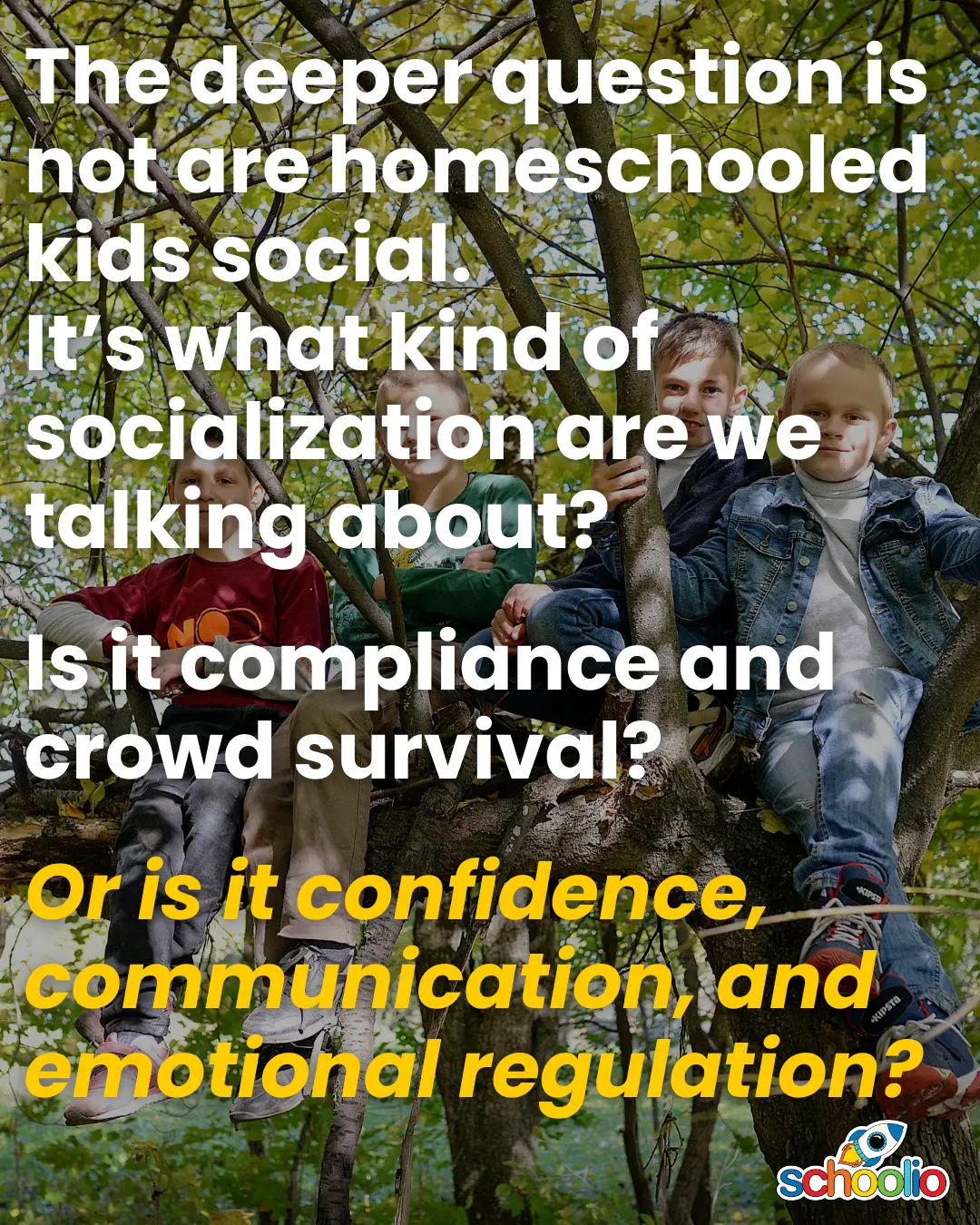
It took me a while to realize that what we call the “real world” — the world of comparison, competition, cliques, and compliance — isn’t the one I want my kids trained to survive in.

I want them prepared to thrive in the world. And there’s a difference.

I don’t want my children to practice ignoring their needs just to fit in. I don’t want them to believe that being bullied is normal or that stress is a requirement of achievement.

I want them to know how to self-regulate. To set boundaries. To ask big questions. To speak kindly. To be confident in who they are without needing a grade to prove it.

That’s what we’re building at home.

No, we don’t have the same “socialization” that school provides. But you know what we do have?

Conversations that go deep.

Friendships that aren’t based on age.

Time for rest and play.

A learning path that honors their needs, not their test scores.

I’m not sheltering my kids from the world. I’m preparing them to enter it with strength, empathy, and a sense of self that isn’t shaken the first time someone tells them they’re not good enough.

And if that looks different than what most people expect — I’m okay with that.

With love,

Lindsey

Certified Special Ed Educator & Co-Founder, Schoolio

Unlearning School: What Homeschooling Helped Me See Differently About Education

Unlearning School: What Homeschooling Helped Me See Differently About Education

By Sathish Bala

This has been on my mind today…

When I look back at my own schooling in Singapore during the 1980s, I realize how much of it was built around conformity. A student’s worth was tied to a test score. Our futures were determined by how well we followed instructions, memorized content, and stayed in our seats. That system didn’t see who we were. It only saw what we could produce.

So much of homeschooling — for me, and for the thousands of families I’ve now spoken with — is really about unlearning that model.

At first, most parents try to recreate school at home. Schedules. Desks. Checklists. But slowly, over time, the shift happens. We stop asking, “Am I doing enough?” and start asking, “Is my child curious? Are they feeling safe enough to learn at their own pace?”

We realize that learning doesn’t have to look like sitting still. It can be messy, playful, deeply personal. Sometimes that realization comes from the chaos — the days when nothing goes according to plan, and you see your child learning anyway. Sometimes it comes from joy.

One mom who just started her free trial with Schoolio shared this incredible moment with us:

“I just signed up for a free trial and had my neurodivergent son test out a lesson in Social Studies, a subject he has not previously enjoyed. Until now! He enjoyed the lesson so much he was asking me to please print the PDFs for him to work on, which he also never does. I think this is a very good sign and look forward to him completing other lessons!”

This is the kind of learning traditional school often misses. For many kids, especially neurodivergent learners, subjects like Social Studies or Language Arts become walls instead of doors. But when the format changes — when they get space to go at their pace, explore topics through different modalities, or simply feel like they’re being listened to — everything opens up.

Homeschooling has helped me see that education isn’t about information delivery. It’s about connection. It’s about nurturing curiosity and self-awareness. It’s about teaching kids how to learn, not just what to memorize.

And that’s what public school often forgets — it’s not just the curriculum that needs change. It’s the entire culture. At Schoolio, we believe deeply in giving families the tools to break that culture, and build something better.

Because when we unlearn school, we begin to see learning everywhere.

Sathish

still learning, still unlearning

The 4 Things No One Tells You About Pulling Your Kid from Public School

The 4 Things No One Tells You About Pulling Your Kid from Public School

By Sathish Bala

This has been on my mind today…

When we think about homeschooling, we usually focus on the moment of decision — the bold step to withdraw your child from public school. But what no one really prepares you for is what comes next. The emotional rollercoaster. The fear. The freedom. The judgement. And sometimes, the deep, healing relief.

I remember sitting across the table from a group of school officials — a counselor, a legal advisor, the principal. All of them there with one clear message. They believed my daughter needed ADHD medication, and they were pushing hard. Not because we had explored every alternative. Not because she was in danger. But because the system didn’t know what else to do.

I was scared. I felt cornered. As a parent, I questioned everything in that moment — am I wrong? Am I risking her future? What happens if I say no?

But I did say no. I refused to medicate my daughter just to make her more “school ready.” I wanted her to grow up understanding her own mind and body. I wanted her to make choices as an adult with full awareness of the consequences — not be forced into something because a system didn’t have the tools to support her.

That moment was a turning point. It made me realize how many families are pushed toward homeschooling not because they planned to, but because they’re trying to protect their child from a system that won’t bend. And once they do take the leap, here’s what they often discover — the things no one tells you.

1. You’ll grieve what you thought school was supposed to be.

Even when school has been hard or harmful, there’s still a sense of loss. You grieve the routine, the friendships, the path you thought your child would follow. That’s normal. You’re not just changing schools — you’re changing your vision of the future. And that takes time.

2. Your child might decompress in ways you didn’t expect.

When kids leave a stressful school environment, they don’t always bounce back right away. Some become withdrawn. Others act out. Some sleep for days or resist any structure. This isn’t failure. It’s healing. You’ve given them space to feel safe — and that space will eventually be filled with curiosity and confidence again.

3. People will question your decision — sometimes harshly.

Friends, family, even strangers might ask, “Are you sure this is a good idea?” or “But what about socialization?” These questions sting, especially when you’re still figuring things out. But over time, you’ll grow more confident in your path — and your results will speak louder than any opinion.

4. You’ll start to see your child clearly — and that changes everything.

One of the most surprising and beautiful parts of homeschooling is how it reconnects you with your child. You notice their quirks, their strengths, their rhythms. You stop measuring them against someone else’s expectations. And you finally see them — not as a student to fix, but as a whole person with so much potential.


I’ve spoken to hundreds of families now who have made this jump. Some were pushed by crisis. Others chose it proactively. But every one of them, at some point, went through this quiet storm of feelings after leaving the public school system.

If that’s you, I just want to say — you’re not alone. This path isn’t easy, but it’s powerful. And your courage will shape your child’s life in ways no traditional system ever could.

Sathish

still learning, still unlearning