Beyond Busy: Making Space for Boredom

Beyond Busy: Making Space for Boredom


This has been on my mind today…

When new homeschoolers start out, one of the first things I see them try to avoid is boredom.

They fill the schedule with academics. Add on some coding games. Sprinkle in art classes, science experiments, and extracurriculars.

All in the name of “keeping them busy.”

But here’s the thing…

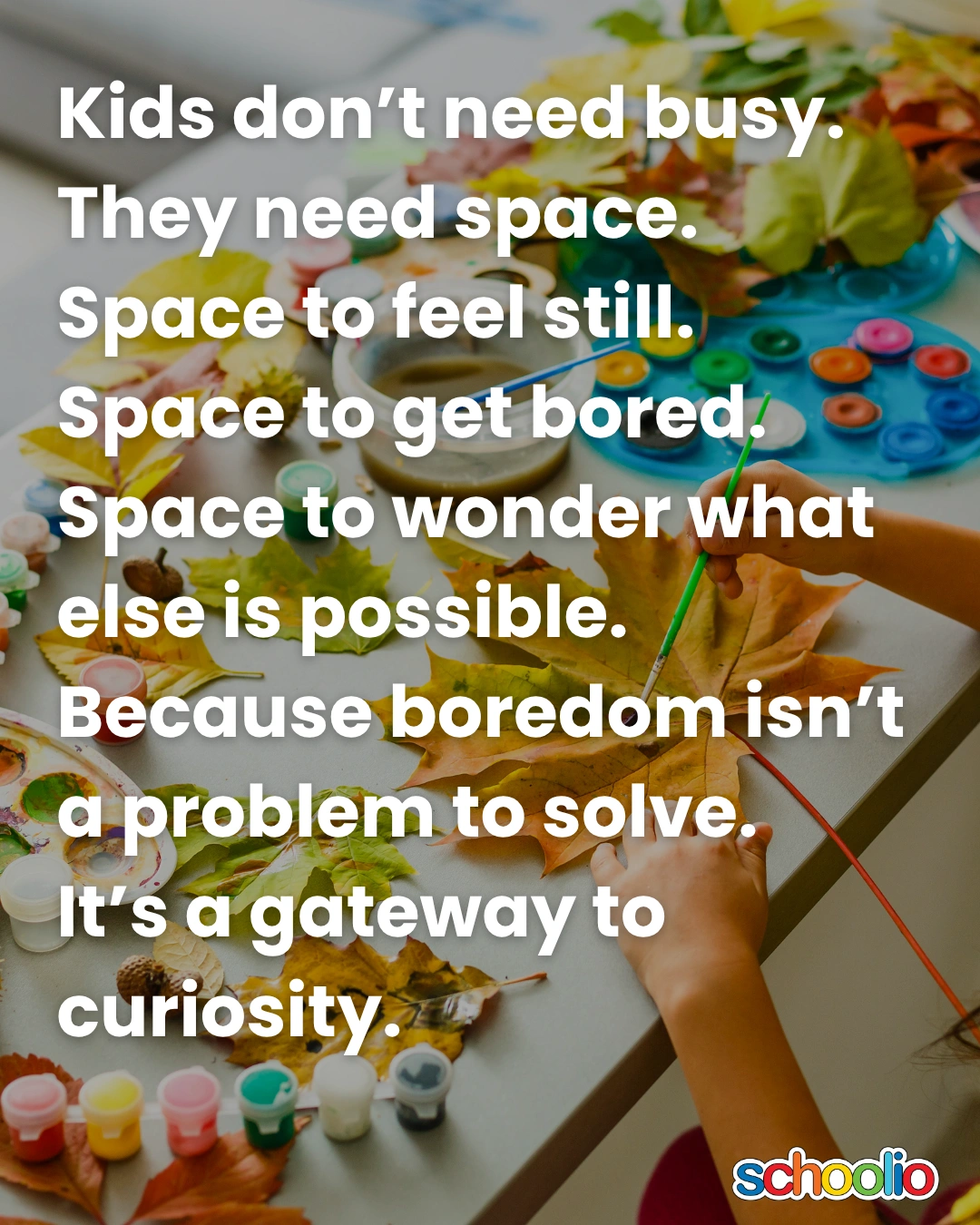
Kids don’t need busy.

They need space.

Space to feel still, to get bored and to wonder what else is possible.

Because boredom isn’t a problem to solve.

It’s a gateway to curiosity.

This weekend, I watched it play out in real life. It was around 7pm this past weekend. My kids were both on their phones, scrolling. Dinner was still an hour away, like it usually is in our house.

I looked over and thought, should I ask them to put it down?

Will it turn into a fight right before dinner? Will it be met with the usual eye rolls or sighs? Probably.

But I asked anyway.

“Take a break,” I said. “Do something else for a bit.”

They both put their phones down, reluctantly. And within a minute, I heard it. The phrase I knew was coming.

“I’m so bored.”

I said nothing. Just let it hang in the air. Ten minutes later, the three of us were at the kitchen table playing UNO. By the 45-minute mark, the game had turned competitive. We were laughing, shouting, teaming up, accusing each other of cheating. And just like that, they weren’t bored anymore.

After dinner, the phones stayed off.

My son pulled out his sketchbook and started drawing.

My daughter went to her room and practiced her DJ set.

No devices. No distractions. Just presence. All because they got bored.

I used to think boredom was something to fix.

Now I see it as a door. Because boredom is what comes before the magic.

Before the game, the drawing, the creativity, the music. And all we have to do is let it happen.

“I’m bored” is not a complaint. It’s a cue.

Let’s stop trying to fill it. Let’s let our kids feel it.

They’ll figure it out. And when they do, it’ll be better than anything on a screen.


Sathish

still learning, still unlearning

Why “Focus” Doesn’t Always Look Like Sitting Still

Why “Focus” Doesn’t Always Look Like Sitting Still


There was a season in our homeschool when math facts were… let’s just say painful.

Every time I pulled out the worksheets, I’d get groans. Wiggling in the chairs. The inevitable: “Do we have to do this?”

One day, instead of pushing through another tense math session at the table, I tried something different. We went outside. Onto the trampoline.

The kids bounced while I called out math facts. “What’s 7×6?” Bounce. Bounce. “42!” “What’s 9×8?” Bounce. Bounce. “72!”

Suddenly, the resistance melted away. They were laughing, shouting out answers between jumps, and begging for the next question. The energy that had been working against us at the table was now working for us.

And it hit me:

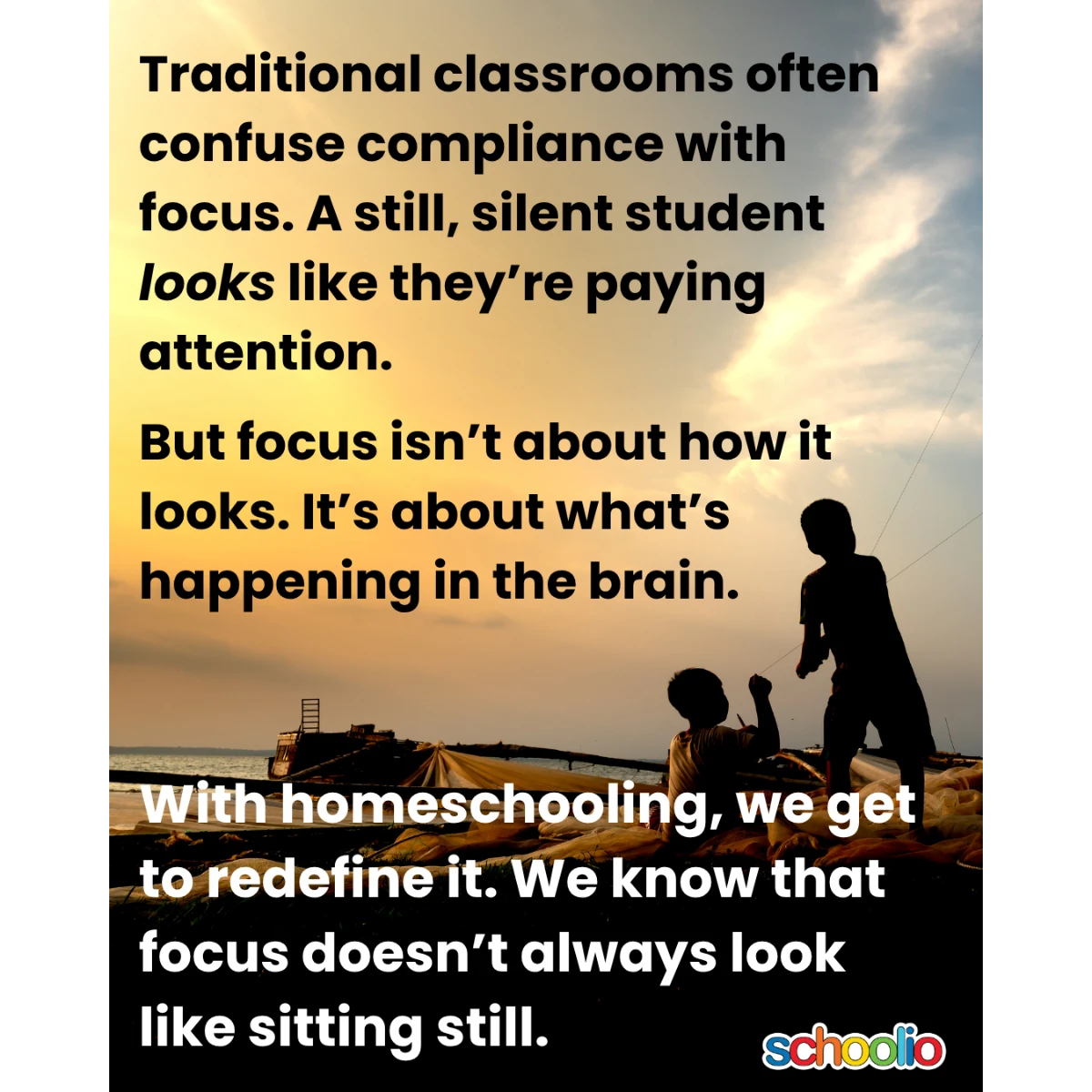
Focus doesn’t always look like sitting still.

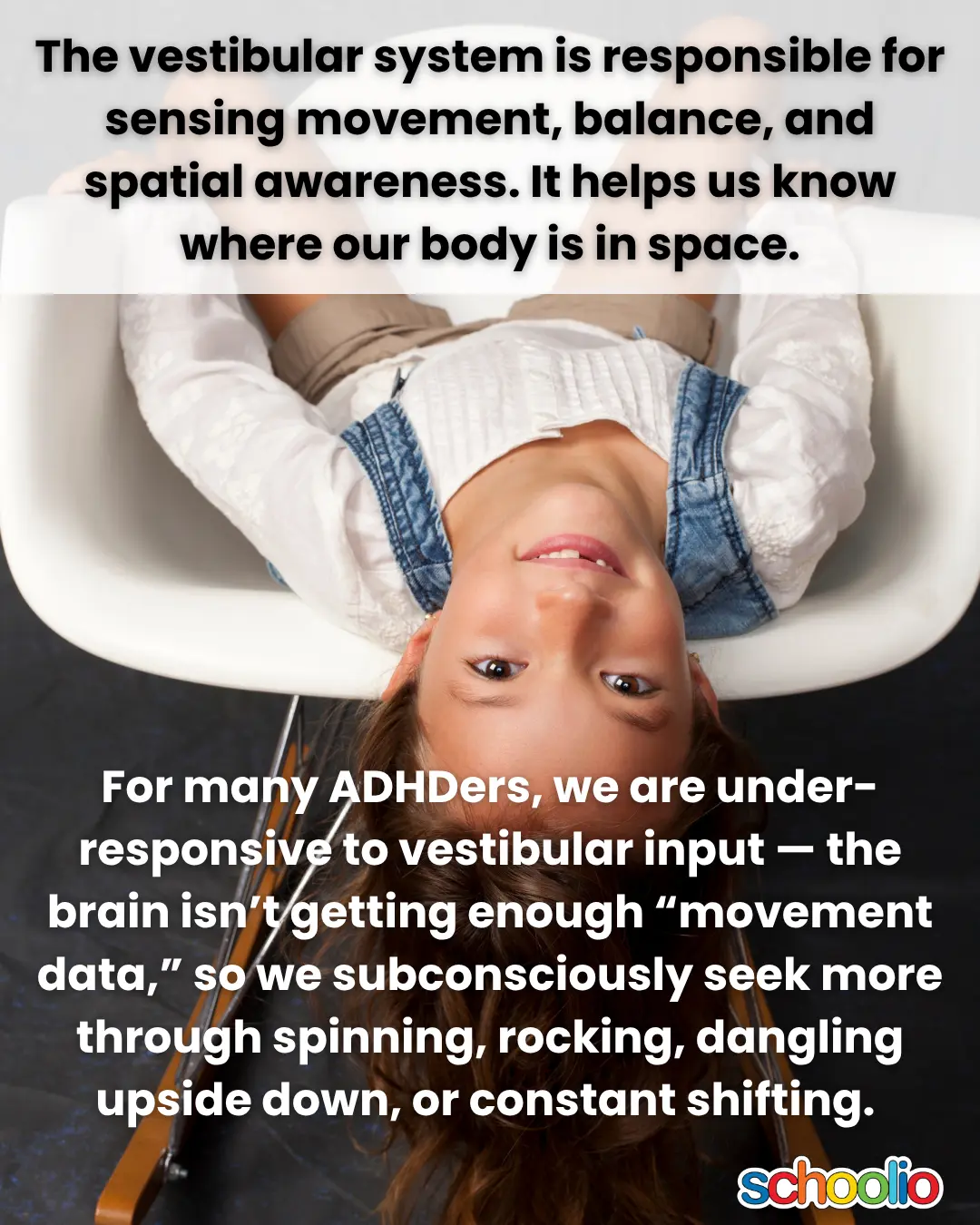
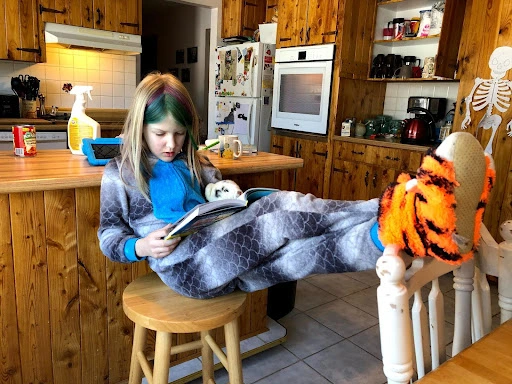
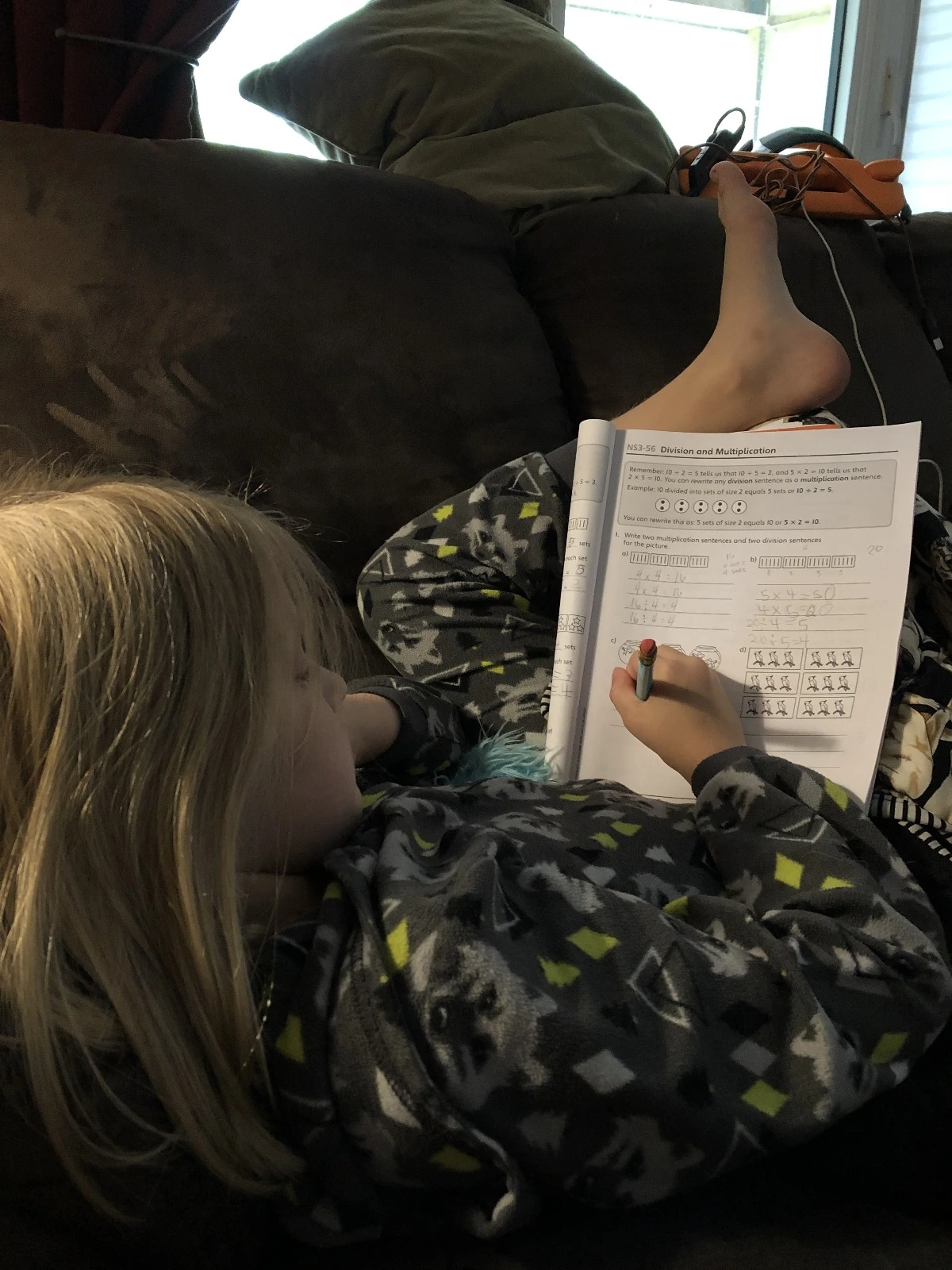
For neurodivergent kids especially, learning can happen best in motion. While doodling. While bouncing. While tapping a pencil. While upside down on the couch. The movement isn’t a distraction — it’s the doorway to attention.

Traditional classrooms often confuse compliance with focus. A still, silent student looks like they’re paying attention. But how many times are they zoning out, daydreaming, or working hard just to appear calm?

At home, we get to redefine it.

✔ Focus can look like doodles in the margin while listening.

✔ Focus can look like bouncing on a trampoline while memorizing math facts.

✔ Focus can look like humming quietly while reading.


The truth is, focus isn’t about how it looks. It’s about what’s happening in the brain.

So if your child can’t sit still — maybe don’t fight it. Maybe lean into it. Movement can be the bridge between frustration and fun, resistance and retention.

Because focus doesn’t always look like stillness. Sometimes it looks like joy.


? Lindsey

Certified Special-Ed Educator & Co-Founder, Schoolio

Trauma-Informed Education

What Is Trauma-Informed Education, And Why It Might Be Exactly What Your Child Needs


By Lindsey, certified special-ed educator and co-founder, Schoolio

If you’ve pulled your child out of school because something wasn’t working- and I mean really wasn’t working- you’re not alone.

We hear from families every day whose kids are recovering from what we call school trauma.

Maybe your child:

  • Was bullied and felt unsafe
  • Shut down from anxiety or sensory overload
  • Was constantly in trouble for behavior no one tried to understand
  • Masked all day to fit in and melted down at home
  • Fell behind and couldn’t catch up, no matter how hard they tried and had their confidence and self-esteem shaken

Whatever your story looks like, one thing is clear:

Your child didn’t just need to “toughen up”. This isn’t a “right of passage” and it’s not learning to “deal with the real world”, they need a completely different kind of learning environment to feel safe and recover.


What “Counts” As Trauma?

Trauma is not something we narrowly define. In reality, all experiences that have negative and long-lasting impact can cause trauma. Another child being mean to your child one time on the playground may not be a traumatic event, but on-going bullying and the emotional abuse, harassment, and character destruction that includes certainly can be. In fact, it is the way we process and experience certain events that defines how traumatic they are; two kids may process the same episode quite differently, making it a traumatic event for one but a minor blip on the radar for the other.

Trauma impacts learning and behavior. It can significantly slow down, or completely stop our ability to learn.

Kids experiencing trauma are more likely to fall behind in school, struggle to catch up, or get in trouble for behavior issues. These results can compound more trauma and make things increasingly worse.

If your child has experienced school trauma, you did the right thing by removing them from that environment. But you might be asking yourself, now what?

That’s where trauma-informed education comes in.


What Is Trauma-Informed Education?

Trauma-informed education isn’t just a buzzword- it’s a researched, intentional framework grounded in how children process stress and recover from negative experiences. It is an approach to teaching that recognizes the widespread impact of trauma on a child, and aims to create a safe, supportive, and inclusive learning environment. It acknowledges that your child’s past experiences, including trauma, can directly affect their ability to learn. By understanding these impacts, we can adjust teaching methods and create a home environment that fosters their recovery and resilience while supporting real learning.

Trauma-Informed Education is built on six key principles:

  1. Safety: Children must feel emotionally, mentally, and physically safe in their learning environment. You’ve established this by bringing them home to learn and removing them from the unsafe environment of school.
  2. Trustworthiness and Transparency: It’s important now that your feels like they know what to expect and know that the adults around them are predictable and honest.
  3. Empowerment, Voice, and Choice: Kids do better when they have a say in their learning process and are given appropriate autonomy.
  4. Collaboration and Mutuality: Learning should not be something done to a child, but something done with them.
  5. Peer Support: Feeling part of a community and knowing you are not alone is a critical part of healing. Remember that your family unit is also a “community”.
  6. Cultural Responsiveness: It’s cruical that your home and family affirm and respect your child’s identity, history, and experiences.

A trauma-informed approach recognizes that stress, fear, and overwhelm shut down learning. When a child feels unsafe, emotionally or physically, their nervous system goes into survival mode. And survival mode leaves very little room for comprehension, creativity, or curiosity. Feeling “unsafe” doesn’t always mean they feel like they’re in danger. Fear of failure or criticism, fear of exclusion, and fear of retaliation are all legitimate attacks on a child’s sense of safety.

Trauma-informed education begins with the right questions:

  • Does my child feel safe right now?
    • Remember the above ways of feeling unsafe- this includes their feel of failing or getting in trouble.
  • Do they feel heard and respected?
  • Are they given choices and control over their learning?
  • Is our environment calm, clear, and consistent?
    • As parents, we get frustrated and overwhelmed too- we’re human after all. If you need a break to calm down, take it. The environment isn’t calm if you’re stressed. Only a regulated person can help calm a dysregulated person.

If the answer to those questions is no, it doesn’t matter how high-quality the curriculum is, their brain won’t be ready to receive it. Establish all four consistently before you start a learning program. Deschooling and recovering from public school burnout should come first. Download our free guide here.

How Schoolio Supports Trauma-Impacted Learners

We didn’t create Schoolio to be a trauma recovery program. But we did design it to be flexible, gentle, and deeply learner-centered. For many children recovering from difficult school experiences, that’s exactly what they need.

Here’s how our program applies trauma-informed educational practices, supports recovery, and helps you provide a safe and calm learning experience for your child:

  1. Predictability Without Pressure

    Our lessons follow a consistent, easy-to-understand structure, but you, the parent, set the pace.

    Kids who’ve experienced chaos or overstimulation in school find relief in knowing what to expect, without the added stress of rigid deadlines.

  2. Reduced Sensory Load

    Our videos and digital content are intentionally designed to be calm and simple. We avoid overstimulation and excessive noise or visuals because overstimulated brains don’t retain information, they shut down.

  3. Adaptable to Their Energy and Academic Levels

    Many children exiting the school system are burnt out. They don’t need another mountain to climb, they need space to breathe. Schoolio’s bite-sized lessons, printable offline options, and flexible scheduling create room for healing without halting progress. You can also mix-and-match grade levels to create a program where they feel confident and successful, rebuilding self-esteem and security.

  4. Emotional Learning Built In

    Our social-emotional learning and mental health courses are not extras, they’re part of our core offerings. Kids deserve to learn how to name their feelings, manage emotions, build healthy relationships, and recover from stress. These aren’t bonus skills, they’re life skills.

  5. No One-Size-Fits-All Expectations

    Many kids develop trauma in school simply because they didn’t fit the mold. At Schoolio, we don’t have a mold.

    Your child can move ahead in one subject while slowing down in another.

    They can demonstrate knowledge through art, play, projects, and conversation, not just multiple-choice tests.

    They can build a learning plan that matches their pace, their passions, and their strengths.

Final Thoughts

If your child is resistant to learning right now, that doesn’t mean they’re lazy or broken.

If they seem shut down, checked out, or angry, that doesn’t mean homeschooling won’t work.

It means they’re still healing.

They need time, safety and trust.

And they need a learning environment that sees them as a whole person, not a problem to fix.

That’s what trauma-informed education offers.

That’s what we aim to provide at Schoolio.

And if that’s what your child needs, you’re in the right place.


Lindsey

certified special-ed educator and co-founder, Schoolio

Stop Trying to Fix What Was Never Broken: Rethinking Autism and Blame

Stop Trying to Fix What Was Never Broken: Rethinking Autism and Blame


This has been on my mind today…

The latest debates around Tylenol and autism feel like déjà vu. Another attempt to eliminate something we don’t fully understand. This time, the theory is that avoiding acetaminophen during pregnancy could somehow prevent a child from being autistic. And while the internet grabs onto that narrative like it’s gospel, I can’t help but think of the damage it’s doing — not just to scientific truth, but to every child being born into a world where their neurodivergence is seen as a defect.

Autism was discovered long before Tylenol hit pharmacy shelves. The spectrum existed before there were labels, diagnoses, or heated panels on morning talk shows. What’s new isn’t autism. What’s new is our panic around accepting it.

I grew up in Singapore, where the approach to childhood “issues” was very different — but carried the same dangerous root: blame. If you weren’t performing well in school, it wasn’t because you learned differently or were overwhelmed or needed support. You were lazy. Disrespectful. A problem.

My parents believed this. So did my teachers. My inability to focus or sit still or memorize math formulas wasn’t something to understand — it was something to beat out of me. Literally.

I was hit at home. Disciplined at school. Shamed in front of peers. I remember hearing the word potential thrown around like it was a threat — like I could have been something, if I just tried harder. The system, they said, was fine. I just didn’t fit it. That was my fault.

Now I’m older, a father, and an educator building a company that works with thousands of students — many of them neurodivergent. And I see the same root problem, just dressed differently.

Instead of beating kids into conformity, we now try to scare parents out of having children that are different in the first place. Avoid this. Don’t take that. Follow these rules and maybe, just maybe, your kid won’t be one of those.

But that’s not progress. That’s erasure.

Autism isn’t something to get rid of. It’s something to understand. Neurodivergent kids aren’t broken. They’re brilliant. But only if we stop trying to fix them.

We need to stop treating difference like a disease. We need to stop hiding behind policies and prevention myths and start asking better questions. Like: How do we build schools, communities, and systems that allow all kids — not just the compliant ones — to thrive?

At Schoolio, that’s our mission. Not just because it’s good pedagogy, but because it’s personal. I know what it feels like to be punished for the way your brain works. I also know what it feels like to unlearn all of that — to parent differently, build differently, lead differently.

So no, I don’t believe Tylenol is the problem. And I don’t believe discipline should be violent, whether physical or emotional. I believe in kids. I believe in learning environments that adapt to the child — not the other way around.

This isn’t about prevention. It’s about permission — to be different, to be seen, to be accepted.

Let’s stop blaming. And start building.


Sathish

still learning, still unlearning

When I Realized My Child’s Learning Style Didn’t Match My Own

When I Realized My Child’s Learning Style Didn’t Match My Own

By Lindsey, certified special-ed educator & co-founder, Schoolio


This has been on my mind today…

When I first started homeschooling, I assumed my kids would learn the way I learn. That’s the default, right? We teach from our own perspective. But it didn’t take long for me to realize their learning styles—and their needs—were very different from mine.

I’m ADHD. I thrive on novelty, challenge, and curiosity. I love going out, seeing people, doing things. My brain comes alive when there’s energy in the room. Planning homeschool field trips, events, parties, and mom meet-ups? That gave me life. I thought it would do the same for my kids.

But my kids are autistic. They enjoy their friends, yes—but in small doses, one-on-one, in familiar settings. Big group outings didn’t energize them the way they did me. They drained them. Where I walked away buzzing with energy, they walked away needing quiet, calm, and time to recover.

It was the same in our learning space. I always wanted music playing, stimulation in the background. They wanted silence. I craved variety and spontaneity. They needed consistent, reliable routines. I thrived on the excitement of new challenges. They thrived on knowing what to expect.

At first, I resisted that difference. I kept thinking, but this is how I learn best—shouldn’t it work for them too? When it didn’t, I felt frustrated. But slowly, I realized I had it backwards. My job wasn’t to shape them into my rhythm. It was to honor theirs.

That shift changed everything.

I began planning fewer big events and focusing on more intentional one-on-one time with friends. Instead of background noise, I chose quiet. Our homeschool days gained more rhythm and held fewer surprises. Along the way, I learned how to stretch myself to meet their needs, and gently taught them to stretch a little too—tolerating small bits of novelty, practicing compromise, and knowing it was okay to ask for quiet whenever they needed it.

Homeschooling taught me as much about myself as it did about them. It reminded me that love often looks like adjusting our pace, our preferences, and our expectations—not forcing someone else into our mold.

And it gave me this truth:

We don’t have to learn the same way to learn together.

Why Different Isn’t Wrong

Why Different Isn’t Wrong

I’ve been called a lot of things growing up. Dumb. Stupid. Social butterfly. But the one that stuck with me the most was weird. That word followed me through school hallways, into classrooms, and even outside of school. Most of the time, people didn’t say it to hurt me. They just didn’t understand me. I saw the world differently, noticed things others didn’t, and asked questions that didn’t have simple answers. And I wasn’t trying to fit in. I just didn’t feel like I needed to.

For a long time, I thought being different meant something was wrong with me. I believed the labels. I thought maybe I really was all those things. But over time, I began to realize that the problem wasn’t me. People often label what they can’t understand. It helps them feel like they’ve figured something out. Like sorting clothes into piles when you don’t know where something belongs. It doesn’t mean the clothes are bad. It just means you’re not sure where they fit.

As I got closer to the families who use Schoolio, I started to see pieces of myself in the children they were teaching. I saw it in the kids who struggled to sit still. In the ones who asked more questions than most teachers had time to answer. In the learners who didn’t follow the same path as everyone else. These kids weren’t broken or difficult. They were just full of a different kind of energy. The kind that doesn’t always show up the way school expects it to.

And the parents who choose to homeschool these children are some of the bravest people I’ve met. They don’t take the easy path and don’t choose homeschooling because it’s convenient. Parents do it because they want their child to feel seen and because they believe there’s more than one way to learn. They do it because their child needs something different, and they’re willing to build it themselves.

I think about how far I’ve come. From the kid who didn’t fit in, to someone who gets to support other kids who feel the same way. It’s not about fixing them—it’s about walking alongside them. Being different isn’t something to hide; it’s a part of who they are. And most of all, it’s something to be proud of.

At Schoolio, we get to be a small part of that journey. We get to help children feel understood. And we get to remind parents that their choice to take the road less travelled matters. Because sometimes, that road leads to the most incredible places.


Sathish

still learning, still unlearning

Why ADHD is Keeping Your Child Awake

Why ADHD is Keeping Your Child Awake: Understanding Sleep Struggles in ADHD Kids


It’s 10:00 p.m., and you’re already bracing yourself. Your ADHD child is tucked into bed, but instead of drifting off, they’re talking a mile a minute, bouncing their legs under the covers, or hyperfocusing on a book, game, or story idea. Hours later, they’re still awake — and you know the morning will be rough.

Sound familiar? You’re not alone. Many families of ADHDers find that bedtime is the hardest time of day. ADHD brains and sleep just don’t follow the same rules as everyone else’s. Understanding why ADHD makes sleep so tricky — and how to work with your child’s brain instead of against it — can help you reduce frustration, ease bedtime battles, and support your child’s overall health.


Why ADHD and Sleep Don’t Mix Easily

For kids (and adults) with ADHD, sleep difficulties are extremely common. Up to 70–80% of ADHDers experience persistent sleep problems — not just because of “bad habits,” but because of how their brains and bodies function.

Here are some key reasons ADHD kids struggle with falling and staying asleep:

1. Delayed Melatonin Release

Research shows that many ADHDers have a delay in melatonin production — the hormone that signals the body it’s time to sleep. Their “sleepy signal” comes hours later than typical, making them naturally more alert at night.

2. Hyperactivity as Racing Thoughts

For some ADHDers, hyperactivity doesn’t mean bouncing off the walls — it’s mental. At night, the brain races through thoughts, ideas, or worries, making it nearly impossible to “shut down.”

3. Hyperfocus at Night

When the world is quiet, ADHDers may lock into hyperfocus — reading, building, gaming, or creating — and lose track of time entirely. That 15-minute “just one more” quickly turns into hours.

4. Irregular Routines

ADHD brains crave novelty and struggle with consistency. Sticking to rigid routines can feel impossible, which often leads to inconsistent bedtimes and wake-ups that disrupt circadian rhythms.

5. Circadian Rhythm Shifts (DSPS)

Delayed Sleep Phase Syndrome (DSPS), where the natural body clock runs later than typical, is notably more common in ADHD individuals. They simply aren’t tired until much later than societal schedules allow, making mornings especially painful.


Signs ADHD Sleep Struggles Might Be Affecting Your Child

  • Bedtime stretching into late hours, no matter how early you start winding down
  • Extreme difficulty waking up, even with enough hours in bed
  • Morning irritability, brain fog, or emotional dysregulation
  • Best focus and energy late in the day instead of mornings
  • Constant battles around bedtime routines

If this sounds like your household, it’s not because you’re “failing” at bedtime. It’s because ADHD brains are wired differently.


The Impact of Poor Sleep on ADHD Kids

When kids with ADHD don’t get quality rest, the ripple effects show up everywhere:

  • Increased ADHD symptoms: impulsivity, distractibility, and poor regulation intensify.
  • Emotional dysregulation: meltdowns, frustration, and mood swings are more frequent.
  • Learning struggles: fatigue worsens focus, memory, and motivation.
  • Family stress: nightly battles and groggy mornings strain relationships.

Adapted Sleep Hygiene for ADHD Brains

Standard sleep hygiene tips often feel overwhelming or unrealistic for ADHD families. A neurodiversity-affirming approach makes them practical and supportive. Here are strategies that actually work for ADHDers:

1. Personalized Routines

Establish consistent wind-down rituals, but tailor them to sensory needs. Some kids may prefer dim lights and quiet reading, while others regulate best with stretching, deep pressure (like a weighted blanket), or calming play.

2. Environmental Supports

Create a sensory-friendly sleep environment. Use blackout curtains to block light, white noise to mask sound, weighted blankets for calming pressure, or soft bedding that avoids irritating textures.

3. Tech Timing

Set a structured cut-off for stimulating screens, but don’t remove special interests entirely. Calming formats like audiobooks, podcasts, or slow-paced shows can support winding down without triggering over-stimulation.

4. Flexible Approach

Avoid rigid “sleep rules” that lead to battles. Instead, focus on gradual adjustments, like moving bedtime earlier by 10–15 minutes at a time, or setting realistic goals instead of strict demands.

5. Regulation Aids

Mindfulness exercises, gentle movement before bed, or sensory tools can help calm the nervous system. In some cases, melatonin supplements (if recommended by a healthcare provider) can support resetting the body’s clock.


Homeschooling and ADHD Sleep Challenges

Here’s the good news: homeschooling gives you flexibility most families don’t have. Instead of fighting the impossible battle of making your ADHD child match a “standard” sleep schedule, you can:

  • Let them sleep until their bodies are rested, without alarms and out-the-door rushes.
  • Start academics later in the morning, when your child is alert and focused
  • Use mornings for movement, outdoor play, or low-demand activities
  • Let afternoons and evenings (their natural focus times) be the most academic
  • Teach self-awareness by helping them recognize when they feel tired or focused

This adaptability not only reduces stress but also helps your child thrive by working with their natural rhythms.

“But that won’t prepare them for the real world!”

I hear you naysayers, but forcing your child to go to bed early and wake up early now, won’t necessarily make it easier for them a decade from now. They have ADHD, which means their brains are wired differently—and they always will be. For many, mornings will always feel harder, and a 9–5 routine will always require an alarm. But that doesn’t mean they need to suffer through that reality now. Also, right now they are growing. They are learning. They are in need of good rest to be their best selves- why wouldn’t we give that to them as part of their homeschooling, and childhood, experience?


A Hopeful Note for Parents

If sleep feels like the never-ending struggle of your ADHD journey, remember this: your child isn’t being defiant, lazy, or manipulative. Their brain chemistry is different, and sleep challenges are part of the package.

With patience, adapted strategies, and flexible routines, you can support your child in finding rest. Homeschooling offers the gift of adjusting the day to fit your child’s real needs — not forcing them into a mold that doesn’t fit.

Better sleep won’t happen overnight (literally!), but small shifts add up. Over time, you’ll find the balance that lets your child rest, recharge, and thrive.


? Lindsey

Certified Special Ed Educator & Co-Founder, Schoolio

What Dopamine Deficiency Looks Like in ADHD Kids

What Dopamine Deficiency Looks Like in ADHD Kids


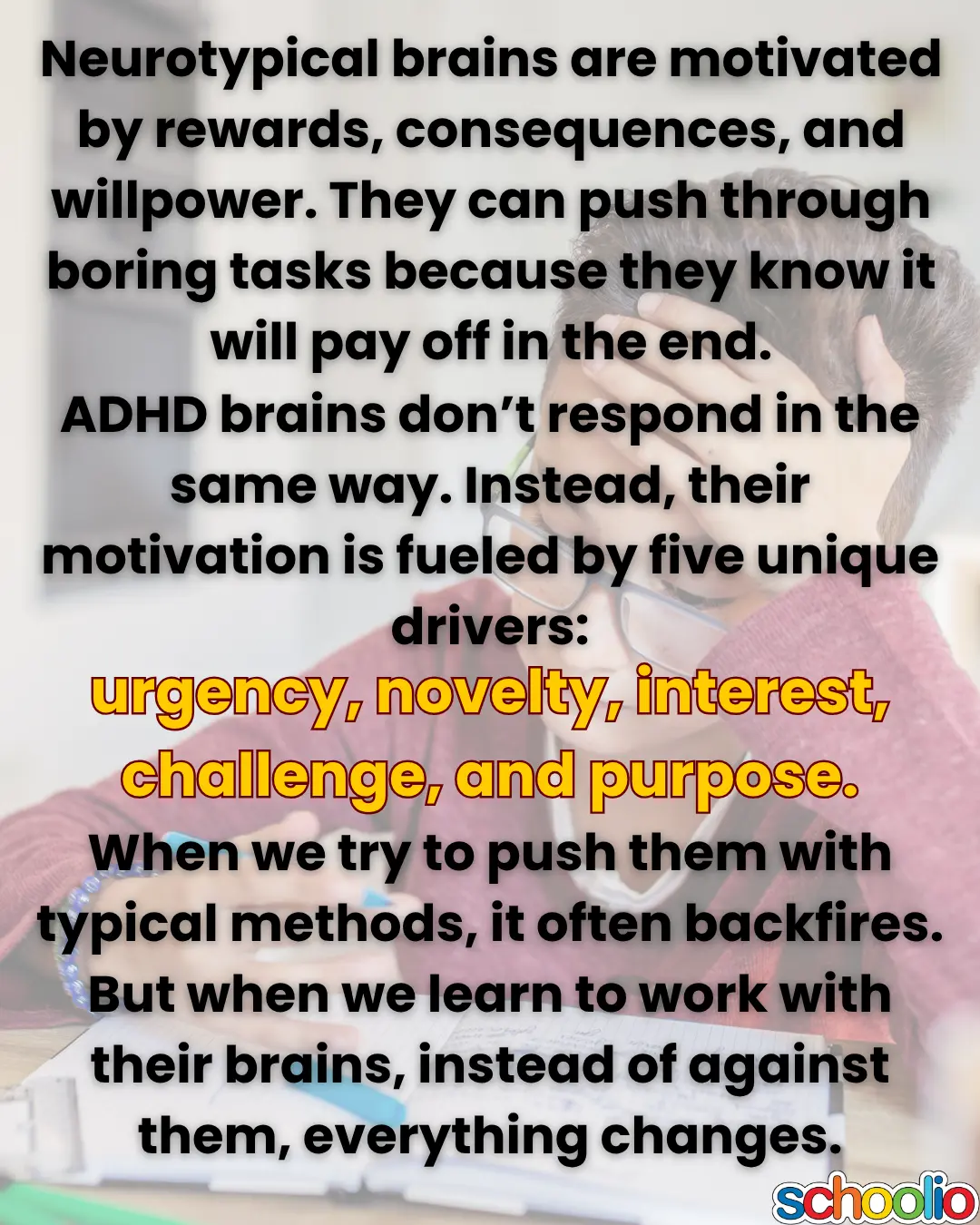
Because ADHD brains don’t release or regulate dopamine effectively, kids often live in a state of chronic “dopamine hunger.” Just like being low on food makes you hungry, being low on dopamine makes the brain crave stimulation.

For ADHD kids, that deficiency can show up as:

  • Inattention: Struggling to stay engaged with boring or repetitive tasks.
  • Restlessness: Constantly moving, fidgeting, or seeking stimulation.
  • Mood swings: Irritability, frustration, or feeling flat when dopamine is low.
  • Low motivation: Finding it nearly impossible to start tasks without external stimulation.
  • Emotional sensitivity: Stronger reactions to rejection, failure, or disappointment.

For your child, it may feel like a constant itch they can’t scratch—an internal restlessness that only eases when something exciting, novel, or rewarding captures their attention.


Dopamine-Seeking Behavior: It’s Not Their Fault

When your child bounces from one activity to another, gets “hooked” on video games, or melts down when asked to do something boring, it’s easy to feel like they’re being defiant or careless. But here’s the truth: their brain is driving them to seek dopamine in the same way hunger drives you to eat.

This is why ADHD kids often:

  • Hyperfocus on video games or special interests.
  • Struggle to stop stimulating activities.
  • Seek out novelty and excitement.
  • Resist boring or repetitive tasks, no matter how important.

It’s not a lack of discipline—it’s survival. Their brain is looking for the fuel it needs.


How Dopamine Affects Learning and Behavior

Dopamine deficiency in ADHD can impact every part of your child’s life:

  • Attention: Without dopamine, focusing feels nearly impossible.
  • Behavior: Kids may act impulsively, even dangerously sometimes, always chasing the next burst of stimulation. Dopamine-seeking risky behaviors can be especially problematic for teenagers.
  • Learning: Learning is always harder when your body is lacking a needed brain chemical, just like with anxiety, depression, or trauma. A dysregulated brain cannot learn, so focus on mental and emotional stability first.
  • Emotions: Dopamine imbalance can make moods more volatile and rejection harder to handle.

When we frame these struggles as brain chemistry—not willpower—it changes everything.


Strategies for Supporting Your Child’s Dopamine Needs

The good news: there are ways to help regulate your child’s dopamine levels and create a homeschooling environment that works with their brain instead of against it.

1. Build in Small Rewards

Break tasks into smaller steps, and celebrate progress often. Rewards don’t have to be big—a sticker, praise, or a short break can be enough to trigger dopamine.

2. Backward Rewarding

“Backward rewarding” is a practice that works well for ADHD kids because it gives them the dopamine they require upfront. We typically reward for work well done- at the end of the task- but without dopamine, no amount of desire, will-power, or motivation will make your child capable of performing the task. For example, 30 minutes of video games before you start school, along with a 30 minute reward at the end, might have math going much more smoothly then with the end-reward only. (Make sure you make the time limit clear before they start, and set timers to remind of the end coming multiple times to make the transition happen.)

3. Use Movement

Physical activity boosts dopamine. Try starting the school day with a walk, dance break, or jumping jacks. Build movement into lessons whenever you can.

4. Lean Into Interests

Remember, interest = dopamine. Whenever possible, tie schoolwork to your child’s passions. If they love animals, use animal examples in math problems or writing prompts. Don’t be afraid to go “off-book” when pulling their interests into your learning. Remember when I turned our geography into dragons? That’s what we’re going for!

5. Add Novelty

Switch up routines occasionally—study in a new spot, use a different color pen, or bring in hands-on projects. Small changes can spark big dopamine boosts.

6. Prioritize Sleep and Nutrition

Dopamine regulation depends on healthy sleep cycles and steady nutrition. Work toward consistent bedtimes and balanced meals with protein to support brain chemistry.

7. Use Tech Wisely

Screen time provides big dopamine hits, which is why it can be so hard for ADHD kids to stop. Instead of banning screens completely, use them strategically—incorporate educational apps, set clear boundaries, and use them as short, structured rewards. Always give multiple warnings for transitions off screens


A Homeschooling Lens

Homeschooling gives you the freedom to design a learning environment that supports your child’s dopamine needs instead of punishing them for them. That means:

  • Flexible schedules to account for energy highs and lows.
  • Interest-driven projects that keep motivation high.
  • Frequent breaks for movement and stimulation.
  • Celebrating effort, not just outcomes, to give consistent dopamine boosts.

Your child doesn’t need to be “fixed.” They need understanding. When you see their restlessness, hyperfocus, or boredom through the lens of dopamine deficiency, it stops looking like defiance and starts looking like what it truly is: a brain craving balance.

With patience, creativity, and neurodiversity-affirming strategies, you can help your child feel less hungry for dopamine—and more successful in learning and in life.

Why I Learned to Plan Our Homeschool in Pencil

Why I Learned to Plan Our Homeschool in Pencil

By Lindsey, certified special-ed educator & co-founder, Schoolio


This has been on my mind today…

When I first started homeschooling, I thought I needed a perfectly structured plan. Color-coded calendars. Long-term schedules. Daily checklists. If I could just organize everything, I told myself, then our homeschool would run smoothly.


And to be honest—I can make a banging plan. ADHD has given me that hyperfocus superpower. I can map out a schedule that looks incredible on paper. But sticking to it? Executing it with military precision day after day? That’s where things fall apart. My brain doesn’t thrive under that kind of rigidity. And neither do my kids.


I remember one day in particular. I had my agenda ready, subjects lined up, and a vision of us moving neatly through the day. Instead, I found myself still in pajamas, sipping my third cup of coffee, reading aloud from the couch while my kids snuggled beside me. That was “school” for the day. And honestly? It worked.


It took me about a year to unlearn the pressure of overplanning. Especially with neurodivergent kids, you never really know what a day will look like. I used to plan out weeks—sometimes months—at a time. But that just set me up for stress and disappointment when life inevitably didn’t go according to script.


Take field trips, for example. I’d schedule an outing with our homeschool friends, then expect the very next day to be a heavy academic “catch-up” day. But my autistic kiddos taught me something important: they needed two days for those big events. One day to go, explore, and engage. And another day to recharge quietly at home. Trying to push through the day after always ended in frustration for everyone.


So I learned to plan differently.


Now I plan in pencil. That’s both literal and metaphorical. I map out gentle rhythms, not rigid schedules. I leave space for flexibility, rest, and the unexpected. I don’t ask, “Are we keeping up?” anymore. I ask, “What do my kids need today?”


And that shift has changed everything.


The truth is, learning doesn’t only happen in neat blocks of time. It happens on the couch with a read-aloud, on a quiet day of rest, and yes—even in pajamas with a stack of coffee cups nearby. When I stopped treating our homeschool like something to control and started treating it like something to live, we all found more peace—and more learning, too.


So if you’re staring at your homeschool planner feeling like you’re always “behind,” I want to gently remind you: you don’t have to plan it all in ink. You don’t have to keep up with anyone else’s schedule. You can plan in pencil. And sometimes, those pajama days on the couch end up being the best days of all.

When Little Things Feel Too Big: Frustration Intolerance in ADHD & Autistic Kids

When Little Things Feel Too Big: Frustration Intolerance in ADHD & Autistic Kids

Does your child melt down the moment something doesn’t go their way? Maybe a math problem is “too hard,” or the Wi-Fi glitches during their game, and suddenly you’re facing tears, yelling, or complete shutdown.

For many ADHD and autistic kids, this isn’t just “having a short fuse.” It’s called frustration intolerance — a real struggle where even small challenges feel unbearable. And if you’re parenting or homeschooling a child who experiences it, you know how exhausting (and heartbreaking) it can be.


What Is Frustration Intolerance?

Frustration intolerance means struggling to cope with situations that are difficult, unpleasant, or don’t go as planned. Instead of “pushing through,” kids may:

  • Explode in anger or tears.
  • Refuse to keep going (“I quit!”).
  • Withdraw completely and shut down.

It’s not about being dramatic. It’s about their brain hitting a wall — and not yet knowing how to climb over it.


Why Neurodivergent Kids Struggle More

For ADHD and autistic kids, frustration intolerance often shows up bigger and louder because of how their brains process the world. Here’s why:

1. Executive Functioning Differences

Planning, organization, emotional control — all of these “thinking skills” are harder for many ND kids. When a task feels overwhelming, their ability to regulate frustration can collapse fast.

2. Sensory Sensitivities

Bright lights, loud noises, scratchy clothes — sensory overload lowers tolerance. Once they’re maxed out, even a tiny frustration feels huge.

3. Dopamine and Motivation

For kids with ADHD, dopamine regulation plays a big role. Tasks that feel boring, slow, or unrewarding become almost impossible to stick with, triggering fast frustration.

4. Rigid Thinking

For many autistic kids, when things don’t go as expected, it’s hard to adapt. A simple change — like math problems being harder than yesterday — can cause them to feel stuck and defeated.


How It Shows Up in Daily Life

Parents of frustration-intolerant kids often see:

  • Homework battles that spiral into tears.
  • Meltdowns over minor inconveniences.
  • Avoidance of activities that might be “too hard.”
  • Perfectionism or quitting early to avoid failure.

If this sounds like your child, you’re not alone. And there are ways to help.


Helping Your Child Cope With Frustration

The good news? Kids can learn to tolerate frustration better — with support, practice, and patience. Here are some strategies you can start using today:

1. Teach Emotional Regulation Tools

Breathing exercises, mindfulness, or fidgets help kids calm their nervous system before frustration takes over. Practice during calm moments so the tools are ready when needed.

2. Break Tasks Into Smaller Steps

Instead of “Write your essay,” try “Brainstorm three ideas.” Smaller steps feel doable — and success builds momentum.

3. Set Realistic Expectations

Match goals to your child’s current capacity. Celebrate small wins and progress, not just the final result.

4. Create a Calm Space

Reduce sensory overload by offering a quiet, comfortable spot for learning or calming down.

5. Use Visual Supports

Schedules, checklists, and timers help make tasks concrete and predictable. Kids feel less overwhelmed when they can see what’s happening and what’s next.

6. Model Problem-Solving

Show them how you handle frustration. Talk through challenges out loud: “This isn’t working. Let’s try another way.” Role-play different solutions together.

7. Stay Patient and Supportive

Setbacks are part of the process. When your child is overwhelmed, validate their feelings: “I can see you’re frustrated. That’s okay.” Then gently guide them toward coping strategies.


Why This Matters

Frustration intolerance doesn’t just impact schoolwork — it shapes how kids see themselves. Without support, they may start believing: “I can’t do hard things.” But with the right tools, they learn that challenges aren’t the enemy — they’re opportunities to grow.


A Hopeful Reminder

If your child struggles with frustration, it doesn’t mean they’re lazy, dramatic, or incapable. It means their brain needs extra scaffolding to build tolerance. And as a parent — especially a homeschooling parent — you have the unique chance to create a space where frustration isn’t the end of the story, but the beginning of resilience.

✨ Want to learn more about frustration intolerance and how it connects to executive dysfunction in neurodivergent kids? Read the full article here ? https://schoolio.com/blog/frustration-intolerance-in-adhd-and-austistic-kids/.

PDA in ADHD and Autistic Kids and How to Help Them Thrive

Pathological Demand Avoidance (PDA) in ADHD and autistic kids is more common than you may realize.

Picture this: It’s almost time for dinner and you ask your ADHD 8-year-old to clean up his toys and wash his hands. He procrastinates, “I just need to finish this one thing first.” You ask him again 5 minutes later. “I’m too tired. My tummy hurts.” Getting frustrated, you put your foot down and insist, “No more excuses, time to clean up now!” Your child escalates, crumples to the floor, crying and in full meltdown. You wonder why your child is so defiant and can’t just listen to you when you ask for something simple like tidying up. If this sounds familiar, you aren’t alone. Getting dressed, brushing teeth, cleaning up, turning off the Playstation or tablet, getting into bed- seemingly simple requests are continuously met with resistance that seems way over the top. The more you insist, the harder they resist. It’s a cycle that leaves you frustrated and angry with a child in a meltdown. Pathological Demand Avoidance, known as PDA, is a term that has gained increasing recognition within the neurodivergent community, particularly when discussing children with ADHD and autism. For those of us parents homeschooling neurodivergent kids, understanding PDA in ADHD and autistic kids is crucial to understanding our kids and then providing the right supports to create an effective learning environment. But what even is PDA? How does it manifest in neurodivergent children and what makes it different than straight-up defiance?

What is PDA?

PDA in ADHD and autistic kids refers to a behavioral profile characterized by an extreme avoidance of everyday demands and expectations, driven by a need to maintain a sense of control. Unlike typical forms of demand avoidance, PDA is rooted in anxiety, where the child’s need to avoid demands is not about defiance but rather about a deep-seated fear of losing autonomy.

PDA is increasingly recognized as a distinct profile within the autism spectrum. It can also co-exist with ADHD, leading to a complex interplay of symptoms that can make traditional behavioral interventions less effective.

PDA in adhd and autistic kids looks like this young boy refusing to mow the yard.

It’s important to note that this avoidance is not merely defiance; it’s driven by anxiety and an overwhelming need to maintain control over the situation. The child isn’t rejecting the task itself but rather the perceived loss of autonomy and the fear of failure or overwhelm if they try to comply.

Another important understanding is what is a “demand”? When we hear the word demand, it can sound like strict orders, but really a demand is any mandatory request, ie. something you tell them to do that they don’t see themselves having an option about complying with. We all make and receive many “demands” every day in our lives.

Signs and Symptoms of PDA in ADHD and Autistic Kids

Recognizing PDA in ADHD and autistic kids involves observing specific behaviors that go beyond a typical resistance to tasks. Here are some common signs you can look out for:

  1. Extreme Demand Avoidance: Children with PDA will go to great lengths to avoid demands, often using strategies like distraction, excuses, or outright refusal. They might agree to tasks but then find ways to delay or disrupt them. Their need to avoid demands is so intense that they may do things out of character, like lie, manipulate, or coerce to avoid it. 
  2. Surface Sociability: Kids with PDA often appear socially adept on the surface, and you may find they get good at using charm or negotiation to avoid demands. However, this sociability can be superficial and more of a learned behavior than a genuine personality trait, and may be masking deeper social difficulties common in autistic people.
  3. Mood Swings and Emotional Dysregulation: PDA in ADHD and autistic kids can result in rapid mood changes, especially when they feel pressured. These mood swings are often linked to their anxiety about demands. They may seem to swing suddenly from happy and relaxed to stubborn, angry, and resistant.
  4. Obsessive Behavior: Children with PDA may develop intense interests or obsessions, often as a way to gain control or escape demands. Special interests, or SPINs, are common in autistic people, but may become more pronounced and the need to engage in them more intense when faced with demands.
  5. Resistance to Routine: Most autistic children find comfort in routine. ADHD children usually thrive with routine but seek novelty to help with dopamine deficiency. Those with PDA may resist routines imposed by others, preferring to set their own schedules and routines, or buck the routine entirely. This is a bid for control and autonomy as a way to combat their anxiety.
Teen sits on his bed on his tablet surrounded by a messy room.

Why is PDA More Common in Neurodivergent Kids?

PDA in ADHD and autistic kids is more prevalent due to the underlying cognitive and emotional challenges associated with these conditions. Here’s why PDA is often seen in neurodivergent children:

  1. Heightened Anxiety: Children who are ADHD and autistic often experience higher levels of anxiety, making them more likely to develop avoidance behaviors as a coping mechanism. Because daily life can be more challenging to those who are ADHD or autistic, along with the persistent feeling that they are unlike their peers, The demands of daily life can feel overwhelming, leading to the development of PDA.
  2. Need for Control: Neurodivergent children, particularly those who are autistic, may have a heightened need for control in order to feel safe and secure. This need can manifest as PDA when they perceive demands as a threat to their autonomy. If you find your child is especially demanding and needs to control their world very strictly, along with resistance to demands you make of them, then this can be a warning sign for PDA.
  3. Executive Functioning Challenges: ADHD, and sometimes autism as well, can be characterized by difficulties with executive functioning, such as planning, organizing, and following through with tasks. This can heighten anxiety, as well as make demands feel more burdensome and stressful, leading to avoidance strategies seen in PDA.
  4. Sensitivity to Change: Many autistic children are sensitive to changes in their environment or routine. Often, they are not only sensitive to change, but require routine for function and comfort. PDA can develop as a way to resist changes that feel unpredictable or uncontrollable.
PDA in ADHD and autistic kids manifests with little girl giving the thumbs down and a grumpy face

Strategies for Managing PDA in ADHD and Autistic Kids

Managing PDA in ADHD and autistic kids can feel really frustrating as a parent. It requires an approach that respects the child’s need for control while gently encouraging cooperation. And lots of patience!

Here are some strategies that can help:

1. Collaboration

Instead of imposing demands, engage your child in collaboration with you, especially if this can be built around problem solving. This approach means you invite your kiddo to engage in a demand with you, rather than asking them to do it alone. Collaborative problem solving involves working together to identify a problem, discuss possible solutions, and agree on a plan of action. By involving your child in decision-making processes, and working together, you can reduce their anxiety and resistance to demands.

Tip: Use language that emphasizes partnership. Two powerful words for kids with PDA are “together” and “let’s”. Instead of saying, “Put on your shoes so you’re ready to go,” try “Let’s put on our shoes together so we are ready to go.” This way, you make the task collaborative and reduce the stress of demand.

2. Offer Choices

Providing choices is a powerful way to give your child a sense of control and autonomy while still guiding them toward completing the tasks you need them to complete. Offer limited, structured choices that allow your child to feel empowered without being overwhelmed by too many options. This can work for both day-to-day parenting and in your homeschool.

Tip: Present choices that are acceptable to you and get what you need done, but still give your child the autonomy of choice. Instead of saying, “It’s time for math,” try “Would you like to start with math or reading today?” This way, tasks are still being completed, but you aren’t triggering your child’s PDA tendencies with a direct demand. You’re also giving them ownership over their learning, which will help them complete activities and tasks assigned to them without feeling like it’s an obligatory demand from you.

Young boy makes choice of breakfast between cereal and fruit

3. Reduce Perceived Demands and Create Challenges

This is when we can minimize the pressure of demands by breaking tasks into smaller, manageable steps or turning them into a challenge or game. Use indirect language or suggestions to reduce the intensity of demands, such as “I wonder if…” or “It might be fun to…” Avoid framing activities as demands and instead present them as opportunities for play by making them a game, or turning them into a challenge. For example, instead of saying, “You need to clean your room,” you could say, “Let’s see how many toys we can put away together in the length of a song.” Another strategy is to use PDA to your advantage by suggesting your child can’t do the thing you want them to do. For example, “I bet you can’t get all the blocks back in the bin before I finish setting the table.” For a lot of people with PDA, suggesting they can’t do something creates a challenge they want to take on. When you turn a demand into a challenge or a game, it not only makes it more motivating and stimulating, but it also creates dopamine in the brain, which ADHDers are lacking and can help them focus and manage stress.

Tip: Try implementing a rewarding deadline. A “rewarding deadline” is a concept used in time management and productivity strategies, particularly for people who struggle with motivation, such as people who are ADHD and autistic. It involves setting a deadline for completing a task and then linking the completion of that task with a reward. The idea is to create a positive incentive to finish the task by the deadline, making the process more motivating and enjoyable. For example, if you want your child to complete their chores by 2pm, instead of saying, “You need to finish your chores by 2:00,” try saying, “If you finish your chores by 2pm, we can go to the park afterward.” The deadline is not just about the time by which the task needs to be completed, but also about the positive outcome that follows, making it a “rewarding deadline.” This technique helps to make the task more appealing and provides a tangible benefit that your child can look forward to, thus increasing the likelihood of task completion. It leverages the brain’s reward system to encourage better time management and task follow-through while avoiding PDA triggers.

4. Establish Predictable Routines

While children with PDA may resist externally imposed routines, establishing a predictable and flexible routine can provide a sense of security. Many autistic kids need routine to thrive, and most ADHD kids do better with a routine as well. Involve your child in creating the routine, allowing them to have input on the schedule and activities. Use visual schedules or checklists that your child can personalize, giving them ownership of their daily routine. This collaborative approach can reduce resistance and increase cooperation. Predictability is important to a feeling of safety, especially in our autistic kids, and deviation from the predictable can cause considerable stress. Stress means we are more likely to trigger their PDA. 

Tip: If a change in routine is unavoidable, as it sometimes is in life, there are things you can do to mitigate the distress for your child. Priming is when we prepare our autistic kids for an unknown or a deviation from the routine by telling them in advance what will be happening, and providing them with as much detail about what the change will be like as possible. Another helpful tool, especially if the change was unexpected and last minute, is simple distraction. Allow them to engage in their special interest or use noise canceling headphones or a tablet or other device to help them regulate through the change in routine.

Boy looks bored over a textbook

5. Use Positive Reinforcement

Positive reinforcement is always a more powerful motivator for children than negative consequences, especially for children with PDA. Focus on praising effort and progress rather than specific outcomes, and use rewards that are meaningful to your child. Rewards aren’t the same as bribes, but rather they are recognition of their hard work and cooperation and a goal for your child to strive towards while completing their obligations.

Tip: Create a reward system that is consistent and predictable. Using something visual is helpful, especially for younger children. Make sure your system is predictable but also flexible enough to adapt to your child’s changing needs and preferences as they grow.

6. Be Patient and Flexible

Managing PDA in ADHD and autistic kids requires a lot of patience and flexibility. Recognize that progress may be slow and that setbacks are normal. Give yourself forgiveness when you inevitably get frustrated or angry. It’s important to remain calm and avoid power struggles, as these can exacerbate the child’s anxiety and resistance. It’s also more important to model for our children how we apologize and repair our mistakes then to model perfect behavior, so be sure to be patient with yourself as well.

Tip: Celebrate small victories and remember that this is not a condition your child asked for, or that they can control or turn off. Remember that you are both learning and growing through this process.

Parents of PDA in ADHD and autistic kids sit on couch looking frustrated while kids run around them

The Role of Homeschooling in Supporting PDA

Homeschooling offers a unique advantage for managing PDA in ADHD and autistic kids. The flexibility and individualized nature of homeschooling allow us as parents to create a learning environment that respects our children’s need for control while gently encouraging progress. It also creates an environment where you can prioritize emotional safety and comfort while helping your child learn about themselves and how to self-manage their needs.

Understanding and managing PDA in ADHD and autistic kids is essential for helping them thrive both academically and emotionally. By recognizing the signs of PDA and implementing these strategies, you can create a supportive and effective homeschooling environment that empowers your child to not only succeed now, but to learn how to manage their own needs in the future. Remember, patience, empathy, and flexibility are key to navigating the challenges of PDA, and with the right approach, your child can develop the confidence and skills they need to manage demands and achieve their full potential.

If you find that PDA is a significant challenge for your child, consider seeking additional support from professionals who specialize in ADHD, autism, and demand avoidance. Together, you can address your child’s unique needs and help them build a positive relationship with learning.

Body Doubling for ADHD: What Is It and How Does It Work?

What is Body Doubling for ADHD?

For homeschooling parents of children with ADHD, finding effective strategies to enhance focus and productivity not only makes your homeschooling days go much more smoothly, but helps teach your kids essential self-management skills they’ll need all their lives. One such technique that has gained popularity in the ADHD community is body doubling. This method involves having another person present while a task is being completed, providing a form of accountability and support that can significantly aid those with ADHD. This person, known as the “body double,” does not necessarily need to assist with the task, but simply being there can help the person with ADHD maintain their focus longer and reduce distractions and procrastination. The presence of the body double creates some structure that encourages task completion and minimizes distractions.

Have you ever found that your ADHD child struggles to complete their schoolwork when you leave them alone, but works much better if you sit with them, even if you’re not working with them? This is how Body Doubling works!

Mom and child body double to complete school work

Why Does Body Doubling Work for ADHD?

For individuals with ADHD, executive function challenges often lead to difficulties with task initiation, focus, and follow-through. The strategy of body doubling for ADHD addresses these challenges by providing external support and accountability.

Here’s why body doubling works:

  1. Increased Accountability: Having another person present creates a sense of obligation, which can motivate the ADHD person to start and complete tasks they might otherwise delay or avoid.
  2. Reduced Distractions: Body Doubling for ADHD can help limit opportunities for distraction, as the ADHDer is less likely to engage in off-task behaviors with someone else around.
  3. Enhanced Focus: The body double serves as a continuous gentle reminder to stay on track, helping the person to maintain focus on the task at hand. It also tends to serve as a deterrent to wandering off, which is a common problem for ADHD people.
  4. Emotional Support: For some kids, just knowing that someone is there to help if they need it can provide emotional reassurance and reduce anxiety about the task they are working on.
Father and son work on math homework together.

How to Implement Body Doubling in Your Homeschool

To make the most of body doubling for ADHD in your homeschool setting, try these practical steps:

  1. Choose the Right Body Double: Your body double needs to be someone who can be present during the times you need the most support. For your homeschooling kiddo, this could be another family member, a friend, or a sibling, but make sure that the body double understands the purpose of their role and is prepared to be a passive presence rather than an active participant, and certainly not a distraction! The best body double for your homeschooling child is most likely you.
  2. Set Clear Expectations: It’s important that you and your body double understand the purpose and the expectations during the body doubling sessions. Outline or consider in advance what tasks will be worked on and what the body double’s role will be. Make sure your child understands that the body double is there for support, not to complete the task for them.
  3. Create a Structured Routine: Establish a routine for body doubling sessions. Consistency can help your child adapt to the process and make it a regular part of their homeschooling routine. For example, you might schedule body doubling sessions during specific times of the day or for particular subjects that your child struggles with the most.
  4. Use Technology for Remote Body Doubling: If in-person body doubling is not feasible, consider using technology. Video calls with a family member or friend can serve as an effective substitute, providing a similar sense of presence and accountability. This can be an excellent way for ADHD kids who live apart to learn to support each other. They don’t need to be working on the same task, or engage with each other, but the simple presence of someone else on the screen beside them can still work as body doubling.
  5. Monitor and Adjust: Regularly assess how well the body doubling strategy is working for your child. Seek feedback from both your child and the body double to make any necessary adjustments. You may need to modify the frequency or duration of body doubling sessions based on what works best for your child.

Examples of Body Doubling in Practice

Here are a few examples of how you might incorporate body doubling for ADHD into your homeschooling routine:

  1. School Work Sessions: Have a family member or friend present while your child works on school work. The body double can sit in the same room, quietly working on their own tasks, which can help your child stay focused. For example, you can read a book at the kitchen table while your child completes their math work.
  2. Project Work: During long-term projects or assignments, schedule regular body doubling sessions to provide ongoing support and motivation. For example, if your child and a friend are entering the same homeschooler science fair, you can arrange for them to work on their individual projects at the same time, either in person or virtually.
  3. Study Time: Incorporate body doubling during study or review sessions to enhance concentration and retention of information. For example, have your middle schooler study for their test at the kitchen counter while another family is making dinner.
Mother and child work on computer together

The Role of Body Doubling in Managing Frustration Intolerance

Body doubling for ADHD can also help manage frustration intolerance, a common issue for neurodivergent children. When working on challenging tasks, having a body double can offer immediate support and encouragement, reducing feelings of frustration and helping your child persevere through difficult moments.

The Science Behind Body Doubling for ADHD

While the concept of body doubling might seem simple, there’s a psychological basis for why it works, particularly for individuals with ADHD. The presence of another person can help regulate the brain’s reward system, which is often dysregulated in ADHD. This regulation occurs because the social context provided by a body double can increase dopamine levels in the brain, making it easier for the person with ADHD to engage in and sustain focus on tasks.

Moreover, body doubling taps into the concept of “social facilitation,” a phenomenon where individuals perform better on tasks when others are present. This is especially true for tasks that might be perceived as mundane or challenging, where the mere presence of another person can boost motivation and performance.

Additional Benefits of Body Doubling

Aside from enhancing focus and reducing procrastination, body doubling for ADHD offers several additional benefits:

  1. Building Social Skills: Regular body doubling sessions can also serve as an opportunity for your child to practice social interactions in a low-pressure setting. This can be especially beneficial for autistic children who may struggle with social communication.
  2. Improving Task Completion Rates: Body doubling can significantly increase the likelihood of task completion, as the structured environment it creates helps your child push through the task, even when they encounter difficulties.
  3. Fostering Independence Over Time: While the initial goal of body doubling is to provide support, over time, it can help your child develop greater independence. As they become more accustomed to working with a body double, they may begin to internalize the strategies and self-regulation skills they need to work independently.
  4. Teaching Self-Management Skills: Showing your child strategies to support their ADHD needs teaches them ways to manage their condition in the future. It reaffirms that their struggles due to their ADHD isn’t something they need to “get over” but is a real condition that can be managed through practical skills and strategies. This self-management will help them all throughout their lives to understand how to support themselves and their needs with ADHD.
Two kids work side by side as body doubles for ADHD support

Potential Challenges and How to Overcome Them

While body doubling for ADHD can be highly effective, there are potential challenges that may arise:

  1. Finding the Right Person: Not every person is suited to be a body double. It’s important to find someone who is patient, understands ADHD, and can provide the right balance of presence without being overly involved. In most cases of homeschooling kids, this is likely to be you, so you may need to accept that this is a support your ADHD child needs, and that they simply can’t work as independently as you may wish they could.
  2. Balancing Dependence and Independence: There is a risk that your child might become too dependent on body doubling to complete tasks. It’s important to encourage independence as your child’s skills improve, while also not making them feel guilty or ashamed of needing on-going supports and accommodations.
  3. Managing Distractions: Sometimes, the body double themselves can become a source of distraction, especially if they engage in conversations or other activities that divert the child’s attention. Setting clear boundaries and expectations can help mitigate this issue, and choosing the right body for each need.

Embrace Body Doubling for ADHD

Implementing body doubling for ADHD can be a valuable strategy for homeschooling parents seeking to support their child’s focus, productivity, and emotional well-being. By choosing the right body double, setting clear expectations, and creating a structured routine, you can help your child overcome challenges and find success in their homeschooling journey.

If you find that body doubling is beneficial, consider exploring other strategies and accommodations to further support your child’s unique needs. Remember, understanding and adapting to your child’s needs is key to fostering a positive and effective homeschooling experience.