Why “Focus” Doesn’t Always Look Like Sitting Still

Why “Focus” Doesn’t Always Look Like Sitting Still


There was a season in our homeschool when math facts were… let’s just say painful.

Every time I pulled out the worksheets, I’d get groans. Wiggling in the chairs. The inevitable: “Do we have to do this?”

One day, instead of pushing through another tense math session at the table, I tried something different. We went outside. Onto the trampoline.

The kids bounced while I called out math facts. “What’s 7×6?” Bounce. Bounce. “42!” “What’s 9×8?” Bounce. Bounce. “72!”

Suddenly, the resistance melted away. They were laughing, shouting out answers between jumps, and begging for the next question. The energy that had been working against us at the table was now working for us.

And it hit me:

Focus doesn’t always look like sitting still.

For neurodivergent kids especially, learning can happen best in motion. While doodling. While bouncing. While tapping a pencil. While upside down on the couch. The movement isn’t a distraction — it’s the doorway to attention.

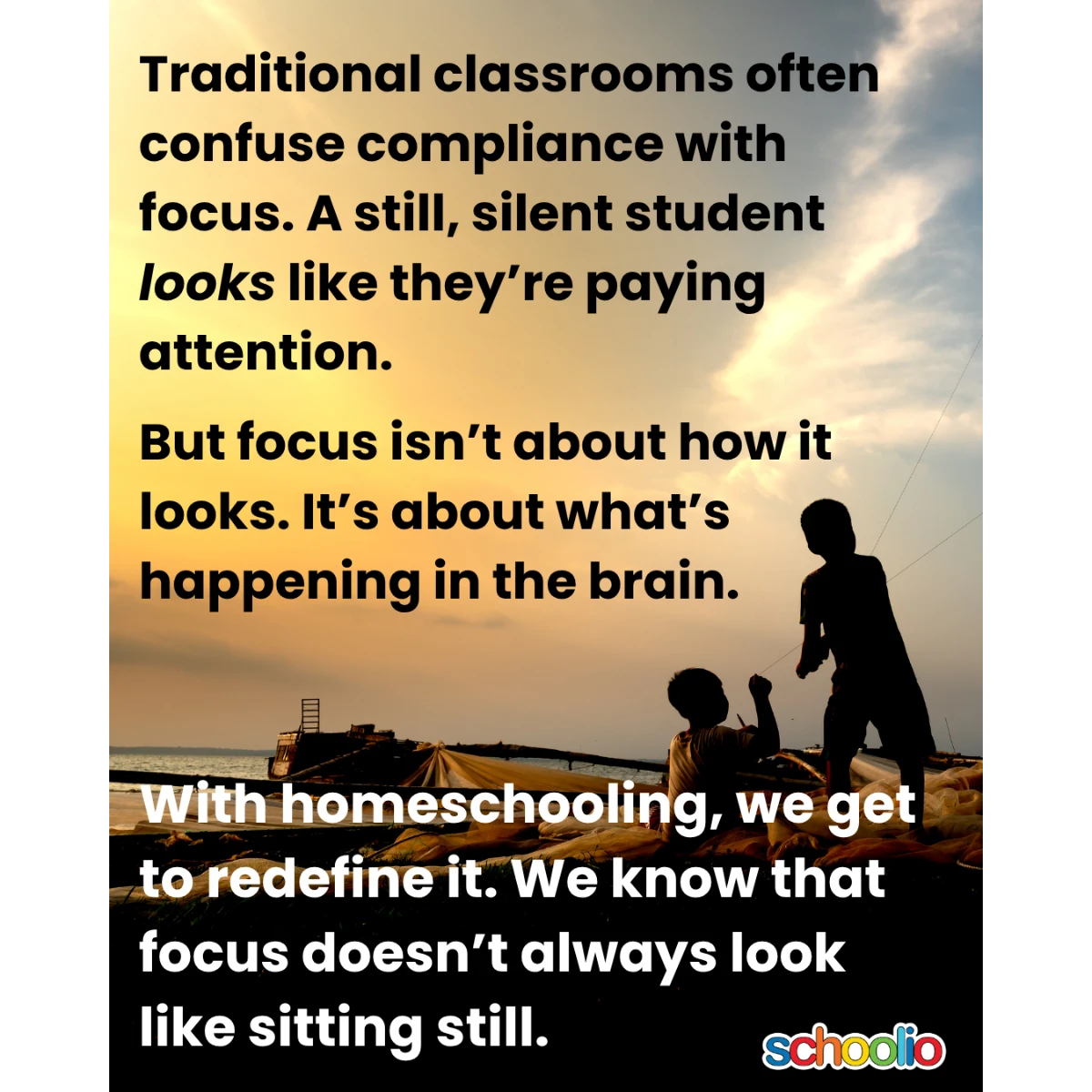
Traditional classrooms often confuse compliance with focus. A still, silent student looks like they’re paying attention. But how many times are they zoning out, daydreaming, or working hard just to appear calm?

At home, we get to redefine it.

✔ Focus can look like doodles in the margin while listening.

✔ Focus can look like bouncing on a trampoline while memorizing math facts.

✔ Focus can look like humming quietly while reading.


The truth is, focus isn’t about how it looks. It’s about what’s happening in the brain.

So if your child can’t sit still — maybe don’t fight it. Maybe lean into it. Movement can be the bridge between frustration and fun, resistance and retention.

Because focus doesn’t always look like stillness. Sometimes it looks like joy.


? Lindsey

Certified Special-Ed Educator & Co-Founder, Schoolio
My Child Is Not an Adult in Training

My Child Is Not an Adult in Training


A home educator dares to imagine an education that matters to the child as a child, not just as an adult in training.” — Julie Bogart


This has been on my mind today…

Somewhere along the way, education stopped being about childhood. It became about adulthood. Test scores. GPAs. College readiness. Career prep.

But what about being ready to be a child?

When I started homeschooling, I thought I was just taking on a different method of schooling. What I didn’t expect was how quickly my kids began to reclaim parts of themselves that had been rushed, quieted, or overlooked.

They became more playful. More curious. They asked more questions. They stopped trying to always be “on” or “perfect” or older than they were.

And I realized something. So much of traditional education is focused on preparing kids for a future life that it forgets they are living one right now.

School culture pushes kids to grow up faster than they’re ready to. To give up play for “coolness” or “serious work”.

They are not adults in training. They are kids. With real thoughts. Real emotions. Real learning rhythms that don’t always fit neat timelines.

Homeschooling gives us the chance to slow it all down.

To build a world around them that says “you matter” without needing to add “when you grow up”, let them rest when they’re tired, and let them chase the weird, wild ideas they can’t stop thinking about.

To let them enjoy learning instead of fearing it.

Let them play.

This doesn’t mean we don’t care about their futures. It means we believe that honoring their present is part of preparing them for it.

I want my kids to grow into capable, wise, thoughtful adults. But I also want them to have a childhood they can look back on with joy — not burnout.

That’s the gift homeschooling gave us. And I’ll never regret choosing it.

With love,

Lindsey

Certified Special Ed Educator & Co-Founder, Schoolio

No, I’m Not Sheltering My Kids. I’m Preparing Them Differently.

No, I’m Not Sheltering My Kids. I’m Preparing Them Differently.

This has been on my mind today…

When people hear I homeschool, the first thing they say isn’t about academics. It’s usually something like,

“But how will your kids learn to handle the real world?”

And I get it. I used to ask the same thing.

It took me a while to realize that what we call the “real world” — the world of comparison, competition, cliques, and compliance — isn’t the one I want my kids trained to survive in.

I want them prepared to thrive in the world. And there’s a difference.

I don’t want my children to practice ignoring their needs just to fit in. I don’t want them to believe that being bullied is normal or that stress is a requirement of achievement.

I want them to know how to self-regulate. To set boundaries. To ask big questions. To speak kindly. To be confident in who they are without needing a grade to prove it.

That’s what we’re building at home.

No, we don’t have the same “socialization” that school provides. But you know what we do have?

Conversations that go deep.

Friendships that aren’t based on age.

Time for rest and play.

A learning path that honors their needs, not their test scores.

I’m not sheltering my kids from the world. I’m preparing them to enter it with strength, empathy, and a sense of self that isn’t shaken the first time someone tells them they’re not good enough.

And if that looks different than what most people expect — I’m okay with that.

With love,

Lindsey

Certified Special Ed Educator & Co-Founder, Schoolio

What Chloe’s Story Reminds Us About Mental Health and the Limits of Traditional School

What Chloe’s Story Reminds Us About Mental Health and the Limits of Traditional School

by Sathish

This has been on my mind today…

I read Chloe Jones’ story in The Big Issue recently, and it brought up something I’ve seen time and time again: when school no longer feels safe, kids find another way.

Chloe was labeled lazy. But what she was really carrying was anxiety. That invisible weight kept her from fully showing up at school — and instead of support, she was met with punishment. That’s the moment that broke my heart. Because that moment isn’t rare.

We’ve spoken with so many families at Schoolio who’ve lived a version of this. Their child wasn’t thriving, their mental health was deteriorating, and the school system just wasn’t equipped to respond with what was actually needed — understanding, flexibility, emotional safety.

So Chloe did what many brave students and parents do: she left.

She taught herself. She found community through her local Youth Zone. And she went on to earn top marks and awards at college. Her story doesn’t surprise me — but it inspires me. It shows what’s possible when a learner is finally given the freedom to move at their own pace, in an environment that feels safe.

This is why Schoolio exists. Not to replicate school at home, but to give families the tools to rebuild something better.

We’ve embedded social-emotional learning into the curriculum because it’s not optional anymore — it’s essential. We’ve designed our lessons to work digitally or offline so families can find a rhythm that works for them. And we make sure parents have community, because no one should have to do this alone.

Chloe’s success didn’t happen in a vacuum. She had motivation, yes. But she also had the space and support to heal while she learned.

That’s the balance we aim to strike at Schoolio — where mental health isn’t an afterthought, but part of the design. Where kids don’t have to choose between feeling okay and getting an education.

If you’re a parent, a microschool founder, or someone building alternative models of education — Chloe’s story is your reminder that the path forward isn’t just about curriculum. It’s about care. And that’s something we can all build around.

Sathish

still learning, still unlearning


? Want to support your child’s education and their mental health?

Explore our bookstore, check out our SEL program or join our 7-day trial to see how it feels in your home. 

Here’s Why It’s so Important to Praise Your Child

Here’s why it’s so important to praise your child.

Here's why it's so important to praise your child

As parents, we all want the best for our children. We want them to grow up to be happy, confident, and successful adults. However, sometimes in our efforts to ensure that our children are disciplined and well-behaved, we forget to praise them for their achievements and contributions. Praising your child can significantly impact their self-esteem and overall well-being. So, here’s why it’s so important to praise your child.

The importance of praising your child.

When a child receives praise from their parent, it helps them feel valued and appreciated. This sense of belonging is crucial to a child’s development and can help them build confidence and self-esteem. Praise can also help to reinforce positive behaviors and encourage your child to continue to do well in the future. Additionally, receiving praise can help build a stronger bond between parent and child. When children feel loved and appreciated, they are more likely to open up and share their thoughts and feelings with their parents.

Suggestions for Parents

It’s essential to praise your child appropriately and at the right time. Here are a few suggestions for parents on how to praise their kids and when to do it:

  1. Be specific: When you praise your child, be specific about what they did well. For example, instead of saying, “Good job,” say, “Great work on finishing your homework on time.” This helps your child understand exactly what they did well and reinforces that positive behavior.
  2. Praise effort, not just results: It’s important to praise your child’s effort for something, not just the outcome. Even if your child doesn’t succeed, praise them for trying their best. This helps your child understand that effort and hard work are valued and appreciated, regardless of the outcome.
  3. Praise them in public: When your child does something noteworthy, praise them in front of others. This can be a powerful motivator for your child and help build their confidence. It also helps to reinforce positive behaviors and encourages your child to continue to do well in the future.

Praise is the most powerful parenting tool.

According to Dr. Laura Markham, a child psychologist, “Praise is one of our most powerful parenting tools. When we praise our children, we show them their efforts are valued and appreciated. This, in turn, helps them develop a positive self-image and build their self-confidence.” It’s important to remember that praise can significantly impact your child’s self-esteem and overall well-being.

Here's why it's so important to praise your child

Helping your child grow up to be happy and confident.

In conclusion, praising your child can have many positive benefits for their self-esteem and overall well-being. As parents, we can help our children build confidence and self-esteem by praising them appropriately and at the right time. Following the suggestions outlined in this blog post and the advice of child psychologists like Dr. Laura Markham, we can help our children grow up to be happy, confident, and successful adults. Remember to take the time to praise your child for their achievements and contributions, and watch them thrive.

Are you looking to teach your child more emotional skills?

We hope you enjoyed reading the blog about praising your child. But while you’re here, let’s discuss Social Emotional Learning.

Adding Social Emotional Learning to your child’s learning plan.

Here's why it's so important to praise your child

Social Emotional Learning (SEL) is essential to a child’s development. SEL teaches children to recognize and manage their emotions, build positive relationships, and make responsible decisions. Children who learn these skills are better equipped to handle stress, build healthy relationships, and succeed in school and beyond. SEL has been shown to positively impact academic achievement, mental health, and overall well-being. By incorporating SEL into their daily lives, parents can help their children develop the skills they need to thrive in all areas.

Check out Schoolio’s extensive library of Social Emotional Learning units!