Beyond Busy: Making Space for Boredom

Beyond Busy: Making Space for Boredom


This has been on my mind today…

When new homeschoolers start out, one of the first things I see them try to avoid is boredom.

They fill the schedule with academics. Add on some coding games. Sprinkle in art classes, science experiments, and extracurriculars.

All in the name of “keeping them busy.”

But here’s the thing…

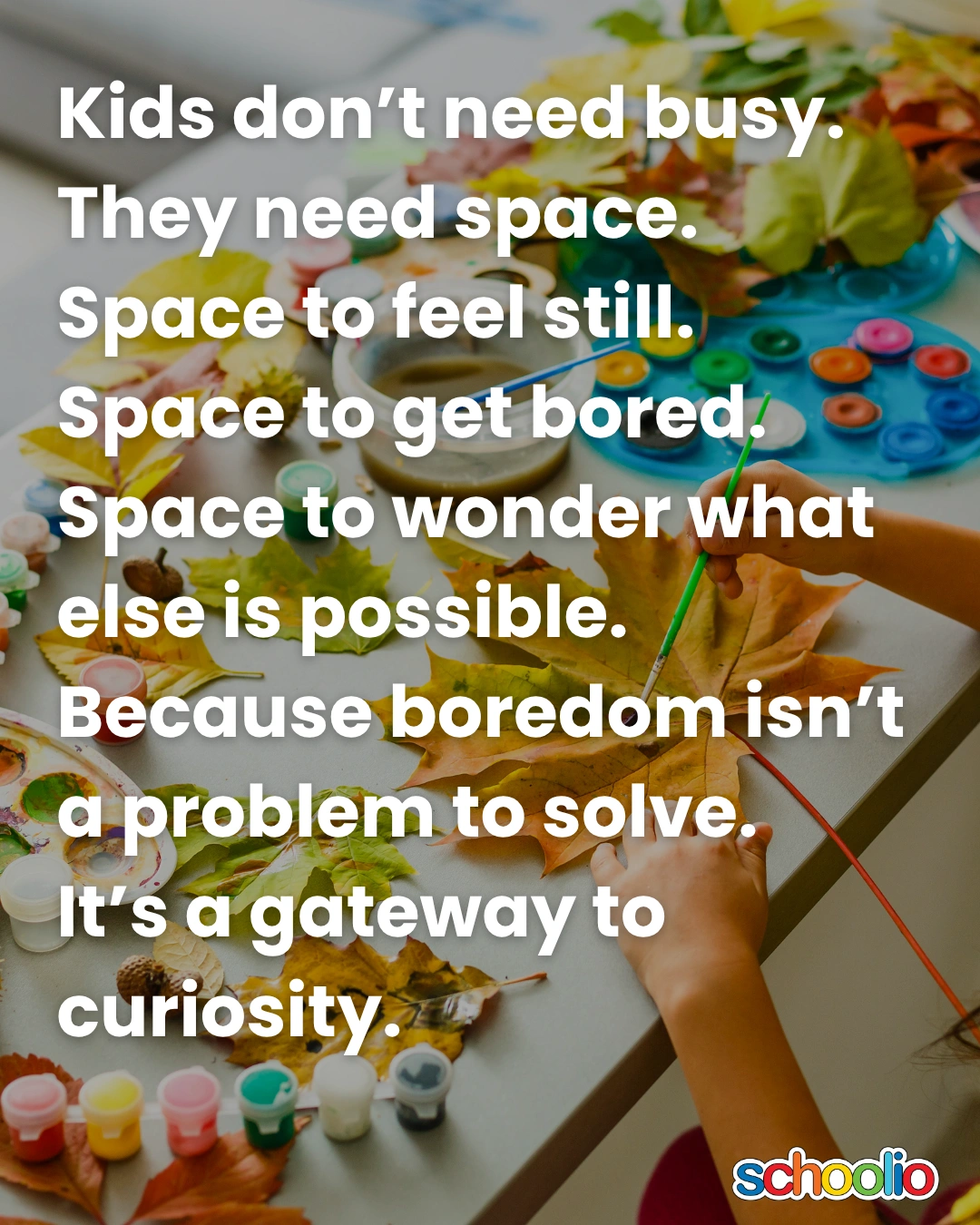
Kids don’t need busy.

They need space.

Space to feel still, to get bored and to wonder what else is possible.

Because boredom isn’t a problem to solve.

It’s a gateway to curiosity.

This weekend, I watched it play out in real life. It was around 7pm this past weekend. My kids were both on their phones, scrolling. Dinner was still an hour away, like it usually is in our house.

I looked over and thought, should I ask them to put it down?

Will it turn into a fight right before dinner? Will it be met with the usual eye rolls or sighs? Probably.

But I asked anyway.

“Take a break,” I said. “Do something else for a bit.”

They both put their phones down, reluctantly. And within a minute, I heard it. The phrase I knew was coming.

“I’m so bored.”

I said nothing. Just let it hang in the air. Ten minutes later, the three of us were at the kitchen table playing UNO. By the 45-minute mark, the game had turned competitive. We were laughing, shouting, teaming up, accusing each other of cheating. And just like that, they weren’t bored anymore.

After dinner, the phones stayed off.

My son pulled out his sketchbook and started drawing.

My daughter went to her room and practiced her DJ set.

No devices. No distractions. Just presence. All because they got bored.

I used to think boredom was something to fix.

Now I see it as a door. Because boredom is what comes before the magic.

Before the game, the drawing, the creativity, the music. And all we have to do is let it happen.

“I’m bored” is not a complaint. It’s a cue.

Let’s stop trying to fill it. Let’s let our kids feel it.

They’ll figure it out. And when they do, it’ll be better than anything on a screen.


Sathish

still learning, still unlearning

Homeschooling Parent- The Quietly Bold

Homeschooling Parent- The Quietly Bold


Fortune favors the bold.

Not the loudest.

Not the most perfect.

Not the ones with the most polished plans.

The bold.

The parent who pulls their kid out of a system everyone else still trusts.

The parent who chooses connection over conformity.

Flexibility over tradition.

Peace over pressure.

I’ve met hundreds of these parents. Quietly bold.

No parade. No validation. Just a gut feeling that this was right for their child.

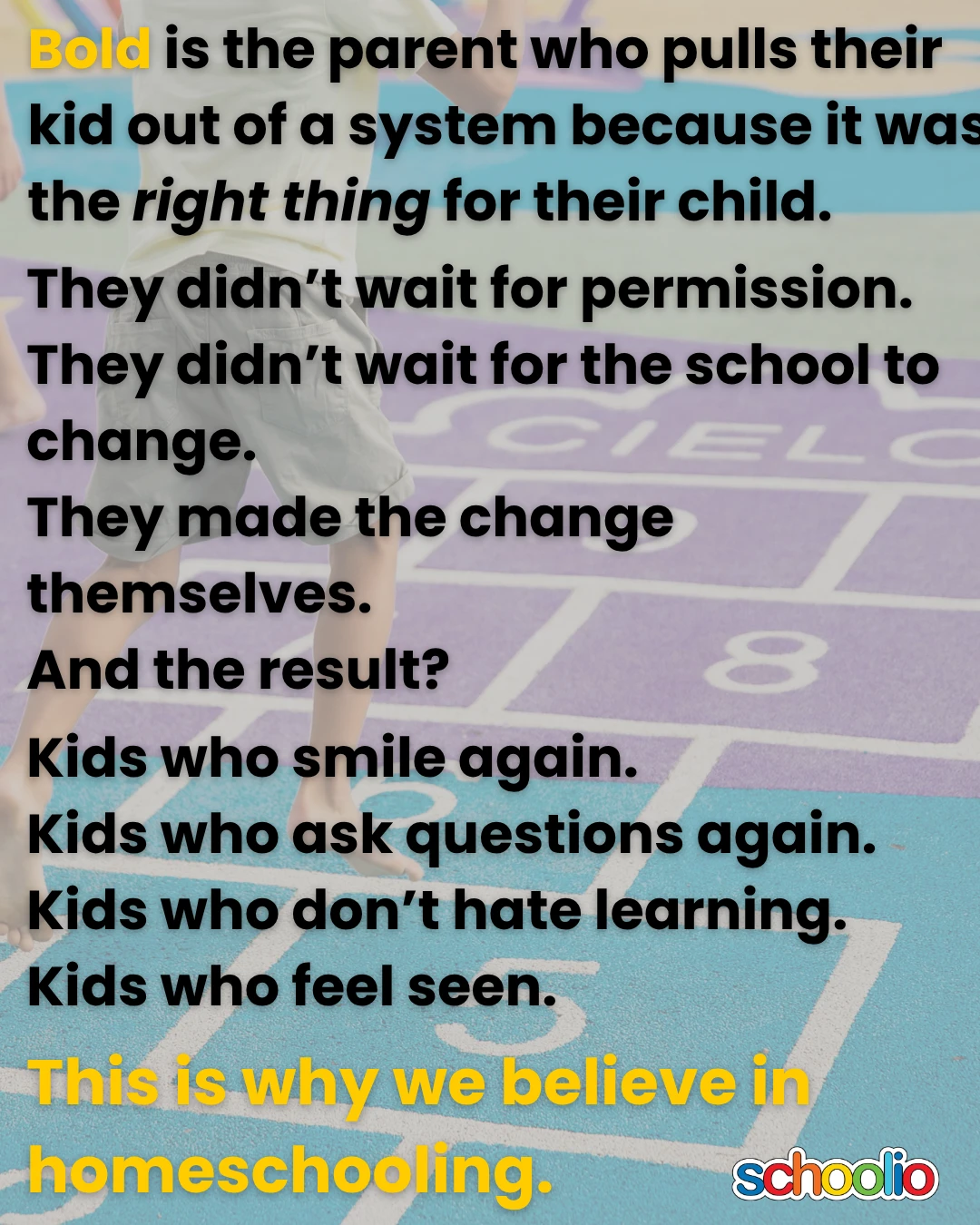
They didn’t wait for permission.

They didn’t wait for the school to change.

They made the change themselves.

And the result? That’s the “fortune” part.

Kids who smile again.

Kids who ask questions again.

Kids who don’t hate learning.

Kids who feel seen.

We get asked all the time: “Is homeschooling a risk?”

Yes. So is sending your child into a system that doesn’t fit. Both paths take boldness. One just gives you more control.

This is why I believe in homeschooling.

This is why I believe in Schoolio.

Not because it’s trendy. Not because it’s perfect. But because it puts the child back at the center — and trusts the parent to lead.

Fortune favors the bold.

If you’ve made the leap, you already know.

If you’re on the edge, maybe this is your sign.


Sathish

still learning, still unlearning

One of Homeschooling Quietest Strengths

One of Homeschooling Quietest Strengths


By Lindsey Casselman, special-ed teacher & homeschooling mom


When I first started homeschooling, I thought a “good homeschooler” had a tidy schedule. Wake up at 8, lessons by 9, neat little blocks of math, reading, and science lined up like ducks in a row.

But then reality stepped in: my kids aren’t ducks, and neither am I.

What I learned over time — and what research keeps confirming — is that one of the most powerful tools we have in homeschooling is also the simplest: sleep.

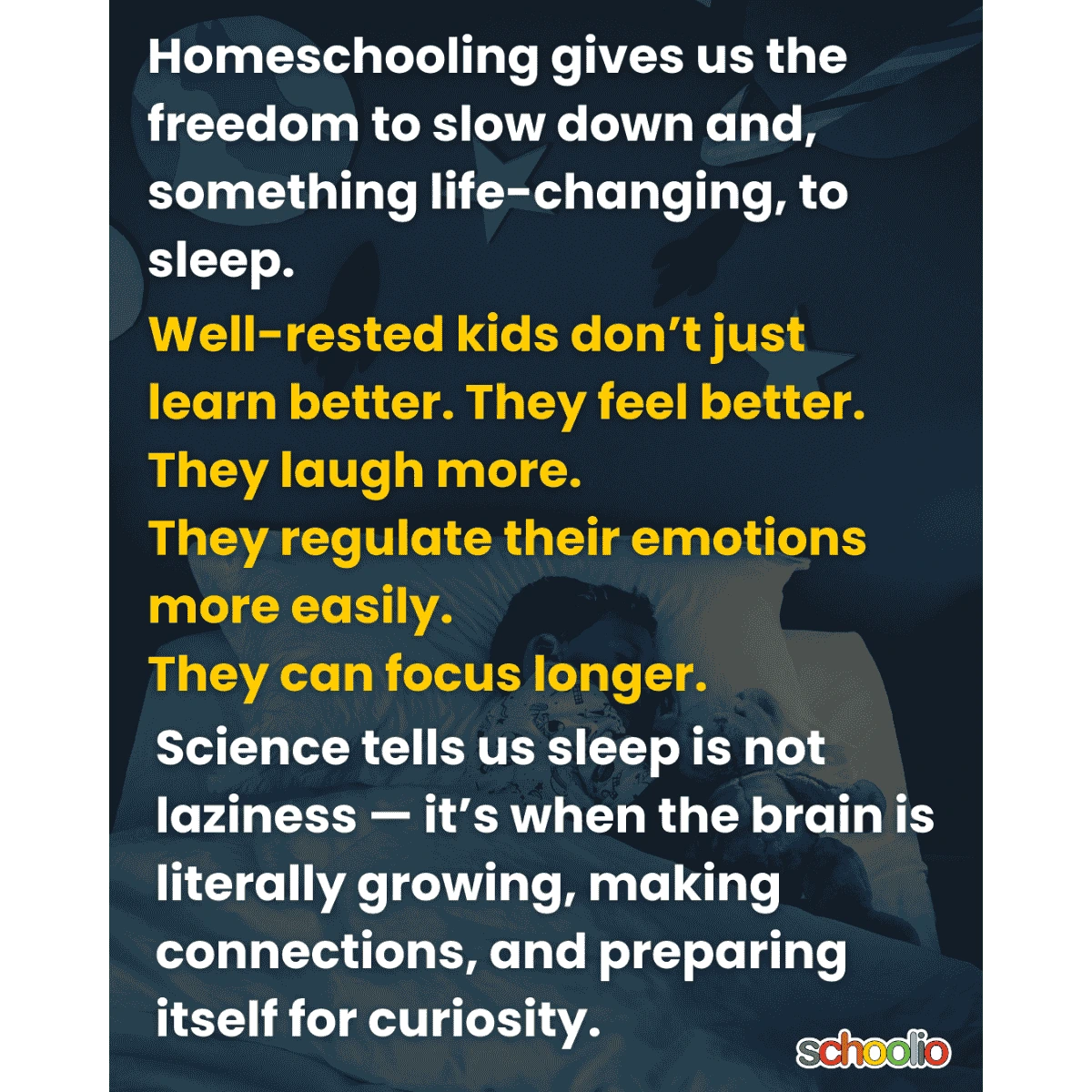
In traditional school, kids are often shaken awake by alarms, rushed through breakfast, dressed half-asleep, and hustled out the door before their brains have even had a chance to fully wake up. I remember my own school mornings feeling like chaos in fast-forward. But homeschooling gave us the freedom to slow down, and that’s when I noticed something life-changing.

Well-rested kids don’t just learn better. They feel better. They laugh more. They regulate their emotions more easily. They can focus longer, without the constant battle against exhaustion. Science tells us sleep is not laziness — it’s learning in disguise. It’s when the brain is literally growing, making connections, and preparing itself for curiosity.


Here’s what that looked like in our homeschool:

  • Starting the day when my kids naturally woke up, not when a bus schedule dictated.
  • Protecting rest days after big field trips, instead of pushing through.
  • Building gentle morning and bedtime rhythms so transitions felt calming, not chaotic.
  • Letting rest be part of the curriculum, because restoration fuels curiosity.

And here’s the best part: this isn’t “falling behind.” It’s moving forward in a way that honors kids as whole humans — body, mind, and spirit.

So maybe the question isn’t, “Am I doing enough school hours?”

Maybe it’s, “Am I giving my child enough rest to flourish?”

Because the truth is, flexible sleep schedules aren’t a weakness of homeschooling. They’re one of its greatest strengths.


? Lindsey

Certified Special-Ed Educator & Co-Founder, Schoolio

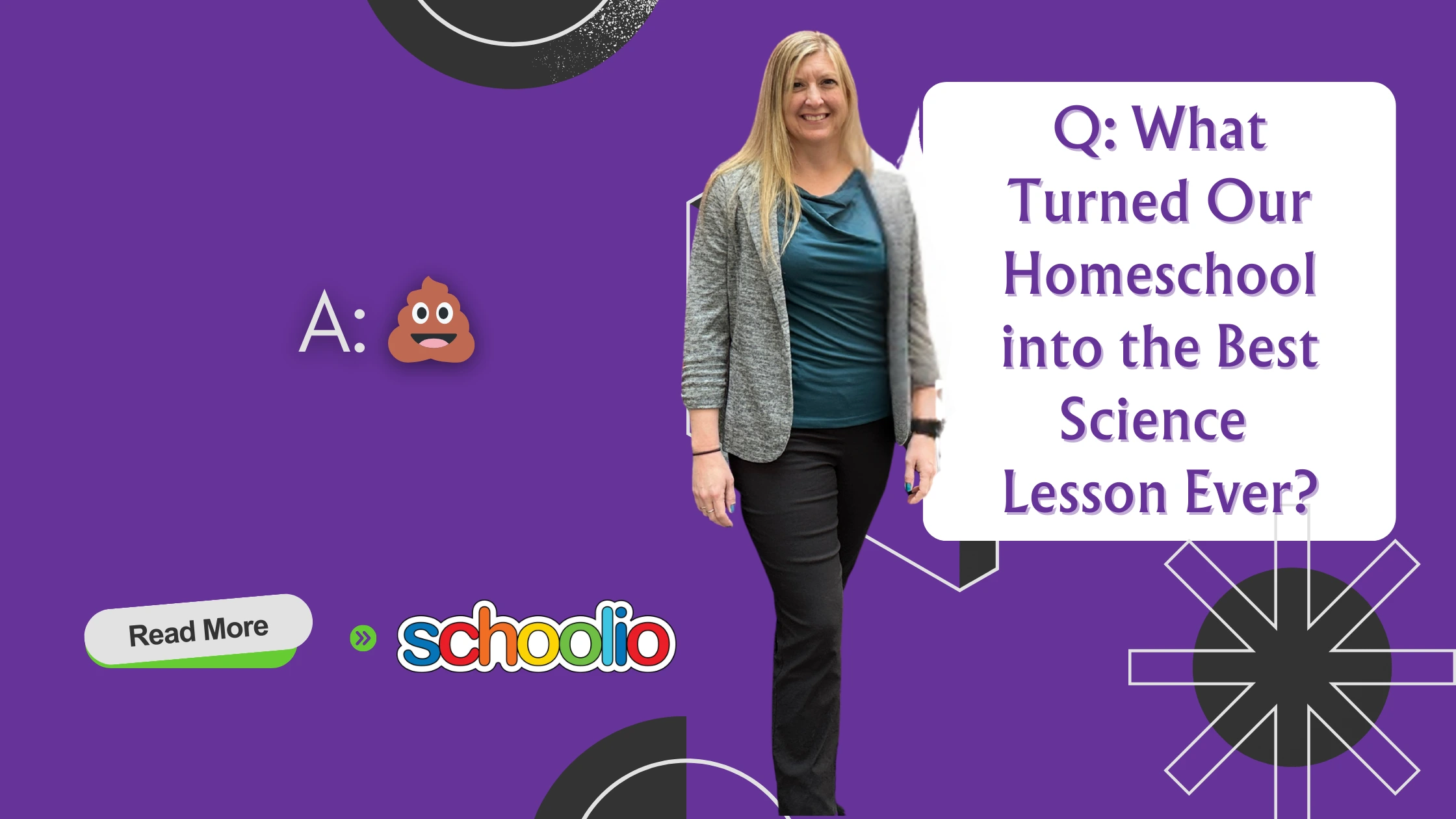
When Our Homeschool Turned to S**t

When Our Homeschool Turned to S**t


This has been on my mind today…

One winter morning, we set out on a nature walk. Nothing fancy, just some fresh air and a chance to stretch our legs. That’s when it happened. The kids stopped, pointed, and announced with total fascination:

“POOP!”

There it was on the path. Just sitting there, waiting to be discovered. And instead of me steering them back to the “lesson plan,” they had one question that became our curriculum for the whole week:

“What animal did this come from?”

We started guessing. Deer? Rabbit? Maybe raccoon? The curiosity snowballed. Back at home, we started researching. We found pictures of animal scat (yes, that’s the proper word) and compared them. We talked about the diets of different animals and how that shows up in their droppings. The kids wanted to make their own scavenger hunt checklist of “poops to find,” so we did. Suddenly every walk was a full-on investigation, magnifying glasses in hand, kids crouched down like little detectives.

And then nature gave us another gift — snow. Once they had learned about scat, the curiosity expanded:

“If we can tell an animal by its poop, can we tell it by its footprints too?”

That week turned into tracking lessons. We studied paw shapes, stride lengths, and patterns. We matched tracks to the animals in our region. Every walk became a treasure hunt. They weren’t just “getting exercise.” They were observing, comparing, classifying, and recording. In other words, science.

And here’s the thing: none of it was on my lesson plan. There was no worksheet waiting on the table that morning titled “Animal Scat and Tracks.” But it was real learning. Engaged, memorable, full of wonder.

The kids didn’t just learn about animals. They learned how to follow a question, how to investigate, how to let curiosity guide them. That’s the kind of learning you don’t forget — even if it started with poop.

So yes, sometimes school looks like math books at the table. Other times, it looks like poop on a trail. Both count. Both matter. And both are homeschooling.

? Lindsey

certified special-ed educator & co-founder, Schoolio

Why Our “First Day of School” Looks Nothing Like Theirs — and Why I Wouldn’t Trade It

Why Our “First Day of School” Looks Nothing Like Theirs — and Why I Wouldn’t Trade It


This has been on my mind today…

The hardest part of the homeschool year for me wasn’t math lessons, or planning, or juggling the day-to-day chaos. It was the first day of public school.

Every September, my social media feeds would flood with photos of smiling kids at the end of the driveway — shiny shoes, new backpacks, parents buzzing with excitement. I would feel it in my chest, that little ache of missing out. Was I depriving my kids of this milestone? Was our homeschool missing something?

But then, something shifted. I realized those photos were it. The moment. The kids posed for a quick picture, then disappeared into a classroom to sit under fluorescent lights, being taught by a stranger for the rest of the day.

So one year, I decided to do something different. I started our own tradition.

That morning, I snapped a “first day of school” photo of my kids… still asleep. Because that’s the beauty of homeschooling: they wake when their bodies are rested, not when a bus pulls up.


Then, just for myself, I kept taking pictures throughout the day. Hour by hour.

? Pancakes in pajamas.

? Jumping on the trampoline after math.

? Reading aloud together on the couch.

? Baking cookies in the kitchen.

? Building sandcastles at a beach we had all to ourselves.

? A social studies lesson with a cat curled up in their lap.

? Walking the dog in the late summer sun.


And when I scrolled through those photos at the end of the day, I finally saw it: this was more.

It wasn’t just about lessons and curriculum (though those happened too). It was about time. About laughter. About siblings who actually enjoy each other. About kids who get to learn at their own pace and still have energy left to play, imagine, and connect. About a childhood that isn’t rushed out the door.

That was the day I stopped feeling wistful about the back-to-school buzz on my feed. Because the truth is, I wasn’t depriving my kids of anything. I was giving them something different. Something richer.

So now, every September, we take our first-day photos too. They just don’t look like everyone else’s. And I’m okay with that.

With love,

? Lindsey

Certified Special Ed Educator & Co-Founder, Schoolio

Why Public School Pressures Kids to Grow Up Too Fast—and Why I’m Grateful My Homeschooler Still Plays

Why Public School Pressures Kids to Grow Up Too Fast—and Why I’m Grateful My Homeschooler Still Plays

This has been on my mind today…

My daughter’s friend, who has always been in public school, told her recently that she wished she could still play with toys. My daughter, without hesitation, said, “So play with toys then! Who cares? Do what you want!” But her friend shook her head. She said no—she was too old for toys, and if other kids found out, they’d make fun of her.

They’re 13 years old. And here’s the thing: 13 is still a child. If a child that age still wants to play, that isn’t immaturity—it’s development happening at the pace it’s meant to. Play and imagination are not only normal, they’re scientifically proven to be deeply beneficial for kids’ brains. Yet her friend felt she couldn’t do it, because the social culture around her said she was “too old.”

And it wasn’t just about toys. She also shared that at her school, there’s pressure to start thinking about crushes, even dating. Imagine that—kids who still long to play with toys being told that what’s “normal” is pairing off romantically. That’s not freedom. That’s conformity.

People often ask homeschool families about socialization. “Aren’t you worried your kids won’t know how to socialize?” But what’s rarely asked is the harder question: what exactly are kids being socialized into at school? Too often, it’s a kind of toxic conformity that shames kids for being developmentally right where they are.

Our homeschoolers aren’t “immature.” They’re maturing at their natural pace. They’re free to linger in play, imagination, and curiosity without shame. And when the time comes, they’ll step naturally into new stages of life—without being rushed there before they’re ready.

One of the greatest gifts of homeschooling is that we get to protect childhood. We get to give our kids the time and space to grow up without unnecessary pressure. And sometimes, that looks like a 13-year-old proudly playing with toys, because she’s still a kid—and that’s exactly what she should be.

Want to give your child the freedom to grow at their own pace? Explore Schoolio’s homeschooling curriculum and see how it can support your family’s journey.

Lindsey
Certified Special Ed Educator & Co-Founder, Schoolio

How to Homeschool Multiple Kids Without Losing Your Mind

How to Homeschool Multiple Kids Without Losing Your Mind

by Lindsey, Head of Curriculum at Schoolio

This has been on my mind today…

Homeschooling even one child is a full-time emotional and mental job. Homeschooling two or three? That’s a whole circus. And if they’re at different grade levels? Let’s just say it took me a while to stop waking up already overwhelmed.

I remember those early years when I felt like I had to mimic a real school day. Everyone had to be at the table at the same time, working on math at 9, reading at 10, science after lunch. It was rigid, exhausting, and full of frustration. Someone always needed help, someone else was bored or acting out. There were tantrums. Sometimes theirs. Sometimes mine.

What saved us was realizing that homeschooling doesn’t have to look anything like public school. And honestly, it probably shouldn’t.

One of the biggest mindset shifts we had was dropping the idea that everyone had to do the same subject at the same time. That’s not how real life works, and it’s not how learning naturally happens. So I started calling the kids to me one at a time. When one was off playing, I could work through a new math concept with the other. Once they had the hang of it, I’d set them up with independent work and call the next one in for reading time. It wasn’t about multitasking anymore. It was about focused, calm, short bursts of one-on-one time.

The second big shift came when I stopped letting grade levels rule our world. At first I was clinging to the public school timeline — this topic in science at this age, this history chapter in third grade, and so on. But it didn’t make sense anymore. Why teach something just because the curriculum says it’s “time,” if they’re not curious or ready? So we started learning science and social studies as a team — everyone at the same time, just at different depths. We’d dive into volcanoes or ancient Egypt or the weather together, and I’d tweak the activities up or down depending on the child. They started helping each other, sharing facts, building projects side by side. The learning stuck. And I wasn’t exhausted.

I used to feel guilty every day. Guilty that one child got more of my attention. Guilty we didn’t finish the lesson plan. Guilty I wasn’t following the school’s rhythm. But I’ve learned that flexibility is not a failure. In homeschooling, it’s a strength.

We use our homeschool planner loosely now — more like a compass than a stopwatch. And the beauty of online homeschool programs is that they let you set your own pace. With Schoolio, I can see where each kid is, pick the lessons that matter most for them right now, and let go of the rest.

So if you’re in the thick of trying to homeschool multiple kids and feeling like you’re falling apart, I promise you’re not alone. The magic isn’t in doing it all at once. The magic is in tuning into your children, one by one, moment by moment — and building a life that works for your family.

And guess what? That’s more than enough.

Lindsey

certified special-ed educator & co-founder, Schoolio


Curious how Schoolio helps families balance learning for multiple kids? Start a 7-day free trial or explore our all-in-one planner built for real homeschool life.

Start your FREE TRIAL.

If It Doesn’t Look Like School… Good.

If It Doesn’t Look Like School… Good.

“Homeschooling doesn’t look like public school. That’s the point.”

This has been on my mind today…

When I first started homeschooling, I tried to make our home look like a classroom. Desks lined up, a daily schedule on the wall, a bell for transitions — I even printed out attendance sheets.

It lasted about three days.

What followed was frustration, tears, and a lot of self-doubt. I thought something was wrong with me. I couldn’t keep up the structure. My kids weren’t responding the way I expected. I wondered if I had made a huge mistake.

But the truth was simpler: I was trying to replicate a system that didn’t actually work for us.

Homeschooling doesn’t look like school. That’s the point.

School is designed for groups. For efficiency. For managing dozens of kids with one adult. It’s built on uniformity and compliancy. But I don’t want my kids to be uniform or compliant.

Homeschooling is built on flexibility. On freedom. On honoring your child’s pace, your family’s values, and your real life.

Some days, math happens at 8am. Other days, it doesn’t happen at all.

Some weeks, we read and entire novel. Other weeks, we’re outside chasing butterflies and calling it science.

Some subjects take root quickly. Others simmer quietly until the spark hits.

And through it all, learning is happening.

It just doesn’t look like it used to. And that’s okay. Actually, it’s better than okay.

It means your homeschool is becoming yours.

There’s no attendance sheet for curiosity. No standardized test for joy. No report card that measures the deep, steady growth happening when a child feels safe, loved, and free to learn in their own way.

So if your homeschool doesn’t look like school — good. That’s the point.

With love,

Lindsey

Certified Special Ed Educator & Co-Founder, Schoolio
How to Start Homeschooling in Texas (2025 Guide)

How to Start Homeschooling in Texas (2025 Guide)

by Sathish

This has been on my mind today…

I’ve spoken with so many families lately who are thinking about making the jump to homeschooling—especially as we launched in Texas and met many of the local families who were ready to start but had never heard of Schoolio before. And while every story is different, the emotions are often the same. One parent told me, “I want to homeschool, but I’m scared I’ll mess it up.” Another said, “We feel like school isn’t working, but what if I can’t give them what they need at home?”

These aren’t small fears. They’re real. And deeply rooted in the way many of us were raised to believe that learning only happens inside a classroom, led by certified professionals with years of training. So to say, “I’m going to homeschool my child,” feels like breaking a rule we didn’t know we were allowed to question.

But here’s what’s been powerful to watch. I’ve seen those same parents a few months later—different posture, different voice, different mindset. One tells me her son is finally reading because he wasn’t forced into a pace that didn’t work for him. Another shares how her daughter stopped having stomachaches every morning now that learning happens at home. They’re not perfect. They’re not experts. But they’re doing it.

That’s the magic. Homeschooling isn’t about doing school at home. It’s about doing what works—for your child, your values, your rhythm as a family. And in Texas, the path to begin is surprisingly simple. The biggest step isn’t paperwork. It’s choosing to believe that you can guide your child’s education in a way that works for both of you.

So here’s what you need to know.

Texas is one of the most homeschool-friendly states in the country. There’s no registration process. No district approval. No testing requirements. You don’t need to submit plans or portfolios. You simply need to teach a few required subjects using a written curriculum. That’s it.

Here are the basics:

  • Homeschooling in Texas is legally recognized as “private education.”
  • You’re required to teach reading, spelling, grammar, math, and good citizenship.
  • There’s no formal notice of intent needed, unless your child is already enrolled in public school. In that case, you’ll just need to withdraw them by notifying the school.

That’s all.

Of course, just because it’s simple on paper doesn’t mean it feels simple emotionally. Starting is the hardest part—not because the laws are complicated, but because the fear is real. What curriculum do I choose? How do I make a schedule? What if I don’t cover everything?

That’s why we built Schoolio—to make it easier for families to get started and stay supported. Whether you want a complete curriculum bundle, an online homeschool program, or just a flexible homeschool planner to design your own flow, you’ll find tools that don’t add pressure, but help you feel capable.

Because that’s the real shift. Homeschooling works best not when you try to recreate the system at home, but when you create something new—something human, flexible, and designed around how your child learns best.

So if you’re in Texas and wondering how to start homeschooling, here’s the truth: you already have. That moment you paused and asked, “What’s best for my child?”—that’s where it begins.

Sathish

still learning, still unlearning

How I Built a Homeschool Schedule That Didn’t Burn Us Out

How I Built a Homeschool Schedule That Didn’t Burn Us Out

by Lindsey

When I think back on our homeschool journey, I remember the spiral-bound planner I bought during that first summer. I had every hour penciled in. Math at 9. Language at 10. Science after lunch. I thought if I could just replicate the structure of a school day at home, we’d be successful. I was trying so hard to “do it right.” But right for who?

What followed were weeks of power struggles. One of my kids melted down every time we had to switch subjects. The other would hyperfocus on one thing and resist everything else. I found myself repeating the same sentence over and over: “We’re behind.” I felt behind. All the time. And so did they.

One day, I remember snapping at my youngest over handwriting. She was crying. I was too. We closed the books and walked away. I sat on the couch, defeated. And that night, after they’d gone to bed, I looked at the planner and realized it wasn’t designed for us. It was built on someone else’s idea of learning. Not mine. Not my kids’.

That’s when I started paying attention to something else—not the clock, but their energy. Their moods. When they were curious. When they were tired. When they needed to move. I swapped strict scheduling for rhythms. Short lessons. Wiggle breaks. Slow mornings. Outside time. And something amazing happened—we all calmed down.

They started learning more. Not because I was teaching harder, but because they were finally able to receive it. And I started feeling more like their guide and less like their warden.

That’s when we started using a flexible homeschool planner. One that gave us space to adjust. One that didn’t guilt-trip us with empty checkboxes, but reminded us to focus on the whole child. I used to think we had to cover every subject, every day, in order to be doing homeschooling the “right” way. Now, I know better.

There are still days where we only get through half a lesson, or days when everyone’s too grumpy to do anything academic. But that’s okay. Because I’ve learned that building a homeschool schedule is less about fitting everything in and more about building a life where learning fits.

And that’s what makes it sustainable. That’s what makes it stick.

certified special-ed educator & co-founder, Schoolio

Homeschooling and the Future of Education: A Shift Toward Individuality

Homeschooling and the Future of Education: A Shift Toward Individuality

Excerpt

Education is meant to inspire creativity and nurture individuality, but traditional schools often fall short. As homeschooling grows worldwide, families are reclaiming the joy of learning. At Schoolio, we’re empowering parents with tools and resources to create personalized, meaningful education journeys. Let’s reimagine education together.

This blog aligns Sir Ken Robinson’s philosophy with the homeschooling movement while positioning Schoolio as a key resource for families seeking educational transformation. Let me know if you’d like further refinements!

Source: https://www.msn.com/en-us/news/world/rise-in-number-of-home-schooled-children-council/ar-AA1vgVAW?apiversion=v2&noservercache=1&domshim=1&renderwebcomponents=1&wcseo=1&batchservertelemetry=1&noservertelemetry=1


The Rise of Homeschooling: Rediscovering the Art of Learning

Education is not just about filling minds with facts; it’s about nurturing creativity, curiosity, and individuality. As Sir Ken Robinson often emphasized, a truly effective education system recognizes and respects the unique talents of every learner. Yet, for many families, the rigidity of traditional schools stifles the very creativity and self-expression that education should ignite.

The recent rise in homeschooling, as highlighted in reports like the MSN article, reflects a deep desire among parents to reclaim the joy of learning for their children. At Schoolio, we see this shift as an opportunity to empower families with the tools to rediscover education as a deeply personal, transformative experience.


Why Families Are Choosing to Homeschool

Across the globe, parents are increasingly dissatisfied with traditional schooling’s one-size-fits-all approach. Mental health challenges, exam pressures, and disengagement are driving families to seek alternatives. In Rotherham, for example, homeschooling has grown over 300% since 2015, a trend mirrored in many other regions.

But this is more than a reaction to systemic failures—it’s a reawakening. Families are embracing homeschooling as a way to:

  • Foster Creativity: Moving beyond rote memorization to encourage imagination and critical thinking.
  • Personalize Education: Tailoring lessons to a child’s unique strengths, interests, and pace.
  • Prioritize Well-Being: Creating environments where children feel safe, supported, and inspired.

As Sir Ken Robinson argued, education must adapt to the individual, not the other way around. Homeschooling allows families to do just that, and Schoolio is here to guide them on this journey.


Reimagining Education with Schoolio

At Schoolio, we believe in education that celebrates individuality and unleashes potential. Our comprehensive K-8 digital curriculum is designed to help families move beyond the constraints of conventional schooling and into a world of personalized, meaningful learning.

Here’s how we’re helping families reimagine education:

  1. Flexible Resources: Our curriculum adapts to each child’s pace and interests, ensuring every learner feels engaged and valued.
  2. Creative Exploration: From electives to life skills programs, we encourage students to think critically and solve problems creatively.
  3. Support for Neurodivergence: Recognizing that every mind learns differently, we offer tools tailored to diverse needs.

Homeschooling is not about isolation—it’s about empowerment. It’s about giving parents and children the freedom to explore education in ways that resonate with their passions and goals.


The Challenges of Traditional Schooling

Traditional education systems were designed for an industrial age, not the dynamic, interconnected world we live in today. Many families are finding that:

  • The emphasis on standardized testing stifles creativity.
  • Rigid schedules and curricula fail to accommodate diverse learning styles.
  • Emotional and social challenges, such as bullying or anxiety, create barriers to learning.

Homeschooling offers a pathway to break free from these constraints. It provides the opportunity to rekindle the natural curiosity and enthusiasm for learning that every child possesses.


A Movement Toward Decentralized Education

The rise of homeschooling is more than a trend—it’s a movement toward decentralizing education. By stepping outside the conventional system, families are reclaiming their role as active participants in their children’s education.

At Schoolio, we support this movement with resources that make homeschooling accessible, inclusive, and effective. Whether you’re new to homeschooling or looking to enhance your current approach, we’re here to help you create an education that works for your family.


The Future of Education: Inspired by Creativity and Individuality

As Sir Ken Robinson eloquently stated, “The key to success is to recognize that we all have talents, and education should help us discover them.” The rise of homeschooling signals a shift toward education systems that prioritize individuality, creativity, and well-being.

At Schoolio, we’re proud to be part of this transformation. We believe that every child deserves an education that honors their uniqueness and prepares them to thrive in a world that values innovation and adaptability.


If you’re ready to rediscover the joy of learning, join the homeschooling movement with Schoolio. Together, we can create an education system that celebrates what makes every child special.

Author: Sathish Bala

OP-ED: Why Parents in Every Province Deserve More School Choices

OP-ED: Parents in Every Province Deserve as Many School Choices as Possible

Source Article,

https://tnc.news/2024/12/04/zwaagstra-parents-in-every-province-deserve-as-many-school-choices-as-possible/


Empowering Homeschoolers: Why Educational Choice is Essential for Families

In an era where education is rapidly evolving, the call for more school choices is louder than ever. A recent piece by Michael Zwaagstra emphasizes the need for parents across every province to have access to diverse educational options, including public, private, charter, and homeschooling. As a cornerstone of educational choice, homeschooling empowers families to take control of their children’s learning journey, tailoring it to their unique needs, values, and aspirations.

At Schoolio, we are deeply aligned with this vision. Our mission is to support homeschoolers by providing flexible, accessible, and comprehensive K-8 education solutions that make personalized learning achievable for every family. We believe that by decentralizing education and offering meaningful choices, we can create a system that works for every child—not just a select few.

Why Educational Choice Matters

Educational choice isn’t just about having options—it’s about ensuring families can choose what’s best for their children. Zwaagstra highlights the growing demand for alternatives to traditional schooling, particularly as more parents seek out environments that prioritize personalized education, flexibility, and alignment with their family values.

For many families, homeschooling has become the ultimate expression of educational freedom. It allows parents to design a curriculum that fits their child’s learning style, pace, and interests—free from the constraints of standardized systems. This aligns perfectly with Schoolio’s philosophy: education should be tailored to the learner, not the other way around.

By offering homeschoolers resources that are flexible, engaging, and future-focused, Schoolio helps families embrace this freedom without compromising on quality. Whether it’s core subjects, electives, or life skills, we provide the tools parents need to build a robust, personalized education plan for their children.

The Growth of Homeschooling in Canada

Across Canada, homeschooling is on the rise as families seek alternatives to conventional schooling. From British Columbia to Nova Scotia, parents are taking charge of their children’s education, driven by factors such as dissatisfaction with traditional schools, a desire for individualized learning, and the need for greater flexibility.

This movement isn’t limited to a specific demographic—it reflects a universal desire for autonomy and choice in education. Families want the ability to prioritize what matters most to them, whether it’s academic rigor, creative exploration, or alignment with their cultural and personal values.

Schoolio is proud to be part of this growing movement. Our curriculum is designed to meet the needs of today’s homeschoolers, offering comprehensive coverage of K-8 core academics while also encouraging creativity and critical thinking. By empowering families with high-quality resources, we’re helping to ensure that homeschooling remains a viable and rewarding option for parents across Canada and beyond.

Supporting Homeschoolers: The Schoolio Mission

At Schoolio, we understand that homeschooling is both an opportunity and a responsibility. Parents who choose this path take on the dual role of educator and caregiver, often juggling multiple responsibilities to ensure their children receive a quality education. That’s why our mission is to make homeschooling as accessible and stress-free as possible.

Our platform offers:

  • Comprehensive Curriculum: From math and science to language arts and social studies, we provide everything families need for a well-rounded K-8 education.
  • Engaging Electives: Our electives spark curiosity and creativity, allowing children to explore new interests and develop essential skills.
  • Future-Readiness Programs: We prepare students for the challenges of tomorrow with a focus on critical thinking, problem-solving, and adaptability.

By centralizing these resources in one user-friendly platform, we eliminate much of the guesswork and planning that can overwhelm new homeschoolers. Instead, parents can focus on what truly matters—supporting their children’s growth and success.

The Role of Policy in Educational Freedom

Zwaagstra’s article also underscores the importance of policy in enabling educational choice. While homeschooling is growing in popularity, it’s still subject to varying regulations and support across provinces. In some areas, parents face significant barriers to accessing resources, funding, or recognition for their choice to homeschool.

This is why advocacy is critical. At Schoolio, we’re not just focused on providing curriculum—we’re also committed to championing the rights of homeschoolers. We believe that every family should have the freedom to choose home education without facing unnecessary obstacles. By working with families, educators, and policymakers, we aim to create a more inclusive system that values diversity in educational approaches.

Homeschooling: A Path to Empowerment

One of the most compelling aspects of homeschooling is its ability to empower both parents and students. For parents, it’s an opportunity to take an active role in their child’s education, tailoring lessons to their unique strengths, challenges, and interests. For students, it’s a chance to learn in an environment that prioritizes their individuality, fostering confidence, curiosity, and a lifelong love of learning.

At Schoolio, we see this empowerment in action every day. Families using our platform share stories of children who thrive in homeschooling after struggling in traditional settings. They talk about the joy of watching their children discover new passions, master challenging concepts, and develop skills that will serve them well into adulthood.

This is the heart of what we do—helping families create personalized learning experiences that inspire and uplift. By providing the tools and support homeschoolers need, we’re ensuring that more children have access to the kind of education that truly meets their potential.

The Future of Educational Choice

As the demand for educational choice continues to grow, the homeschooling movement is poised to play a key role in shaping the future of education. Platforms like Schoolio are at the forefront of this transformation, making it easier than ever for families to embrace home education without sacrificing quality or accessibility.

But the work doesn’t stop here. To ensure that homeschooling remains a viable option for all families, we must continue to advocate for policies that support educational freedom. This includes funding programs that make resources accessible, recognizing the value of alternative education paths, and fostering a culture that celebrates choice and innovation.

By working together—parents, educators, and advocates—we can create a system where every family has the freedom to choose the educational path that’s right for them. Whether it’s homeschooling, private school, or another alternative, the goal is the same: to empower families and ensure that every child has the opportunity to thrive.

Join the Schoolio Movement

If you’re considering homeschooling or looking for ways to enhance your current approach, Schoolio is here to help. Our platform offers a comprehensive suite of resources designed to make home education simple, effective, and inspiring.

As Zwaagstra highlights, education is not a one-size-fits-all solution. It’s a journey that should reflect the unique needs and values of each family. At Schoolio, we’re proud to support homeschoolers across Canada and beyond in creating educational experiences that are as unique as the children they serve.

Let’s work together to build a future where educational choice isn’t just an option—it’s a right for every family. Join the Schoolio movement today and discover how personalized learning can transform your child’s education.

Author: Sathish Bala