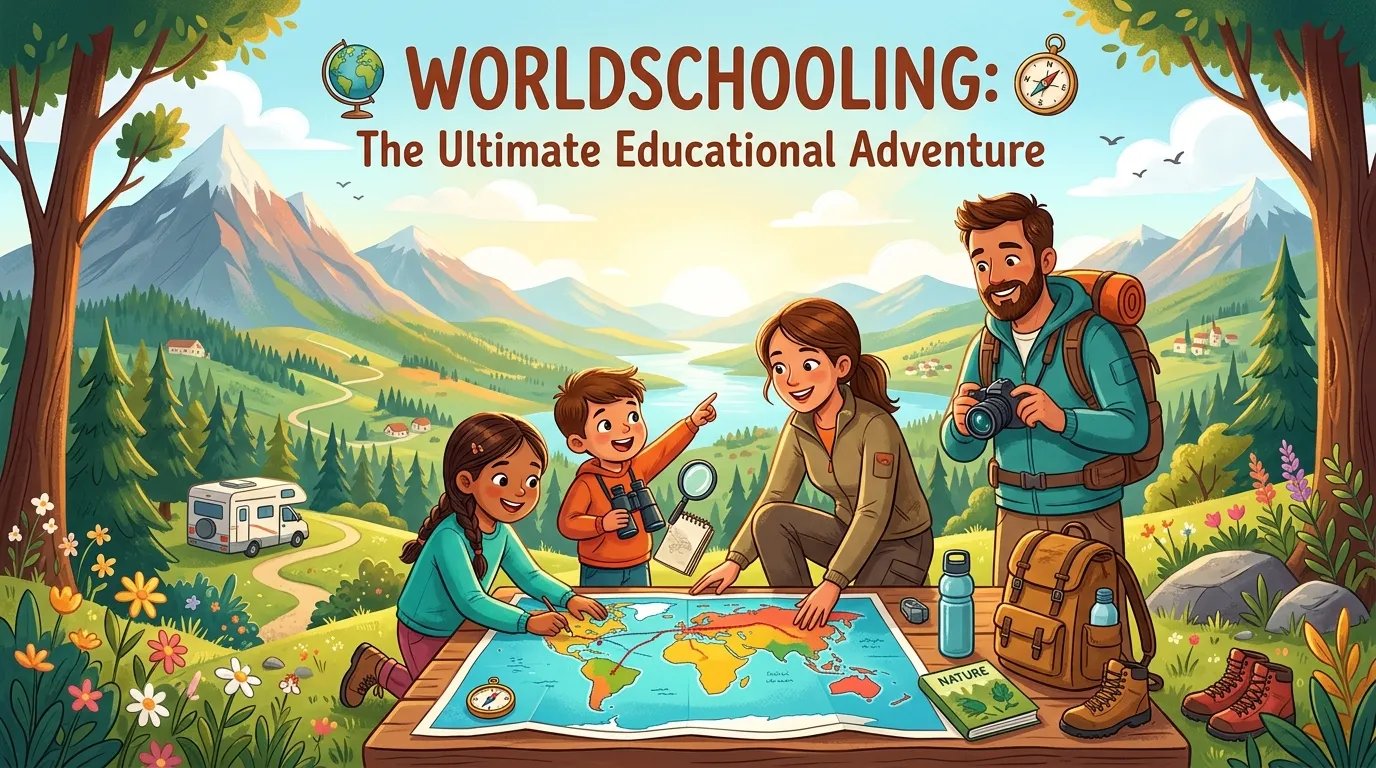
Why confine learning to a desk when the world can be your curriculum? Worldschooling is a rapidly growing movement of families who travel and learn simultaneously, breaking free from the rigid 7-hour public school workday. Whether you are living in an RV traversing national parks, operating as digital nomads across Europe, or simply taking extended family trips during the traditional academic year, learning doesn’t have to stop when you leave your house. In fact, that’s precisely when the most impactful learning begins.
The concept of worldschooling is beautifully simple but profoundly transformative: the world itself is the classroom. Every museum, every hiking trail, every interaction at a local market becomes a tangible lesson in history, science, geography, or economics. If you have been feeling the burnout of standard education or seeking a way to merge family travel with academic excellence, the worldschooling lifestyle might be the perfect fit.
The Philosophy Behind Worldschooling
Traditional schooling requires strict adherence to a specific location, a standardized timetable, and an inflexible curriculum. Worldschooling flips this paradigm completely on its head. Instead of reading about the Colosseum in a dry textbook, a worldschooling child walks its ancient steps and touches the stone. Instead of memorizing biology facts from a whiteboard, they explore tide pools in Costa Rica, observe ecosystems firsthand, or track animal footprints in the Rocky Mountains. Education becomes a living, breathing experience.
This experiential learning cements knowledge far deeper than rote memorization ever could. According to resources on neurodevelopment and learning, such as the Child Mind Institute, hands-on, multisensory learning experiences significantly improve retention and engagement, particularly for neurodivergent children. When a child can see, touch, and experience the subject matter, the abstract becomes concrete.
Micro-Bursts and the End of the 7-Hour Grind
A common fear among prospective traveling families is how to fit “school” into a busy travel itinerary. “How will we have time to explore if we have to do school for 7 hours a day?” The secret lies in abandoning the 7-hour public school model altogether. When you remove classroom management, roll call, transitions, cafeteria time, and busywork, a child’s core academic needs—math, reading, and writing—can often be completed in about two hours.
By utilizing 15-minute micro-bursts of high-intensity learning, a child can complete their math lesson while waiting for a train, read their language arts passage at a café, or practice phonics on a long car ride. The rest of the day is spent immersed in the culture and environment around them. This approach prevents burnout and preserves the joy of exploration, ensuring that learning remains a seamless part of the day rather than a tedious chore.
Logistics: How to Manage Curriculum on the Road
Carrying heavy textbooks, workbooks, and binders across international borders or in a cramped RV is simply not feasible. Baggage limits and space constraints make physical curriculum a logistical nightmare. This is where a robust digital platform becomes the worldschooler’s best friend.
Schoolio’s digital platform is built exactly for this kind of extreme flexibility. Because our platform tracks progress automatically, parents don’t need to worry about losing paperwork, grading quizzes manually, or carrying heavy teacher guides. Your child logs in, completes their daily core subjects, and logs off. It’s truly open-and-go from anywhere with a Wi-Fi connection.
If you want to review what subjects are covered, you can explore Schoolio’s comprehensive Academics to see how our curriculum scales from Kindergarten through Grade 8, no matter where in the world you are located.
The Ultimate Form of Socialization
One of the most persistent questions any homeschooling family faces is, “But what about socialization?” Critics often assume that learning outside a traditional classroom leads to isolation. In reality, worldschooling provides the ultimate socialization.
Children learn to interact with people of all ages, cultures, and backgrounds. They aren’t limited to socializing only with peers born in the exact same twelve-month window. They learn to navigate language barriers, understand diverse cultural norms, and engage with the world confidently. They develop empathy, global awareness, and adaptability—critical soft skills that are essential for success in the modern world but are rarely taught in a traditional classroom setting.
Navigating Costs and Accessibility
Many families assume that worldschooling requires a massive trust fund or lottery win. While travel certainly involves costs, blending education and lifestyle often allows families to embrace geographic arbitrage—living in areas where the cost of living is significantly lower than their home country.
When it comes to the educational materials themselves, flexibility shouldn’t break the bank. You can check out Schoolio’s flexible Pricing Plans to see how an all-in-one digital solution can replace thousands of dollars worth of physical textbooks and supplementary tutors.
Ready to Pack Your Bags?
Worldschooling is more than an educational choice; it is a lifestyle commitment. It demands flexibility, curiosity, and a willingness to step outside the conventional boundaries of what “school” looks like. But for the families who embrace it, the rewards are immeasurable. A child raised as a global citizen possesses a breadth of knowledge and a depth of character that will serve them for a lifetime.
If you are ready to take the leap, equip yourself with the right tools. An open-and-go curriculum paired with a sense of adventure is all you really need to turn the entire globe into your child’s classroom.
“Education shouldn’t be confined to four walls and a rigid bell schedule. By abandoning the 7-hour grind and embracing micro-bursts of learning, worldschooling families are proving that the most profound education happens out in the real world.”
— Lindsey Casselman, Co-Founder of Schoolio
Related Reading: Homeschool Travel: A New Way to Learn Beyond the Classroom | Embracing the Nomadic Lifestyle: A Conversation with Megan